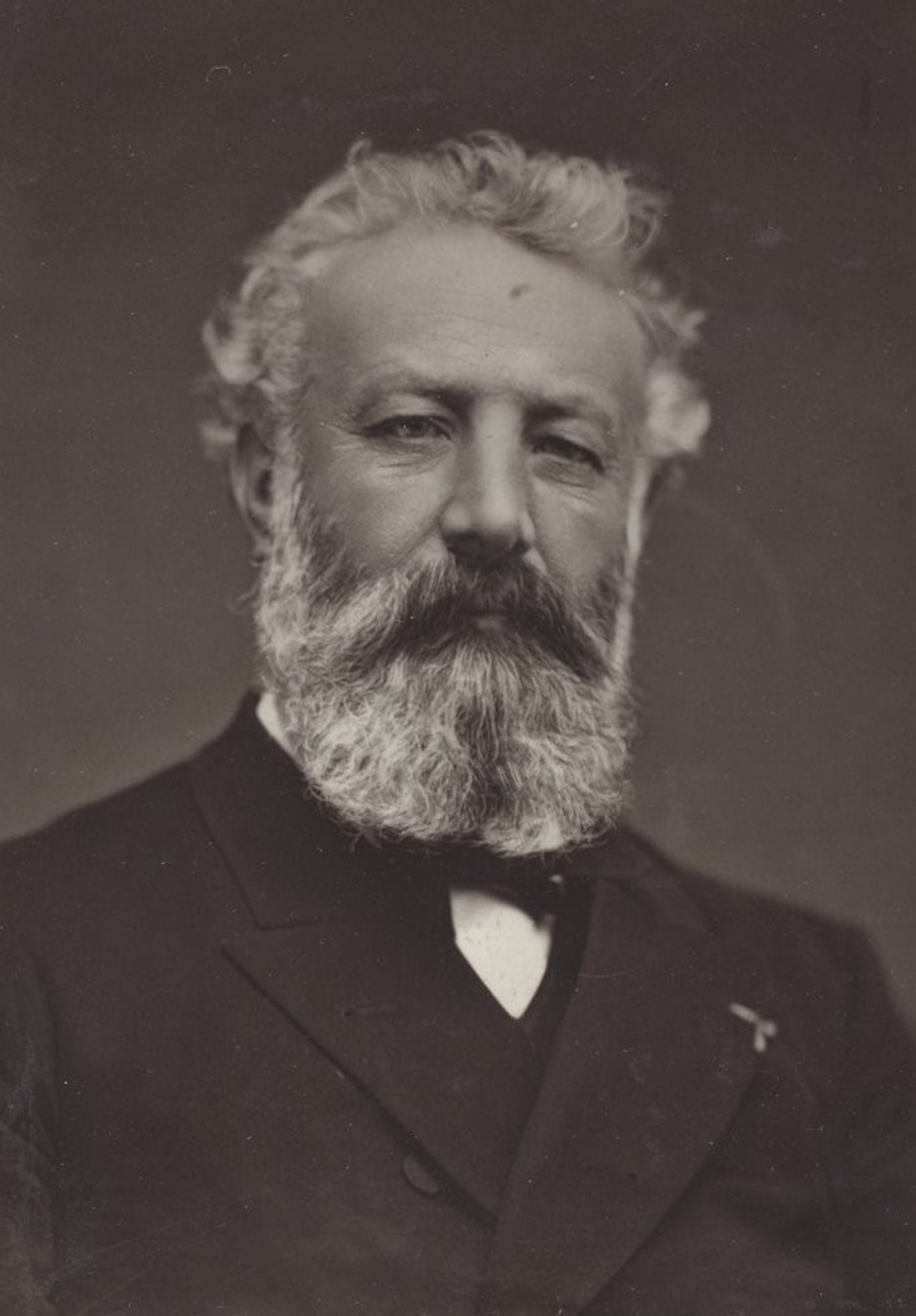
Jules Verne
Back to people overviewJules Verne (1828–1905) was born in Nantes, a port city whose maritime culture helped shape his lifelong fascination with travel, exploration, and distant horizons.
Although trained in law, he was drawn instead to literature and the theatre, gradually helping to define the genre of scientific adventure romance for which he became famous.
His career was transformed by his association with the publisher Pierre-Jules Hetzel, with whom he developed the Voyages Extraordinaires, a vast sequence of more than fifty novels intended to combine entertainment with modern geographical, geological, historical, astronomical, and scientific knowledge. Works such as Journey to the Centre of the Earth (1864), Twenty Thousand Leagues under the Sea (1870), and Around the World in Eighty Days (1872) made Verne one of the most widely read authors of the nineteenth century.
Cartography was central to his imaginative method: maps, routes, instruments, diagrams, and coordinates give his extraordinary journeys the authority of scientific and geographical fact. His fiction not only ranged across the surface of the earth; it opened up new territories of wonder beneath its surface, in the depths of its oceans, and outward beyond its atmosphere.
Image ©Bibliothèque Nationale de France