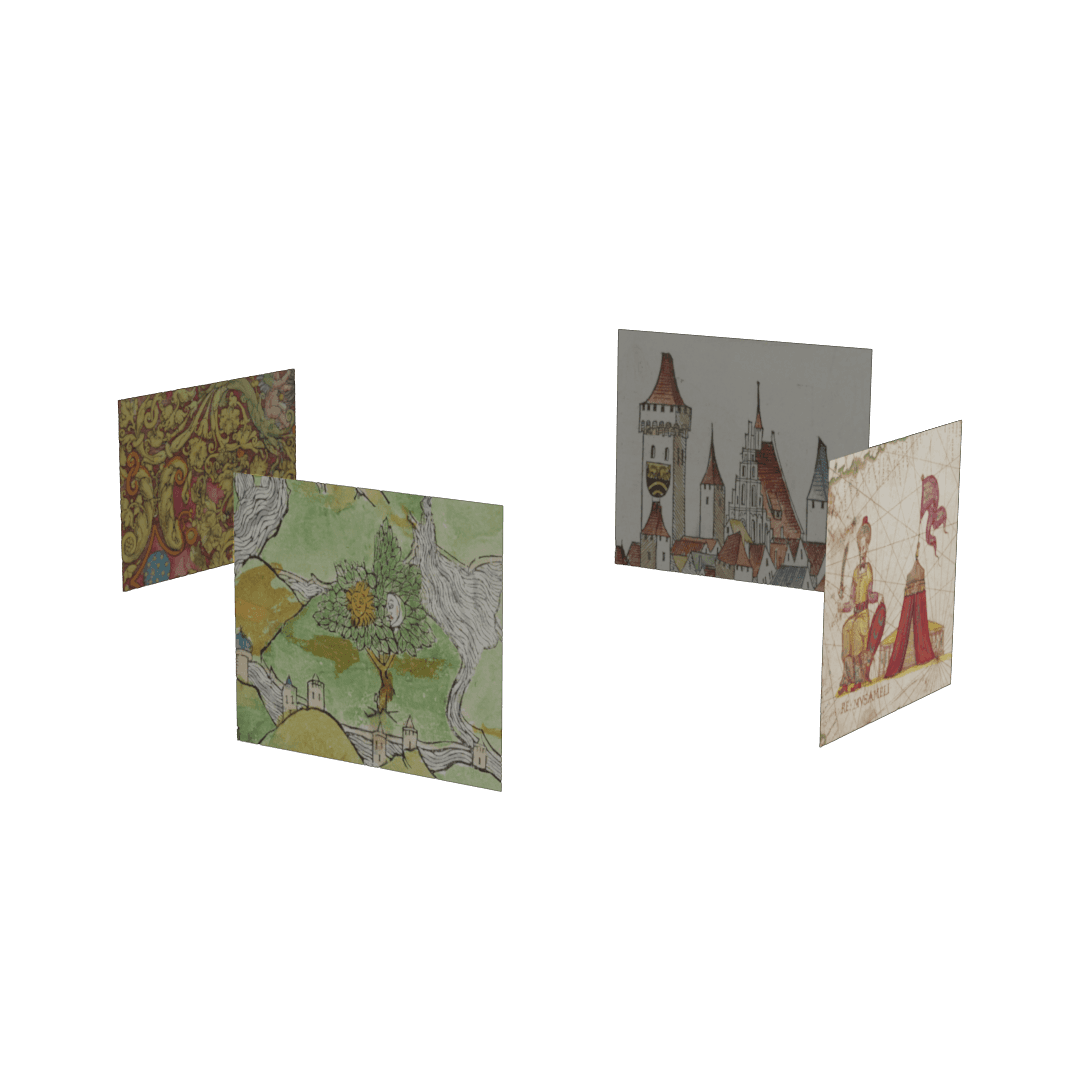
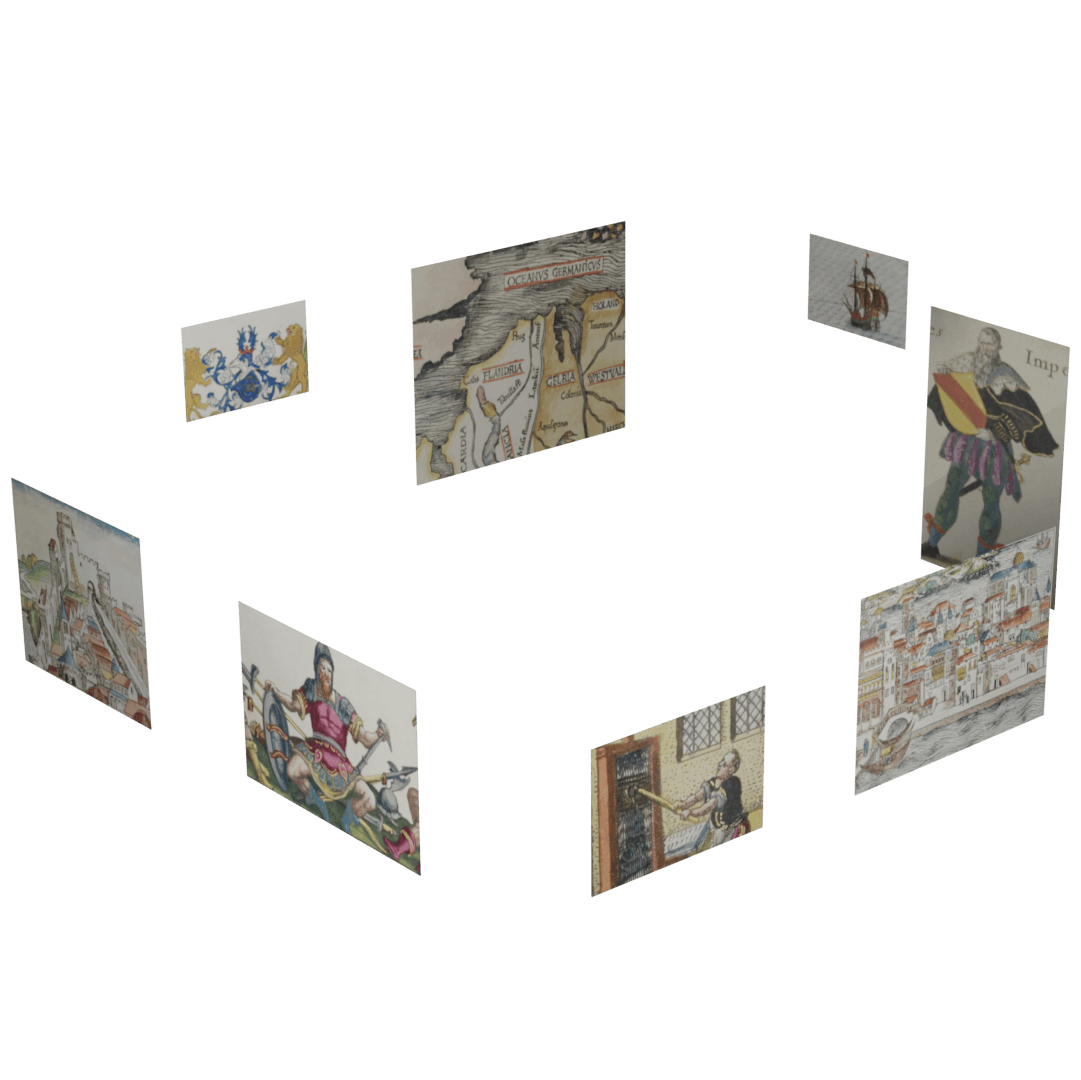

Hondius’s World Map
Henricus Hondius' World Map (c.1633)
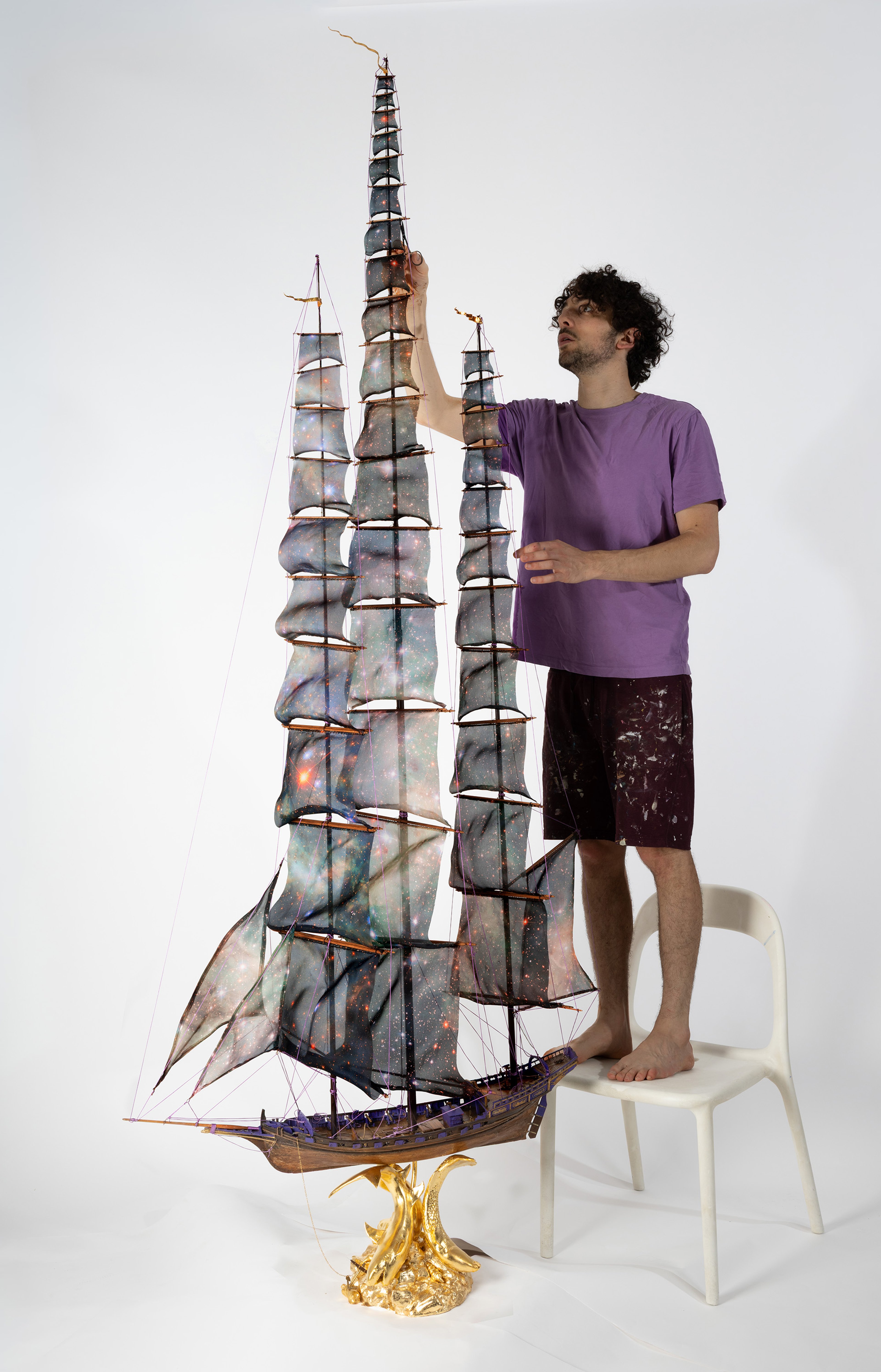
Simon working on 'Uranometria'
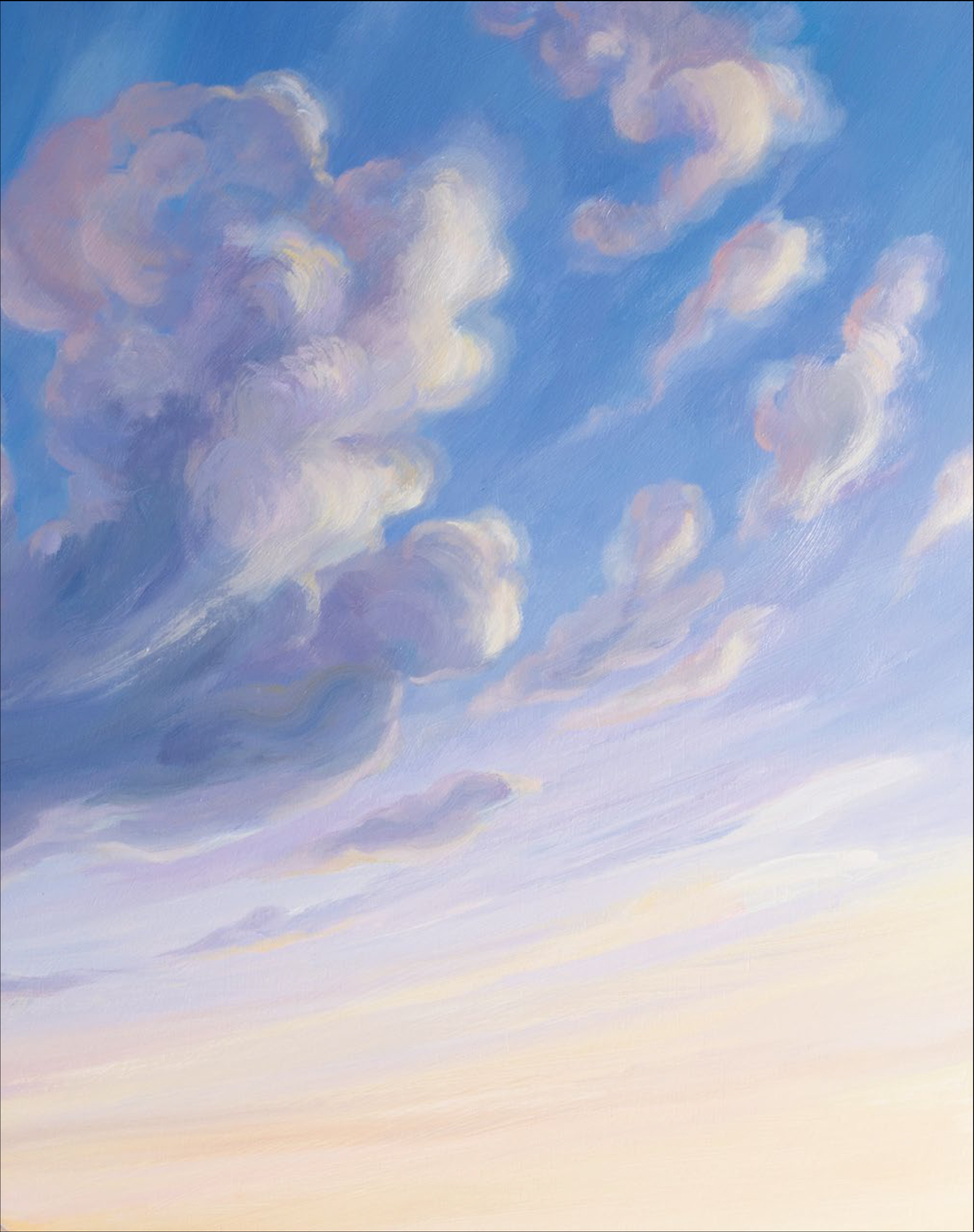
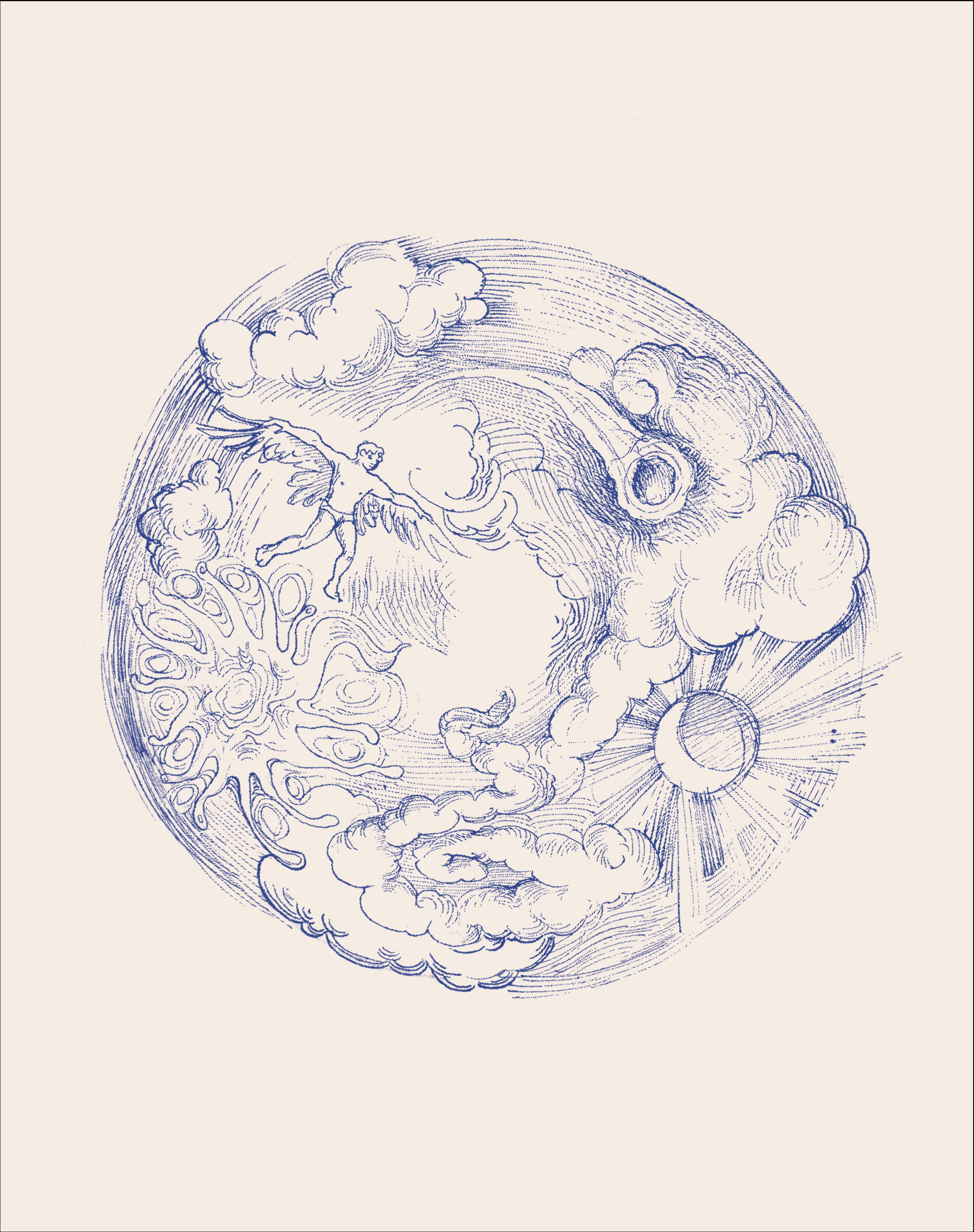
Clouds from Simon's sketchbook

Mount Olympus
The Temple of Daphne from Abraham Ortelius' 'Theatrum Orbis Terrarum' (1603)
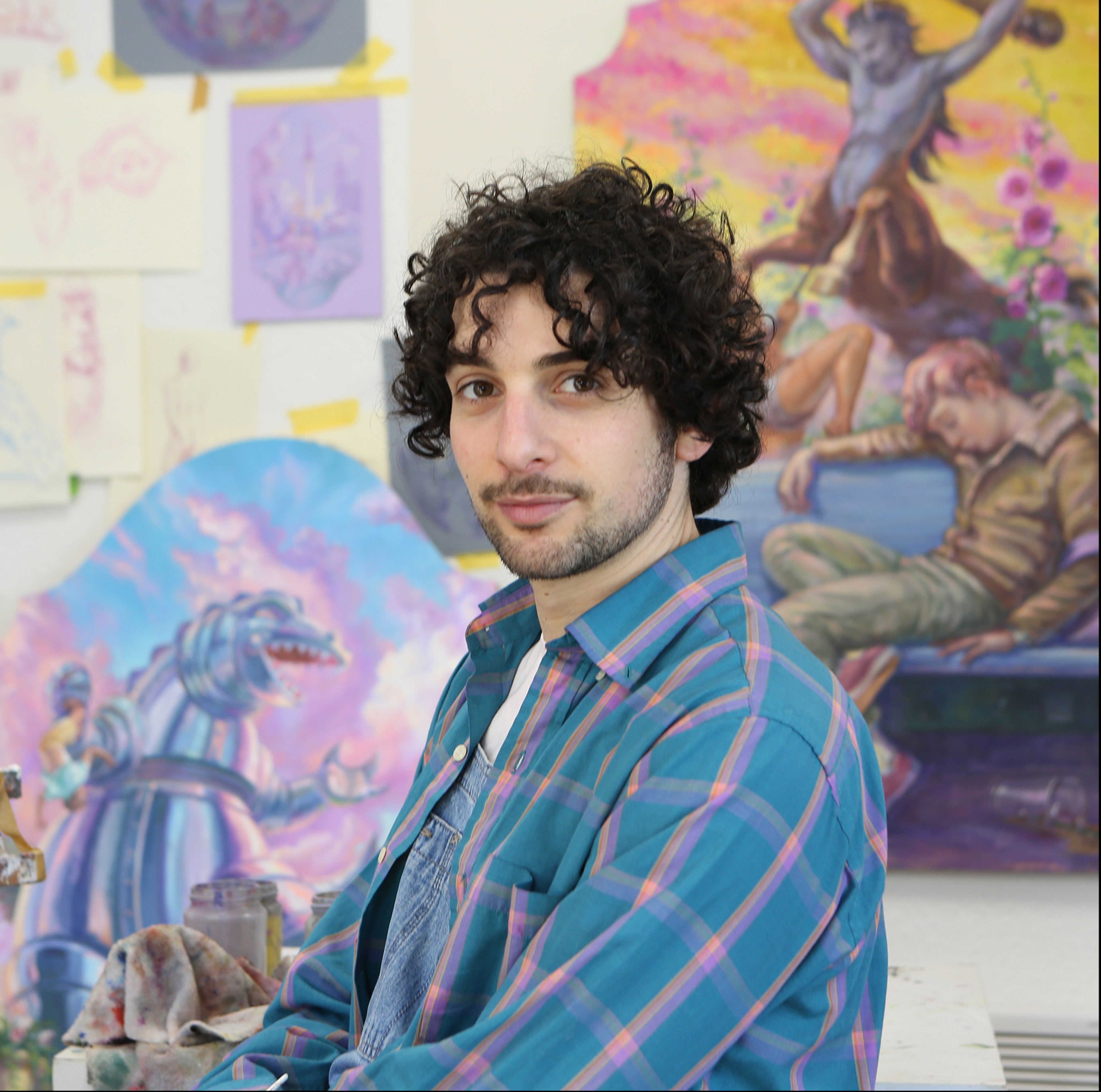
Simon Bejer
The artist in his Bordeaux studio, 2025
Sun motif
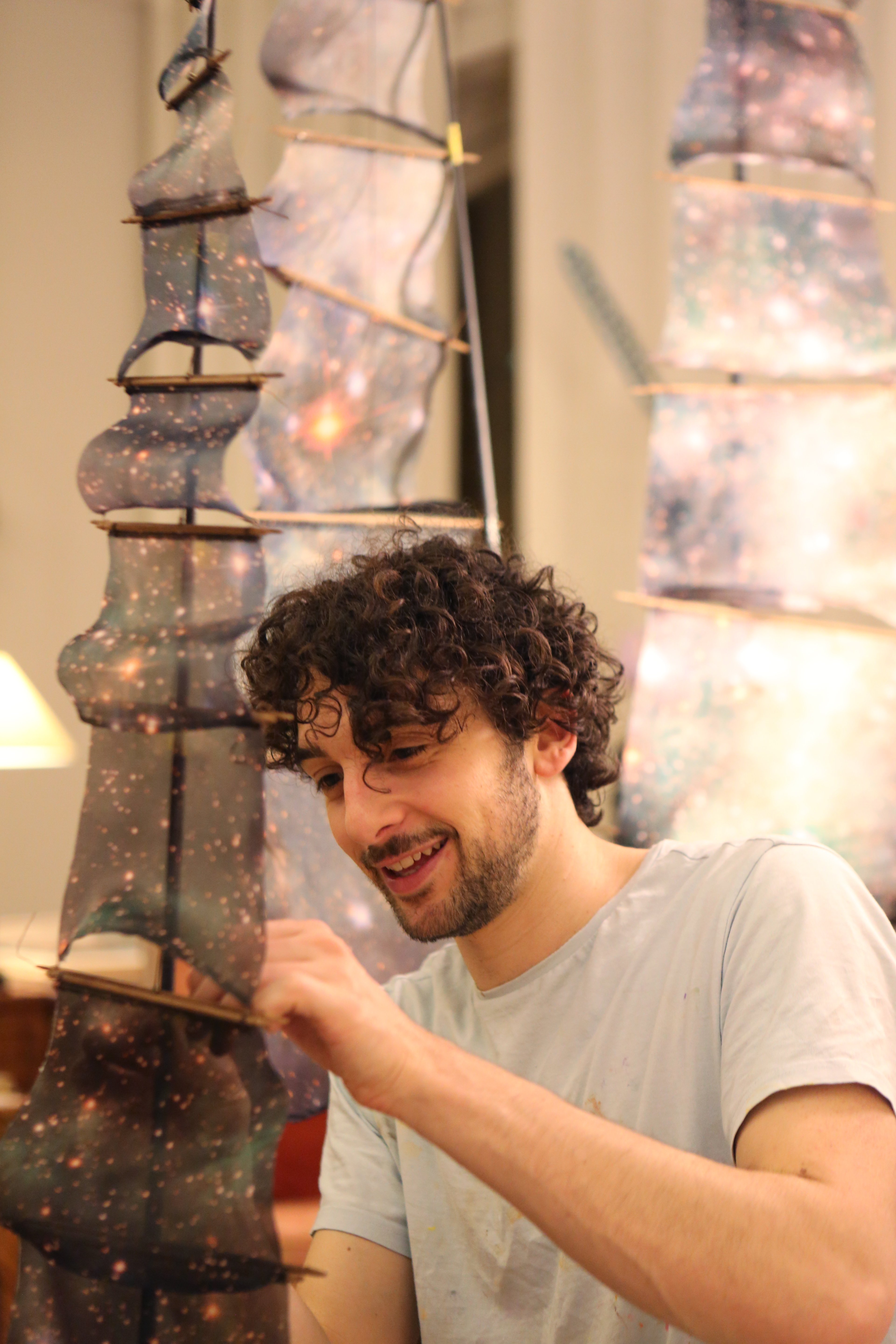
Simon in his studio
Working on the sails for Uranometria (2026)
Geometric motif

Introduction to And Everything Under the Sun. Credit: Sarah Scott/Caro Communications

Volvelle from Petrus Apianus' Astronomicum Caesareum (1540)
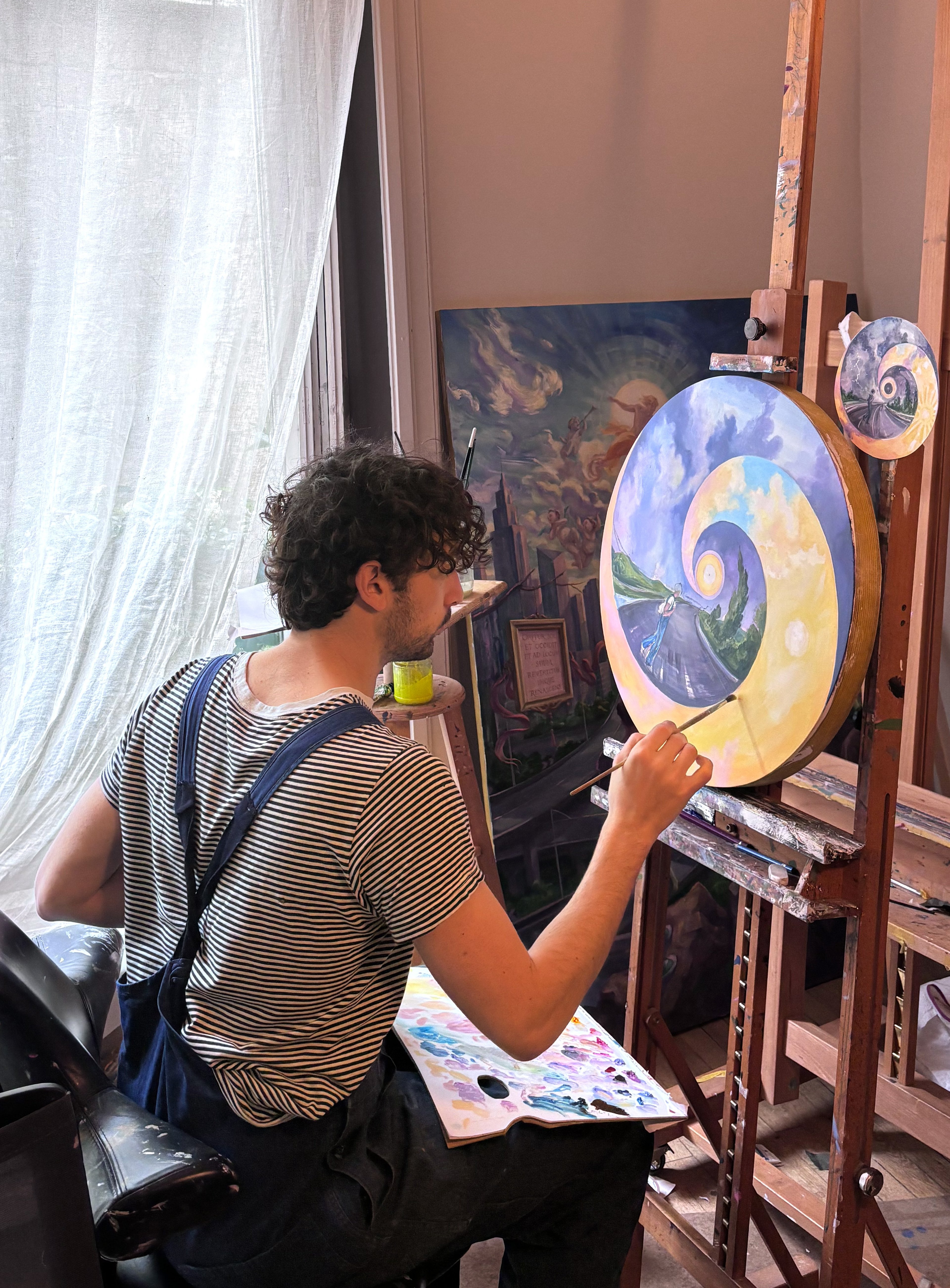
Simon working from his Bordeaux studio
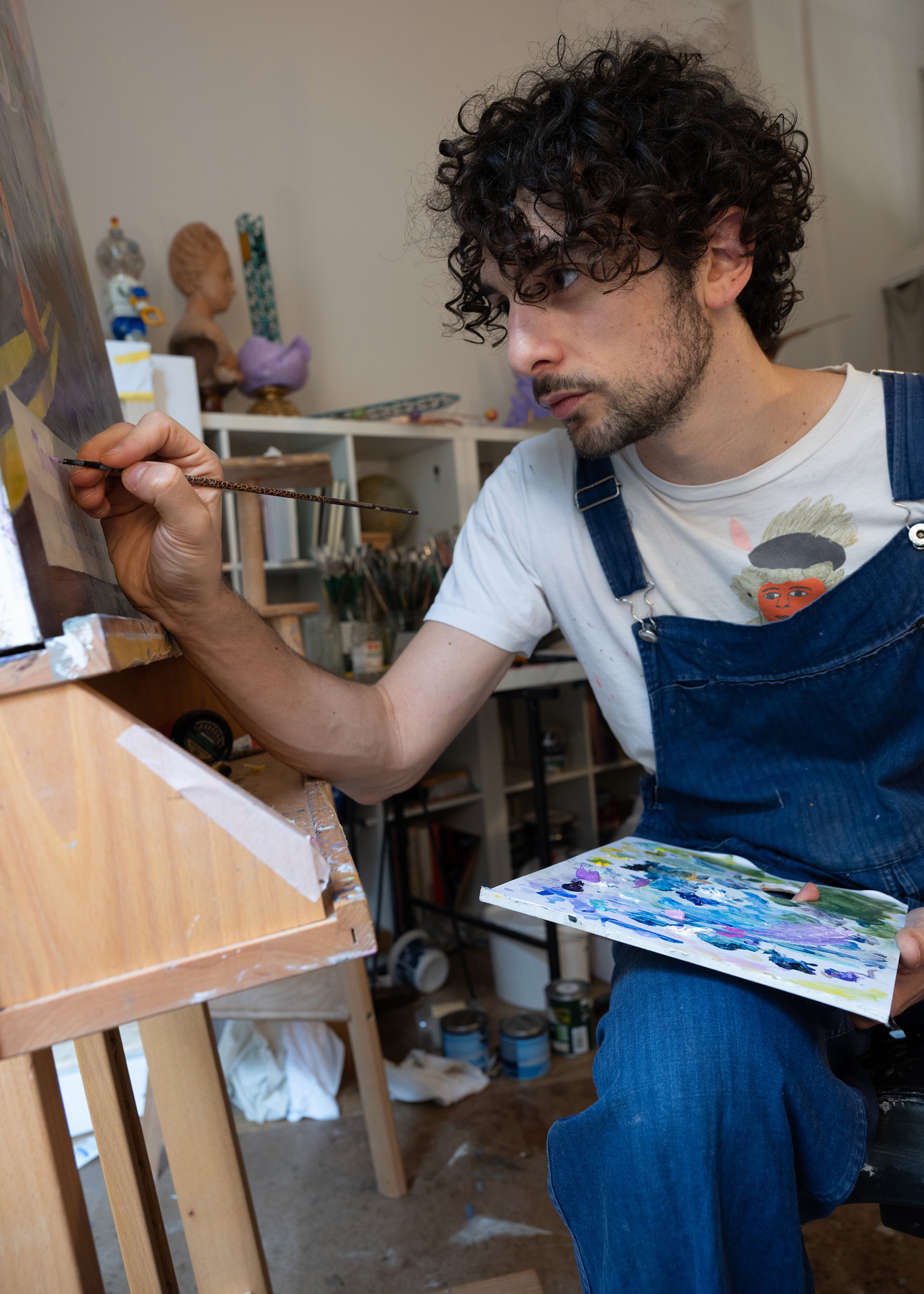
Simon in his Bordeaux studio working on 'Four Elements: Fire'
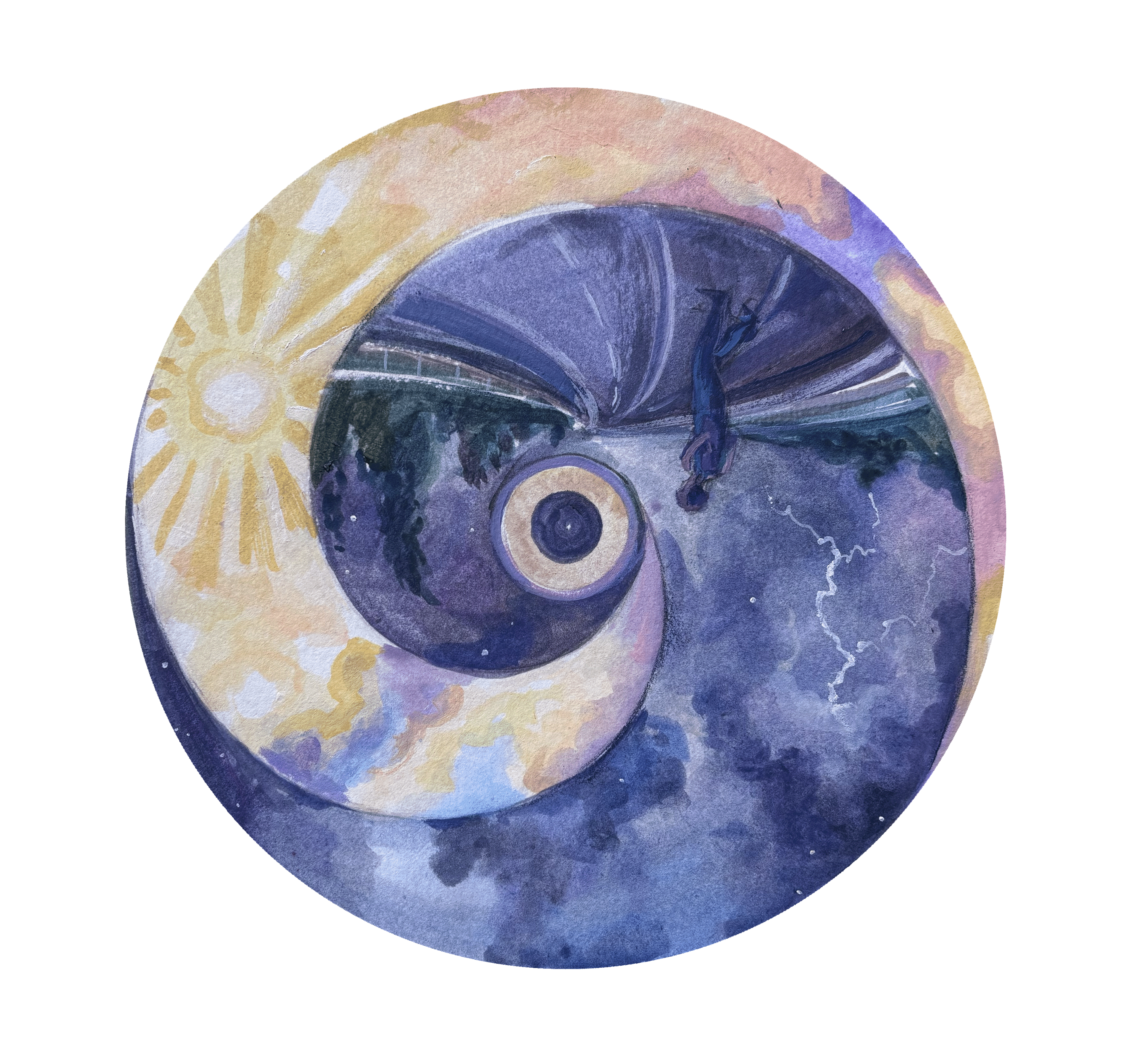
Volvelle study for Australis / Borealis
Born in Melbourne and based in London and Bordeaux, Simon Bejer studied fine art and stage design. His extensive experience as a designer for theatre has remained influential as he returned to his artistic practice which now incorporates painting, sculpture, drawing, printmaking and installation.
Play, wonder and absurdity are central to his approach with which he investigates past and present ideas of taste, beauty and the picturesque.
Simon’s practice engages in the mash-up of visual languages which so characterises contemporary life, blurring the boundaries between ‘high’ and ‘low’ culture, kitschi-ness and refinement, history and modernity.
Landscapes feature prominently in his paintings through which he explores concepts of change, loss, and the uncertain dichotomy between nature and the human. These themes reappear in his sculpture, where he pushes material experimentation, combining unusual and incongruous elements to dramatic, and often humorous effect. Playing off one another, Simon’s two and three dimensional works allow him to construct complex spatial dynamics, as well as a sense of drama and decorative spectacle.
In 2022, he graduated with a MFA from the City & Guilds Art School, London. From 2022 to 2023 he held the Decorative Surfaces Fellowship of the Worshipful Company of Painter-Stainers. His work has been exhibited in group exhibitions in the UK, Australia, the US and Hong Kong as well as solo shows in Taipei and London.

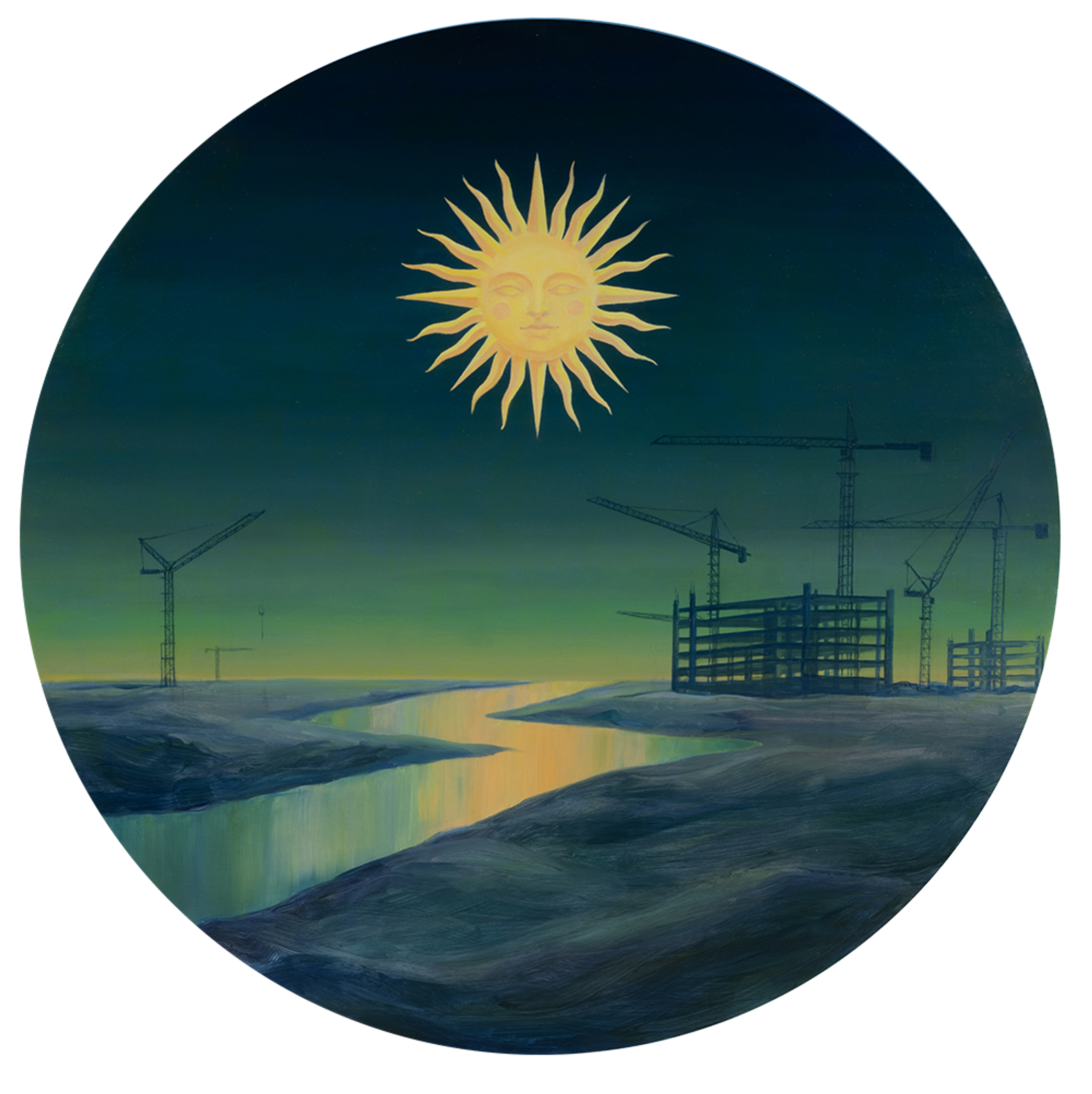
Fire, from The Four Elements
Oil on birch-ply panel, 105 x 69 cm

Earth, from The Four Elements
Oil paint on birch-ply panel, 105 x 69 cm

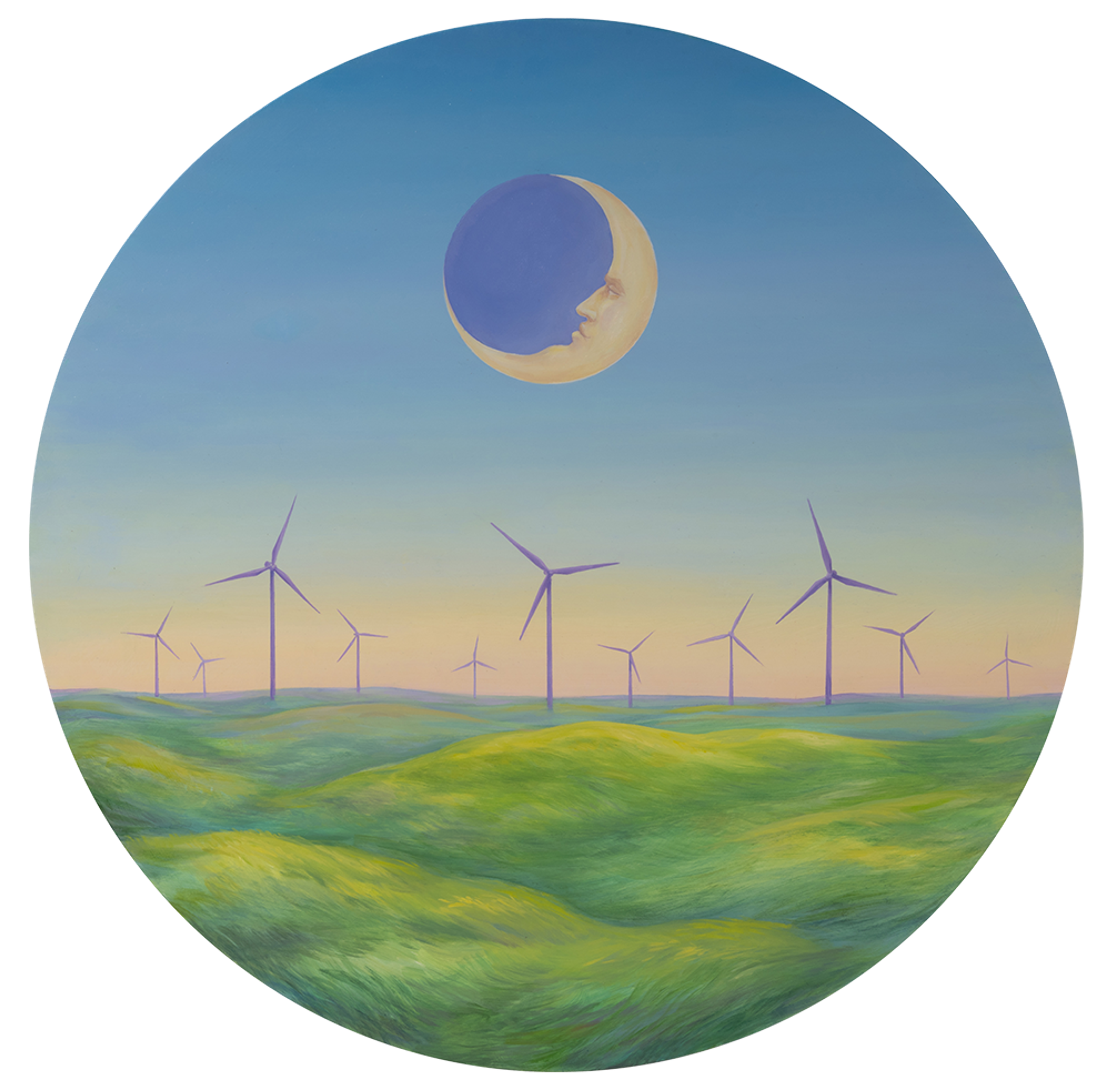
Air, from The Four Elements
Oil paint on birch-ply panel, 105 x 69 cm

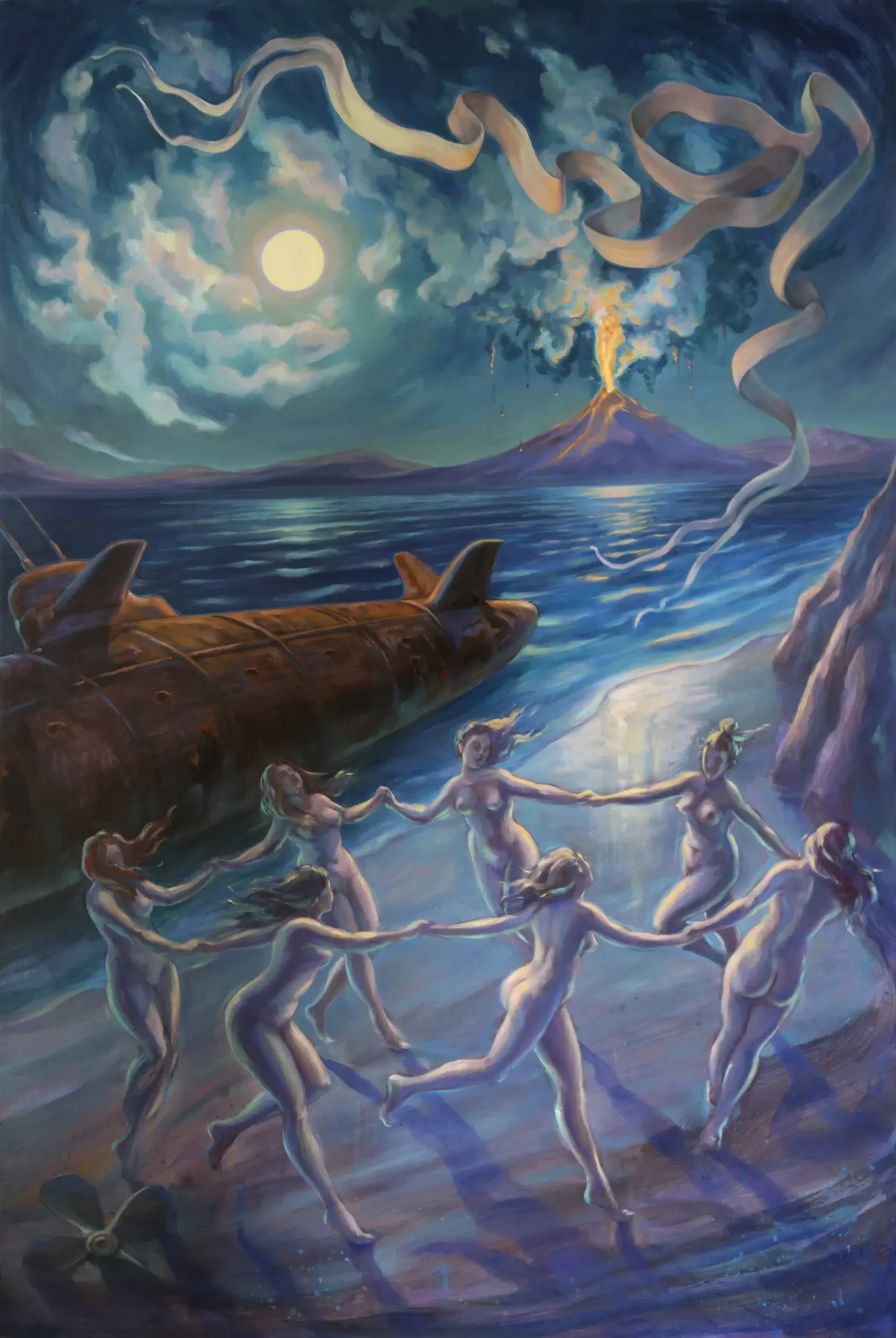
Water, from The Four Elements
Oil paint on birch-ply panel, 105 x 69 cm
In ‘The Four Elements’ series, Simon creates novel interpretations of Air, Earth, Fire, and Water by juxtaposing historical worldviews and perspectives with modern realities.
In his artist statement, he reflects on feeling overwhelmed - not only by the extraordinary array of colours and shapes or the dense blending of text and symbolism found in the works of The Sunderland Collection, but by how seamlessly art, science, mathematics, religion, and mythology intersect.
The foundational inspiration for these four pieces came from the allegorical representations of the seasons featured in the detailed borders of double-hemisphere world maps of Henricus Hondius (1633) and Frederick de Wit (circa 1660).
Art critic Matthew Holman introduces the works:
The first painting in the elemental series - Air - sees an airport ground worker in an orange hard hat and ear defenders tend to a sextant, an instrument with a graduated arc of 60° and a sighting mechanism, used for measuring the angular distances between objects and especially for taking altitudes. Two wide-bodied jets sit on the apron in the flat, in the overexposed light of aviation photography, and above them, occupying the upper third of the canvas, a vast planetary body hangs in a graduated sky with the suggestion of astrological forms: scorpion, centaur, crab. Around the worker’s feet, sheep wander with mild indifference.
Lost, they remind me of the rams and ewes in William Holman Hunt’s rustic paradise, ‘Our English Coasts’ (1852), but their depiction as a strayed flock without a pastor is hyper-accelerated here as they are transplanted into an alternative reality where the solaces of bramble and verge have been replaced by the cold logic of concrete and painted yellow lines. Bejer’s use of the sextant was inspired by Robert Dudley’s ‘Dell’Arcano del Mare’ (1647), the volvelle design from which is held in the Oculi Mundi collection, the first sea atlas to cover the entire world, the first compiled by an Englishman, and the first to base its charts on Mercator’s projection.
Dudley’s encyclopaedia was, at its core, a machine for the organisation of global trade routes and maritime capital. The engraver Antonio Francesco Lucini, working in seclusion for 12 years in an obscure Tuscan village, used in excess of 5,000 pounds of copper in the preparation of the work. That copper - its extraction, its smelting, its transportation to a Tuscan studio, its transformation into engraved plates through 12 years of skilled manual labour - is the material base of an object whose purpose was the coordination of further extraction elsewhere: the navigation of ships carrying enslaved people, colonial commodities, plundered resources across the oceans whose mysteries Dudley claimed to have unlocked.
The arcano - the secret - of the sea was always the labour and violence concealed within the circuits of maritime accumulation. The fourth work in this series takes earth as its element, announced by the blazing orange of a Renaissance explorer’s flag bearing a disembodied hand, index finger extended, signalling the forward march of colonial expansion, or more broadly the hubristic thrust of human ambition.
The handsomely muscular, open-shirted youth who flies it does so with the zeal of an Aleksandr Deineka hero, but a committed peredovik he is not: the course leads nowhere. Beneath a sky of delicate clouds, a fur-coated figure - the proud leader of the expedition - holds a globe and gazes toward a flat, featureless horizon, the great age of discovery reframed as a planning consultation. His boat butts against a road bollard striped in black and amber, the kind one might encounter at the threshold of a grey distribution centre on the outskirts of a provincial town.
Along the canvas’ lower edge runs an ornate cartouche, which tends to signal historical gravity or official sanction, but the words are a kitsch poem, its rhymes awkwardly inconsistent, awarding the speaker a “B plus for effort” from a personified Fortune who ‘bitch-slaps’ them into submission.
Bejer’s figures are all in the business of organising the world for movement - for the passage of goods, bodies, and capital - and the painting folds a Renaissance explorer’s swagger into the anachronistic geometry of a modern roundabout, as if the energy that drives men to plant flags and draw maps were continuous with the engineering of traffic flow in a neoliberal economy.
The Earth, in Bejer’s reading, has always been a logistics problem to be overcome, not merely the place from which we orient ourselves in the cosmos. What changes between Dudley’s copper plates and the road bollard, then, appears to be the costume, not the calculus.
Several works in the series rely less on the accumulation of anachronistic imagery - or rather, that accumulation does not undermine the legibility of the scene in the same way. In Air and Earth, the figures and objects cannot be imagined together on the same picture plane, even as they criss-cross through different historical vistas; the structural logic of the scene, of the coherence of depth and togetherness, simply cannot hold.

You Are Here
Oil paint on birch-ply panels, 160 x 90 cm (each)
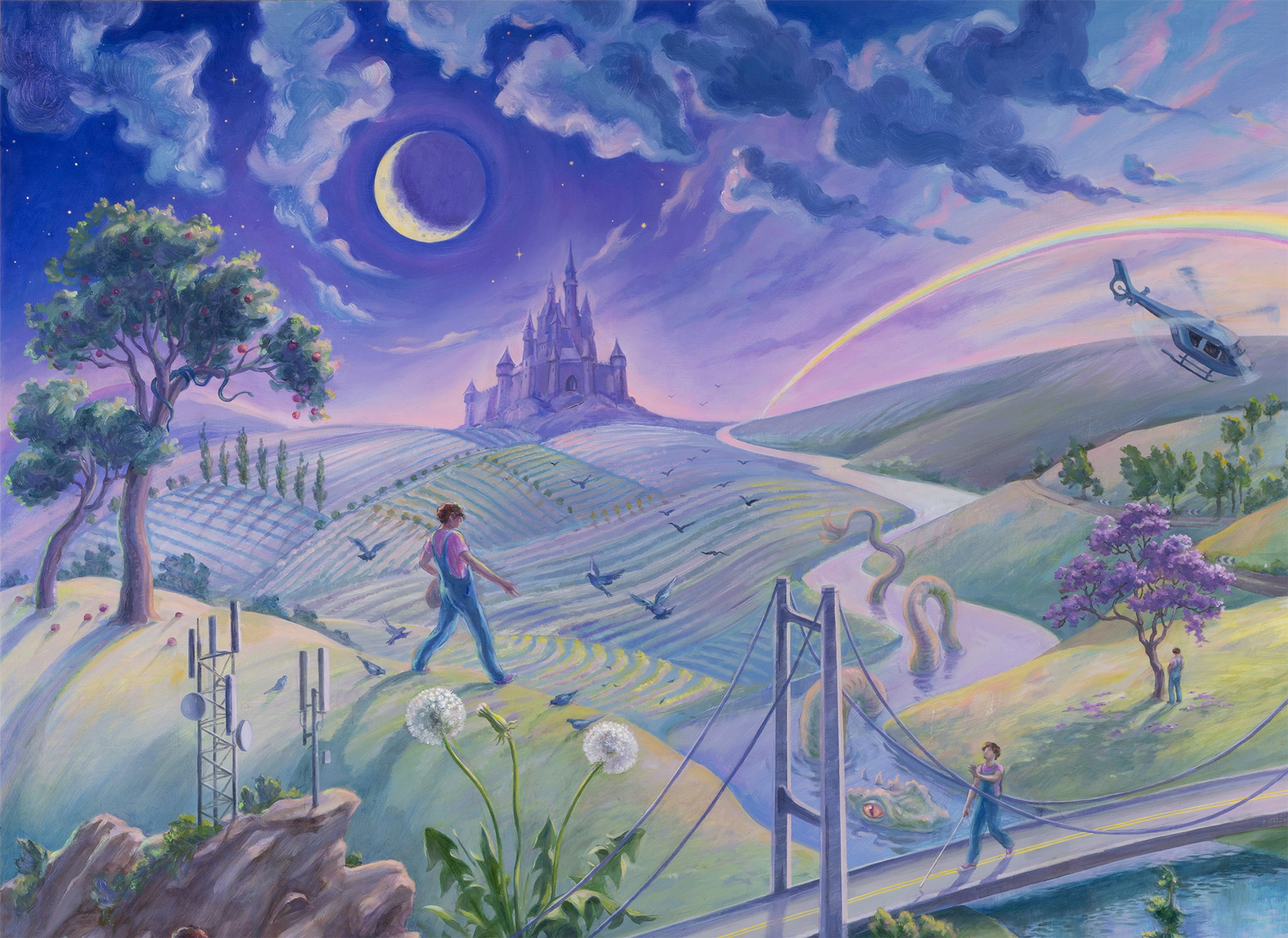
Detail from You Are Here
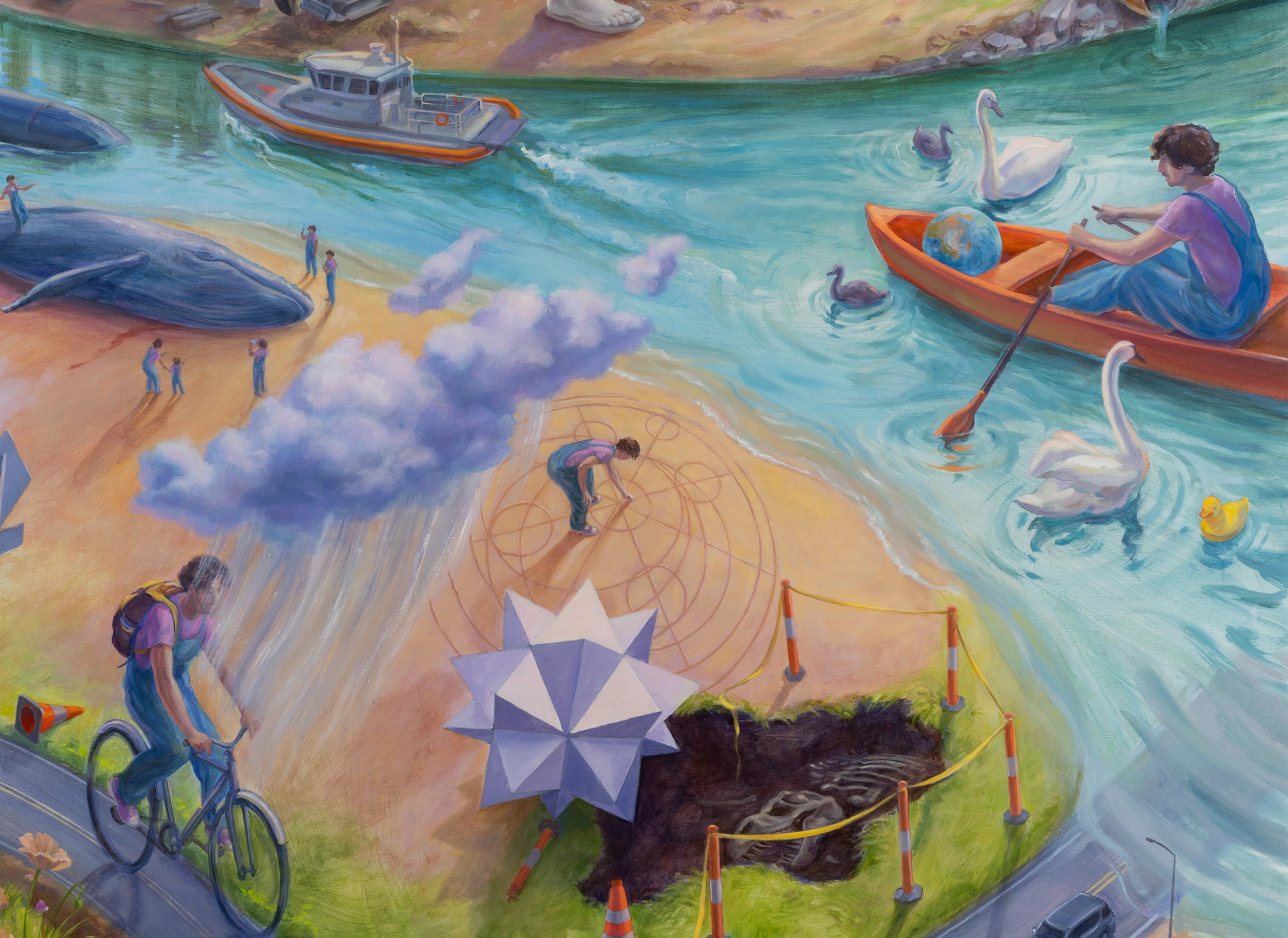
Detail from You Are Here
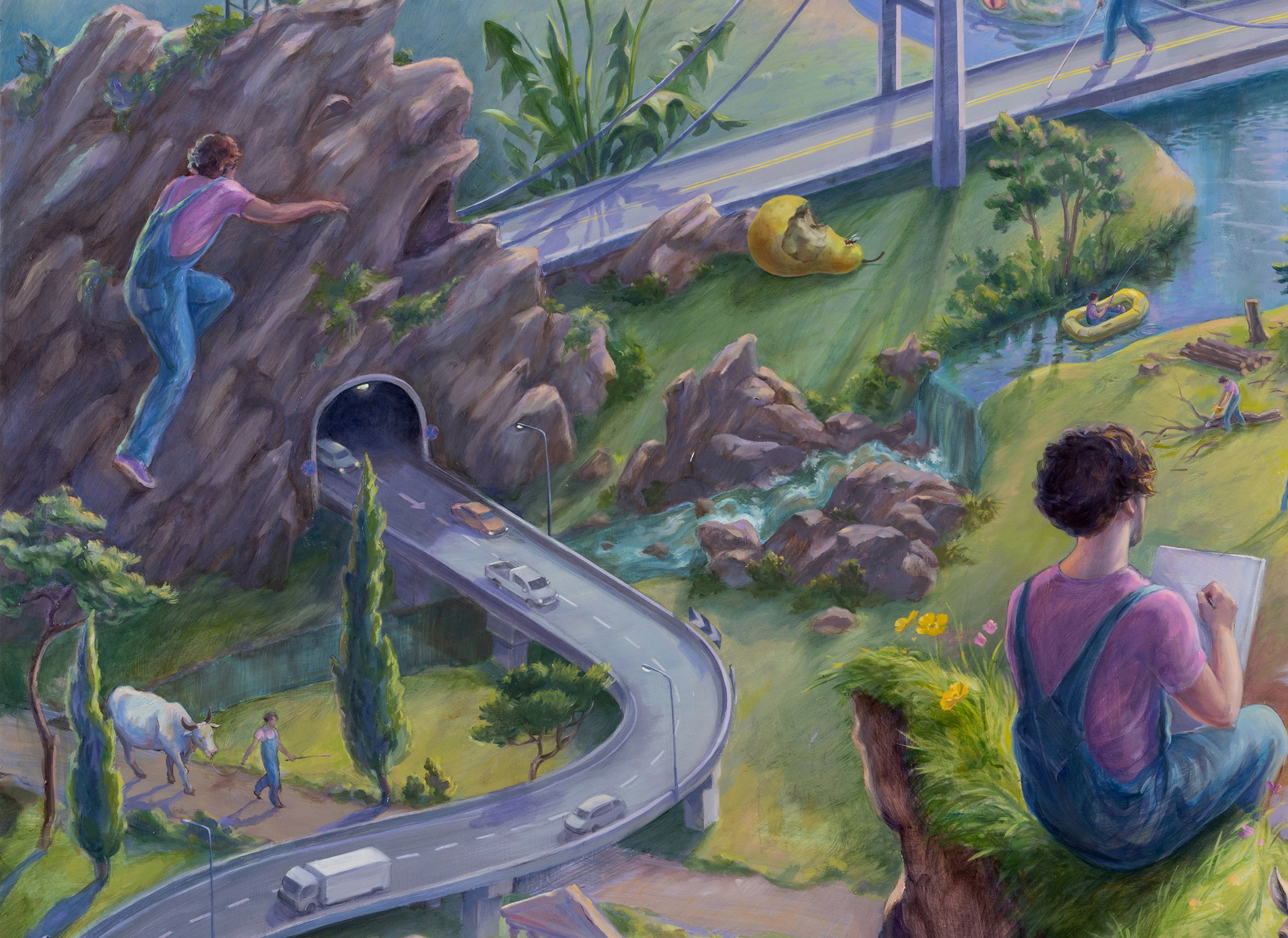
Detail from You Are Here
In the magnificent two-panel work titled ‘You Are Here’, Simon explains that the title references contemporary local or evacuation maps. It directly attempts to embody the spatial and perspective inconsistencies common in historical cartographic objects - where giant ships and sea monsters exist in a separate realm from the exacting maps they inhabit.
The work contrasts ancient motifs found on maps and in historical books of knowledge with contemporary technology, unusual perspectives, and mundane tasks, all in a phenomenal technicolour vista captured across the diptych.
Art critic Matthew Holman likened the painting to Dutch master Hieronymus Bosch (d.1516) who combined impossible juxtapositions into a coherent composition. “Simon arranges the infrastructure of modern capitalism to reveal the divine and the damned within the same scale-defying universe.”

Dell'Arcano del Mare
Ceramic, wood, wrought iron, steel, epoxy resin, paint, gold and silver leaf, 85 x 88 x 66 cm

Apollo
Ceramic, wood, wrought iron, plastic, epoxy resin, steel, oil and acrylic paint, aluminium, LED lights, metal foil, 107 x 64 x 30 cm

Uranometria
Ceramic, wood, wrought iron, fibreglass, silk, nylon, brass, plastic, gold leaf, 252 x 110 x 43 cm

Harmonia Macrocosmica
Wood, wrought iron, bronze, steel, brass, copper, resin, porcelain, rubber, plastic, nylon, paper, gold leaf, 207 x 118 x 75 cm
Three of Simon’s sculptures bear the names of great works of cartography, each a nod to the spirit of exploration, of heroic toil, of trial and error. They are each an homage to the compelling desire to project human-scale form and meaning onto the unknown.
Created as a tribute to Johann Bayer’s monumental endeavour to chart every star in the heavens, ‘Uranometria’ incorporates NASA/ESA imagery of the vast Tarantula Nebula across its silk sails. It stands - tall - as a modern continuation of Bayer’s atlas and a testament to all who keep mapping the night sky.
‘Harmonia Macrocosmica’ draws its title from Andreas Cellarius’ magnificent 1661 star atlas - widely regarded as one of the most exquisite celestial books ever created - in yet another effort to map the cosmos and comprehend humanity's role within it.
Taking its title as a tribute to Robert Dudley's pioneering four-volume maritime atlas and instructional text, ‘Dell’Arcano del Mare’ carries an aura of mystery, translating directly from Italian as ‘The Secrets of the Sea.’
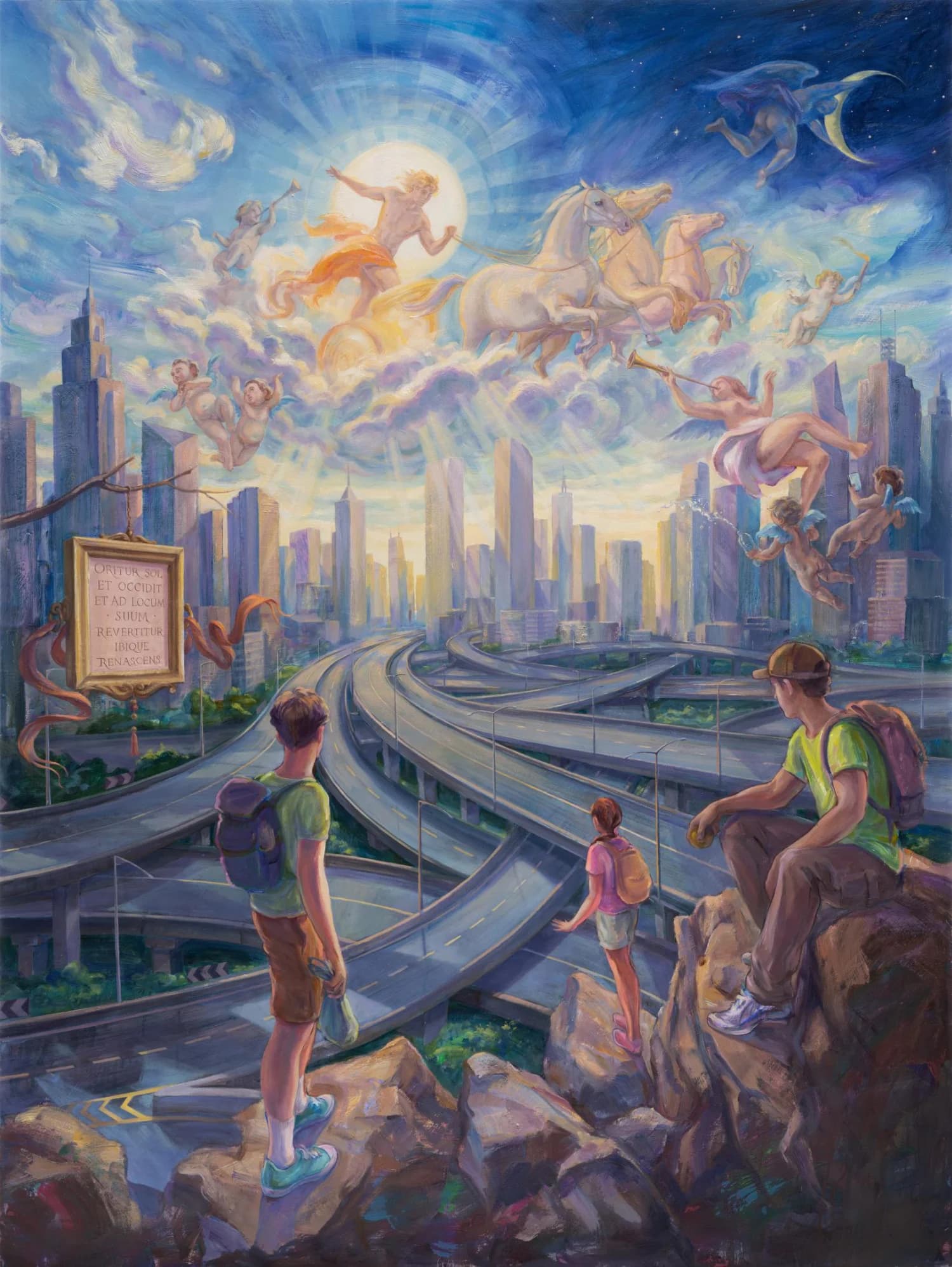
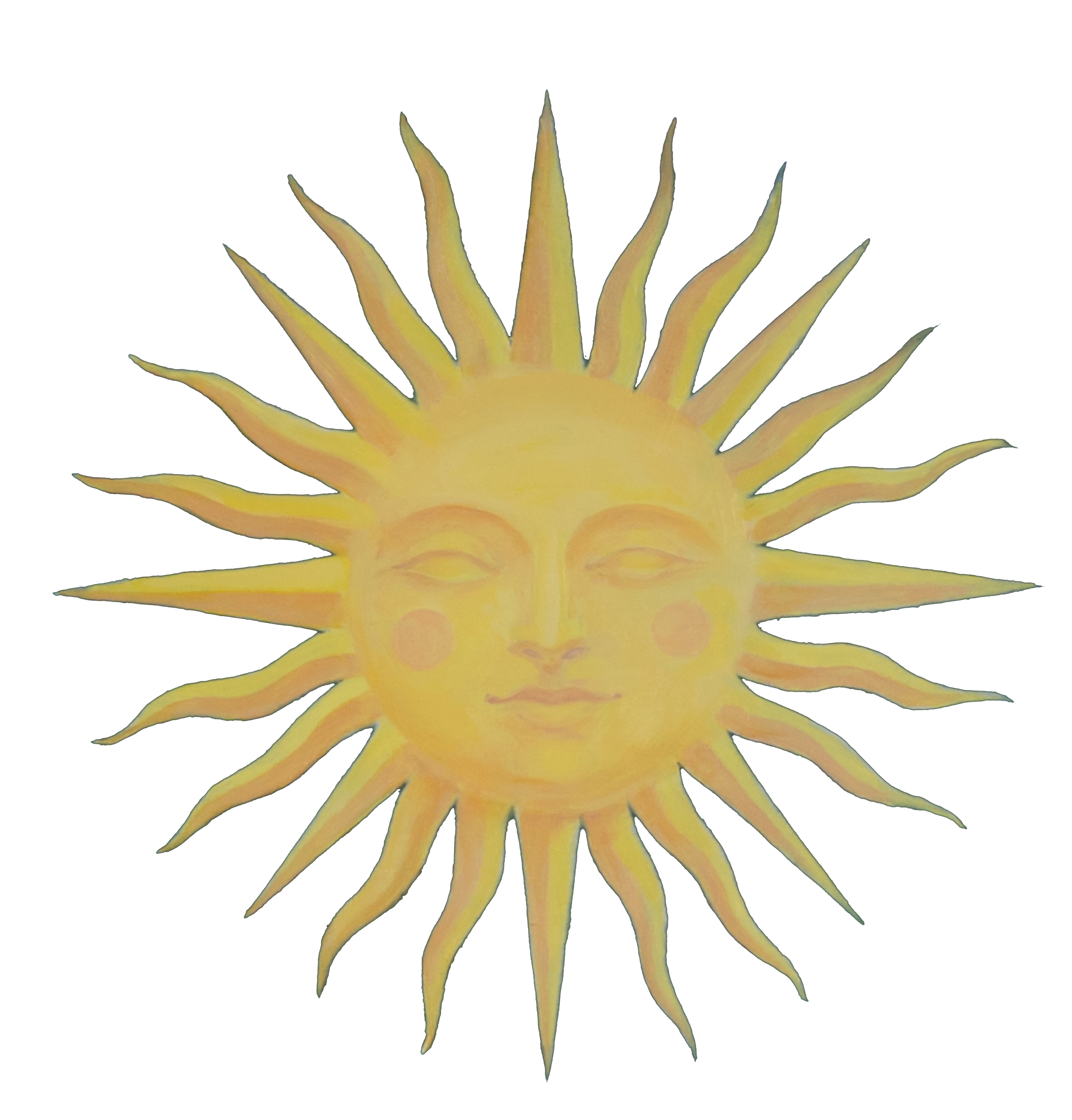
Named for the Greek sun god, ‘Apollo’ serves as a contemporary allegory, endorsed by another namesake - an Apollo-era rocket. Perhaps drawing creative inspiration from the decorative borders of historic maps that personified elements, seasons, and celestial bodies, the artwork offers a radiant reimagining of the sun itself.
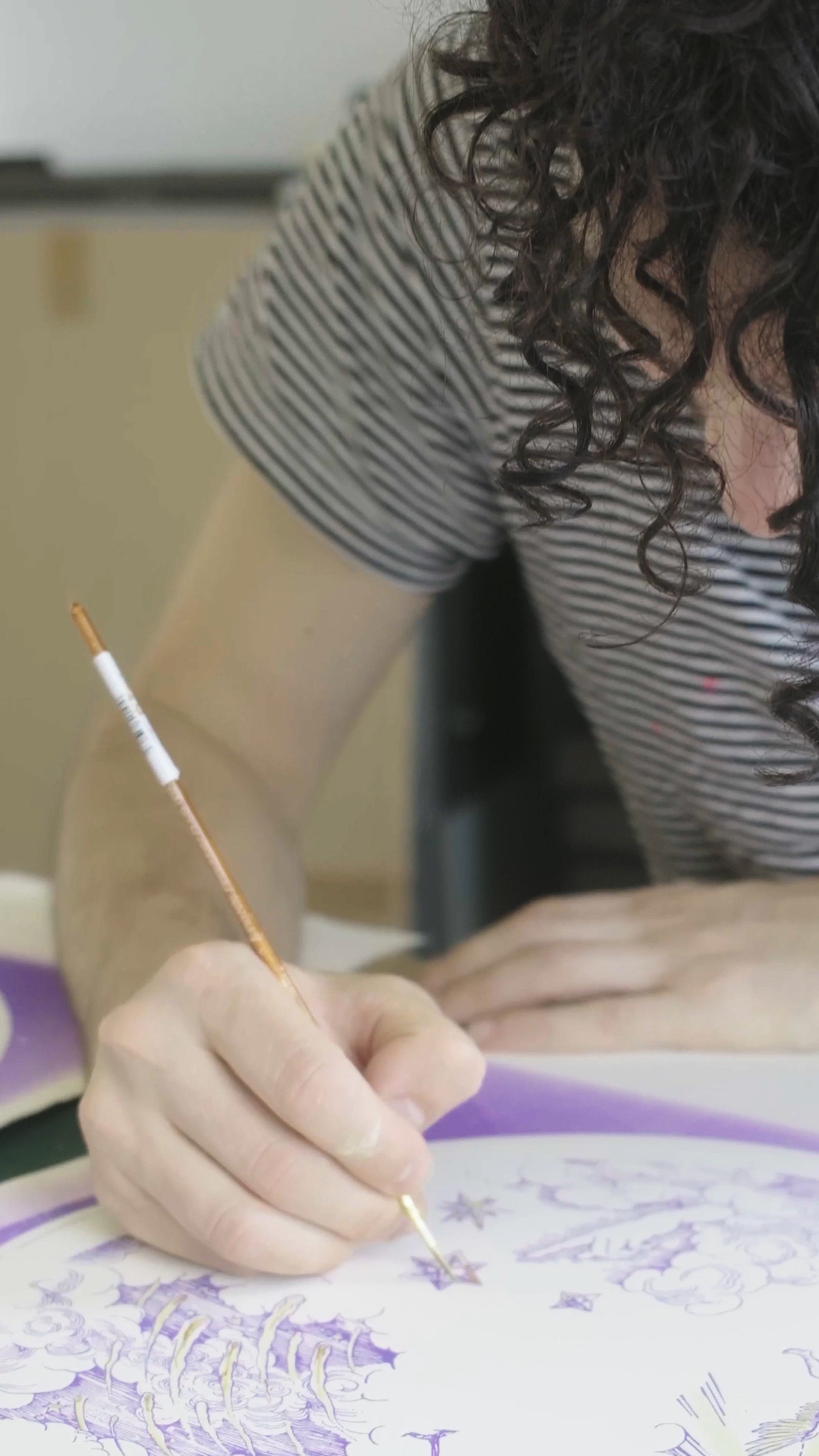
Simon colouring the limited edition print, The Silent Road
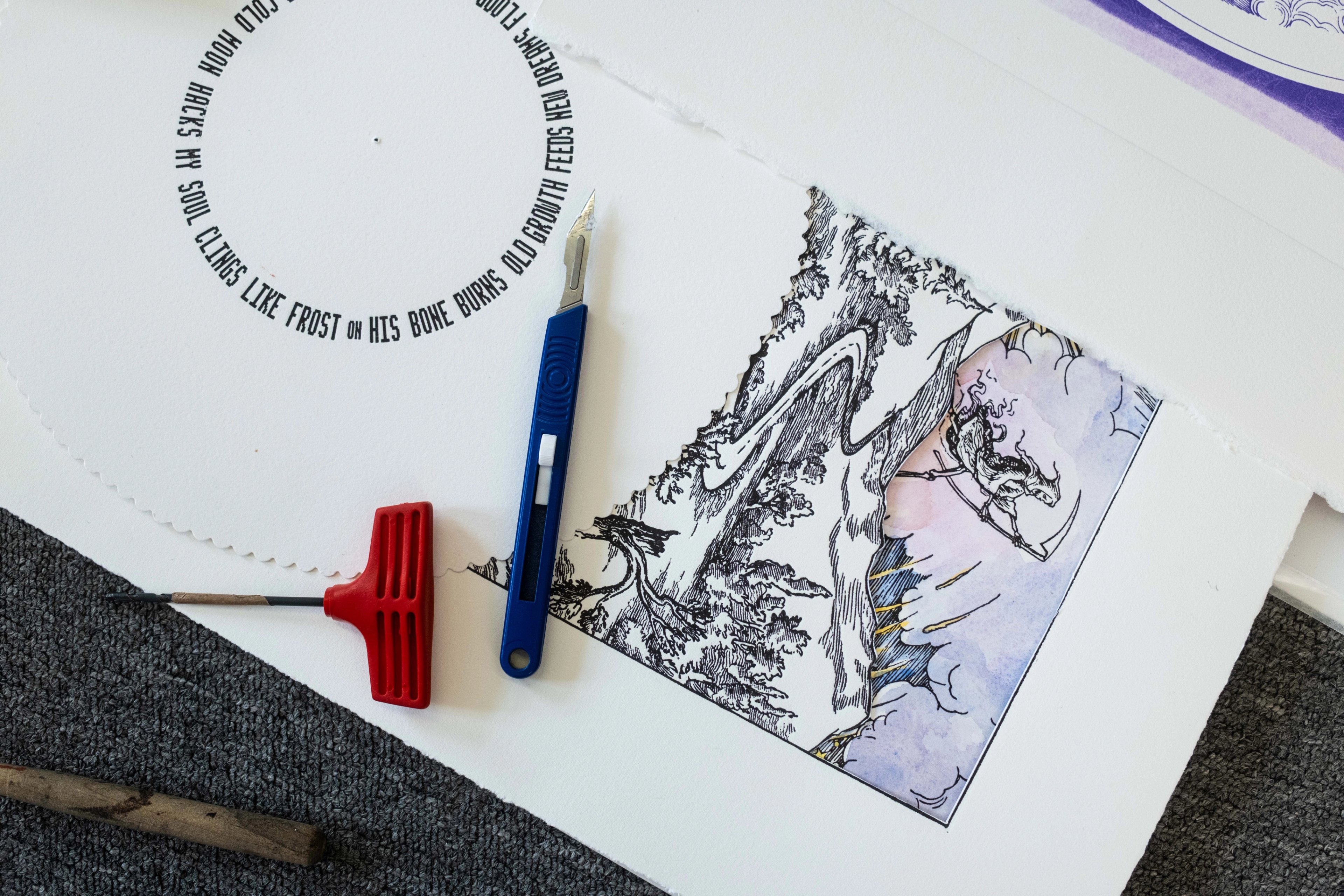
Preparing the print for assembly
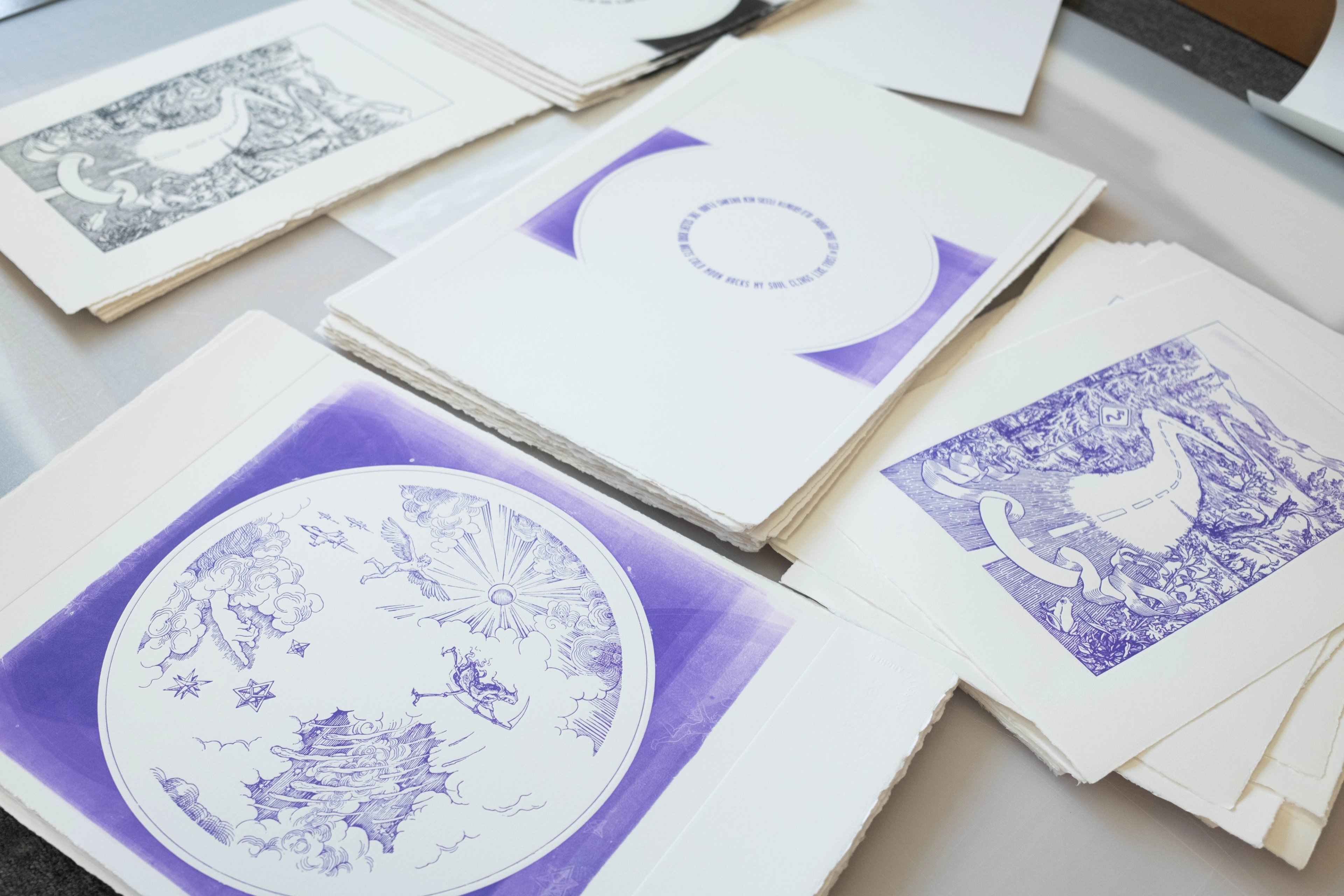
Assembling the interactive limited edition in the studio
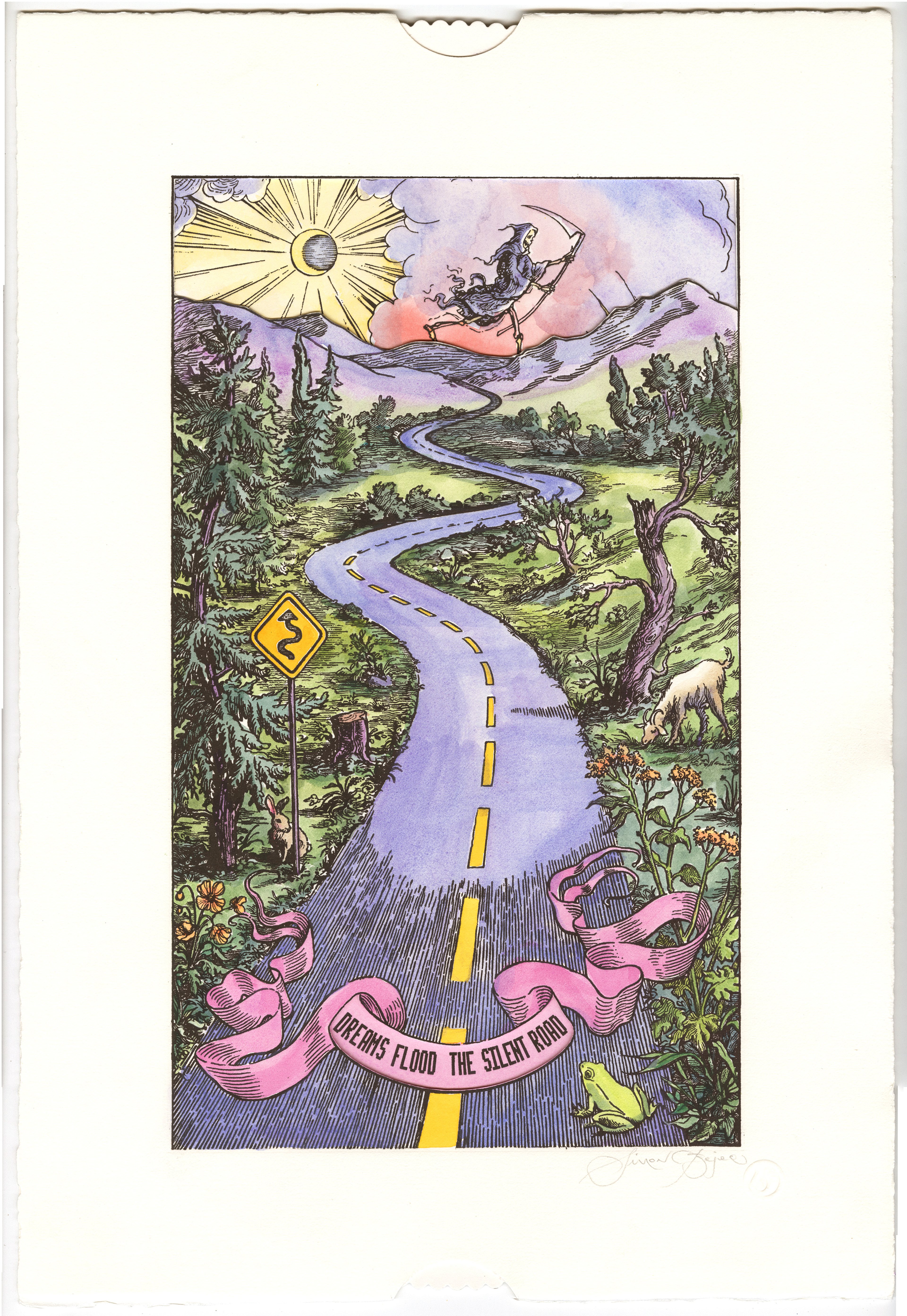
The Silent Road - Full hand-coloured edition
Three-plate interactive relief print, with two moveable volvelles. Hand-painted with watercolour and gold oil paint. Printed on Fabriano 100% cotton, 300 gsm.
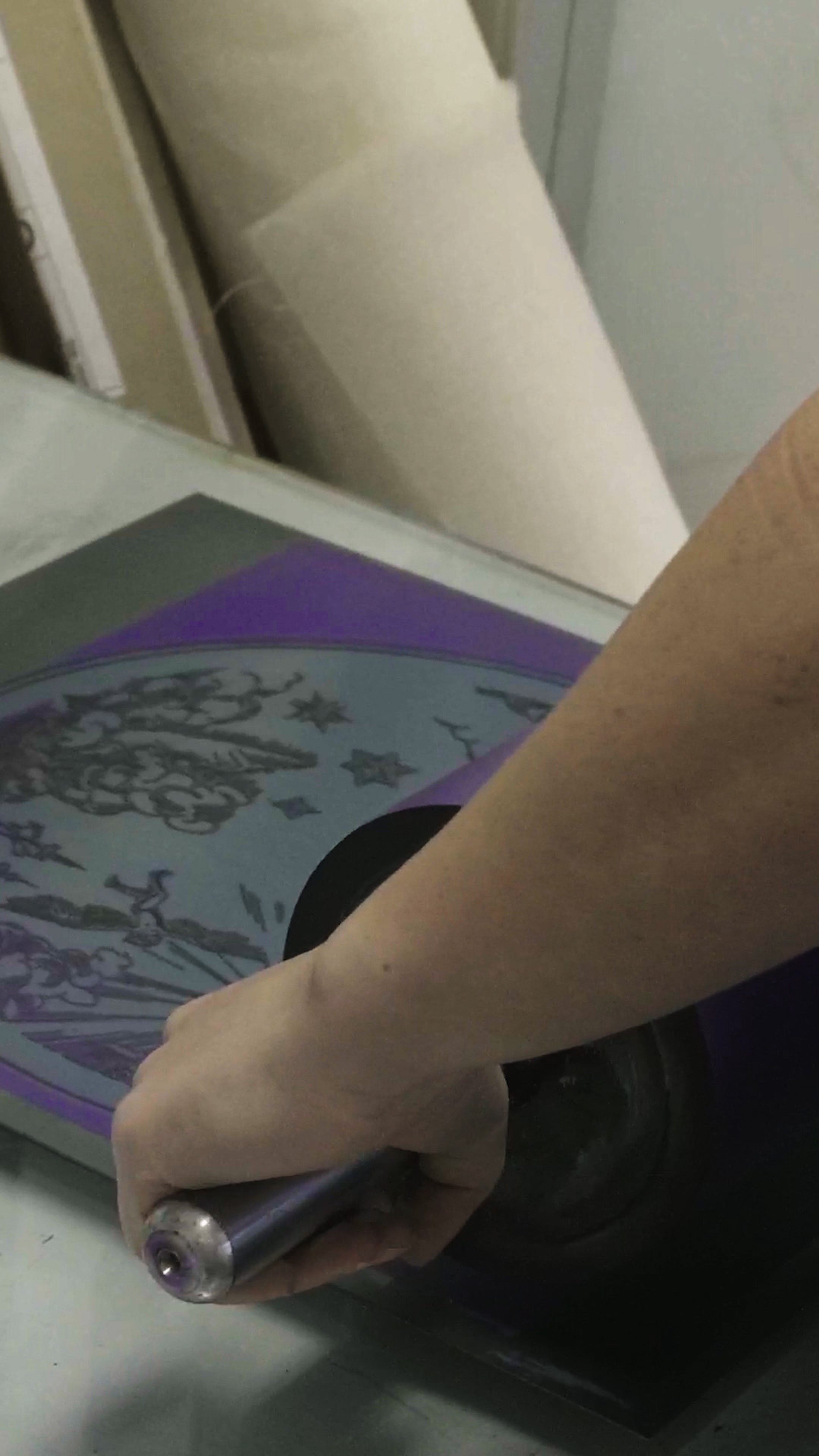
Print master Kristina inking the relief plate before it is put through the press
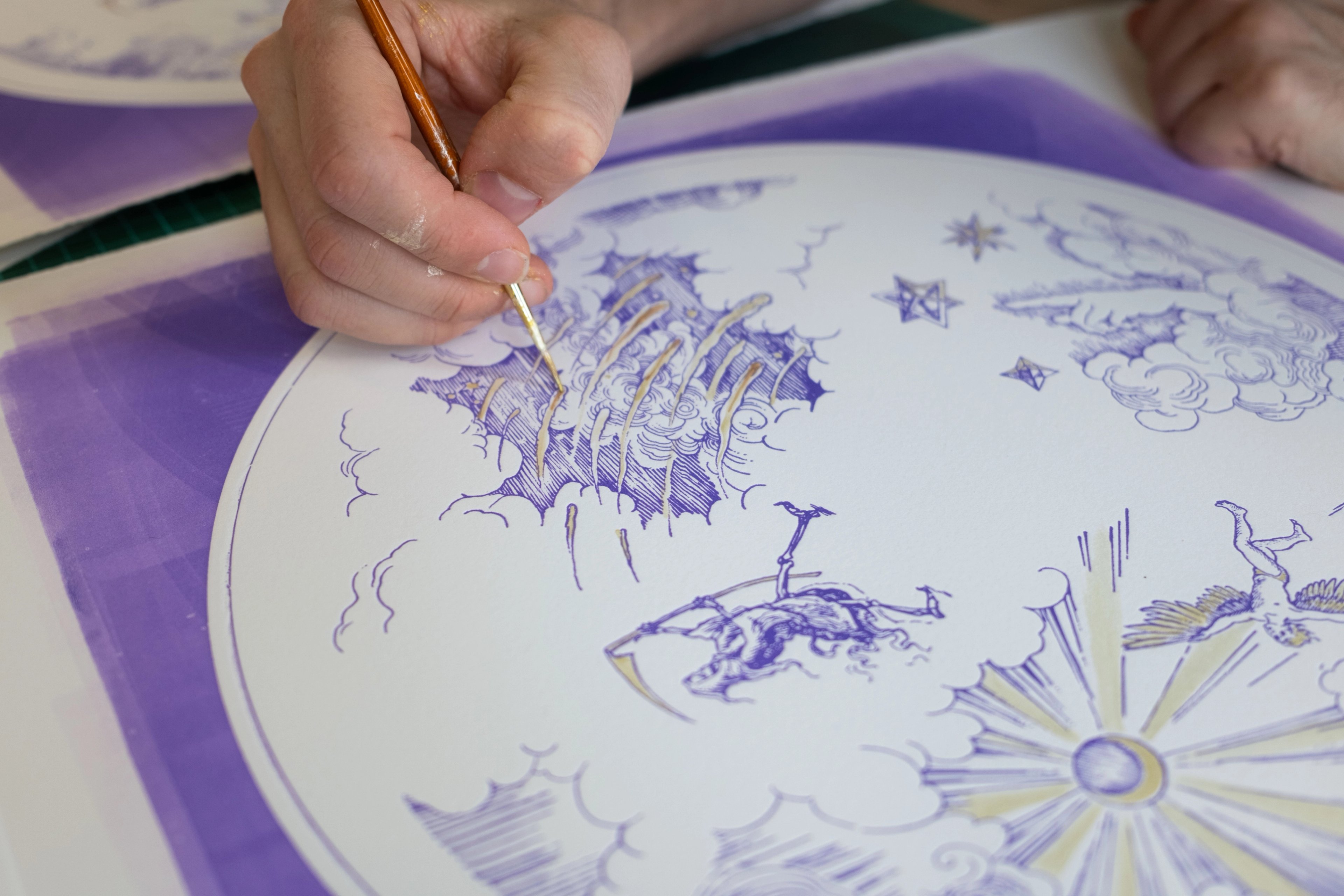
Simon painting The Silent Road gold oil highlights
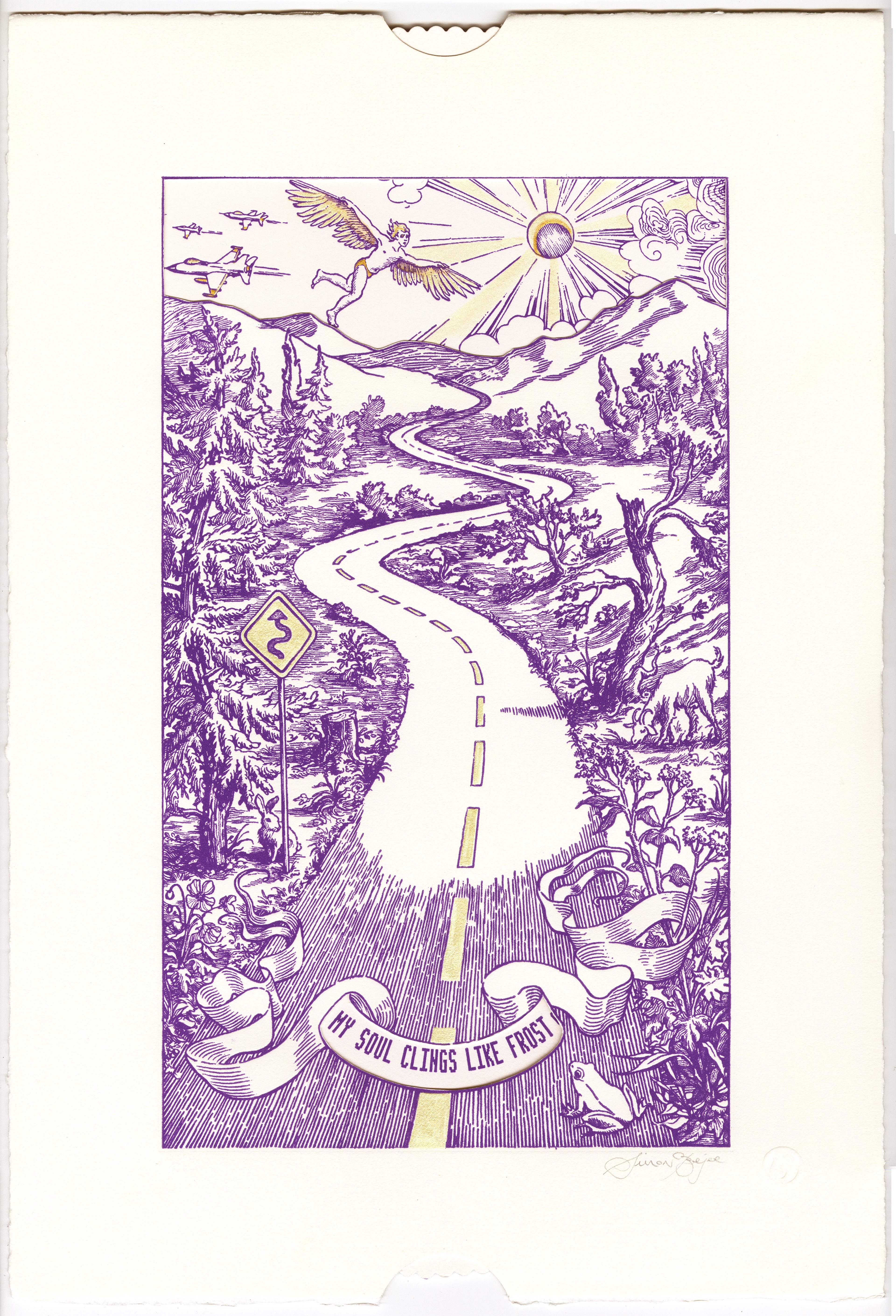
The Silent Road - Purple and Gold Edition
Three-plate interactive relief print, with two moveable volvelles. Hand-painted with gold oil highlights. Printed on Fabriano 100% cotton, 300 gsm.
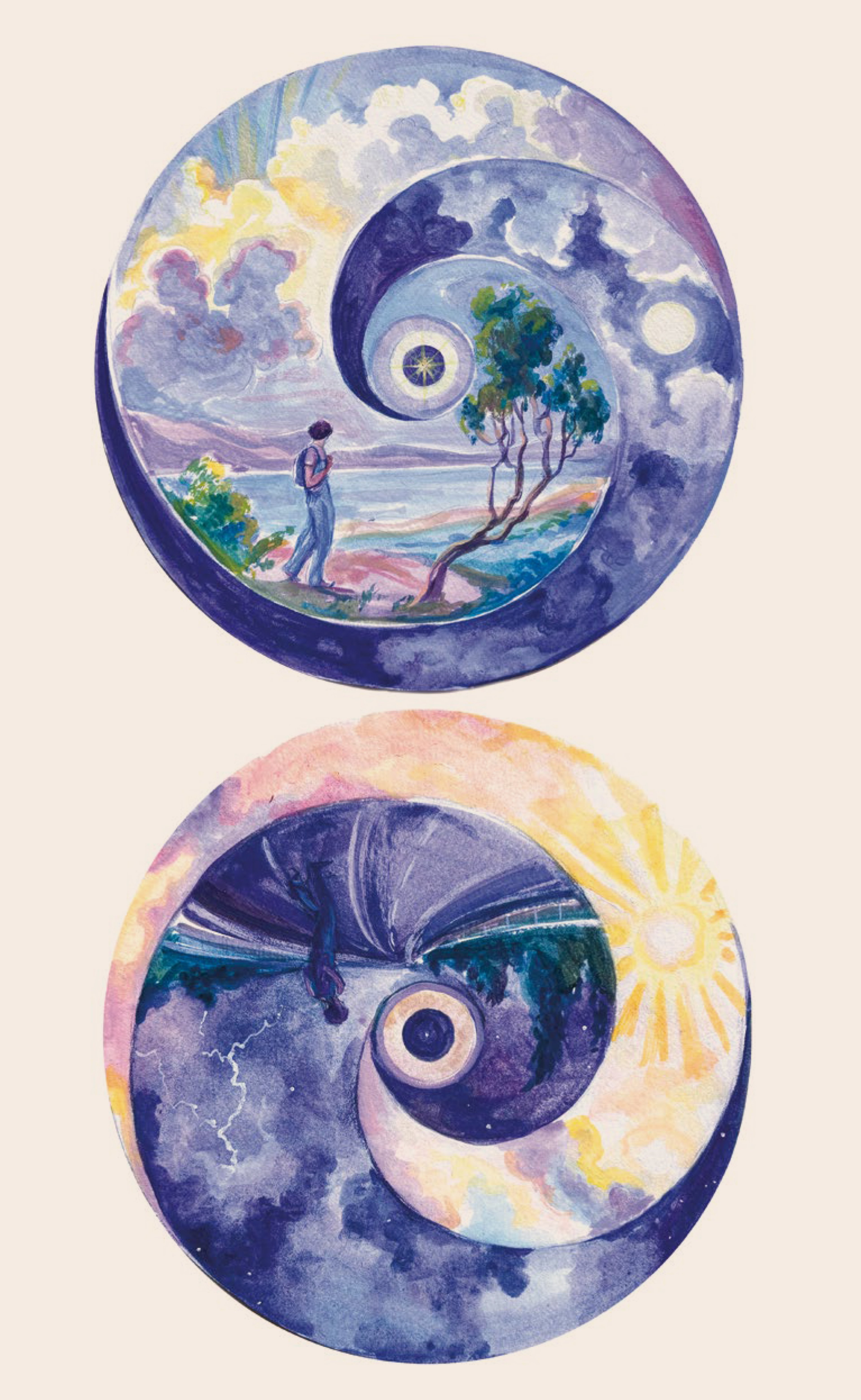
To accompany his unique works, Simon has created a stunning limited edition print with moving dials, inspired by etchings of landscapes and scientific instruments in the Collection.
The Silent Road is available in two colourways, in an edition of 10 each. Every print is individually hand-pressed using traditional methods on Fabriano paper by Plaintiff Press in London, and hand-coloured by the artist - and therefore every print is unique.
Available via the Oculi Mundi Shop or in the gallery during the exhibition

Study for Day and Night (2026)
Watercolour on paper, 25.8 x 36 cm
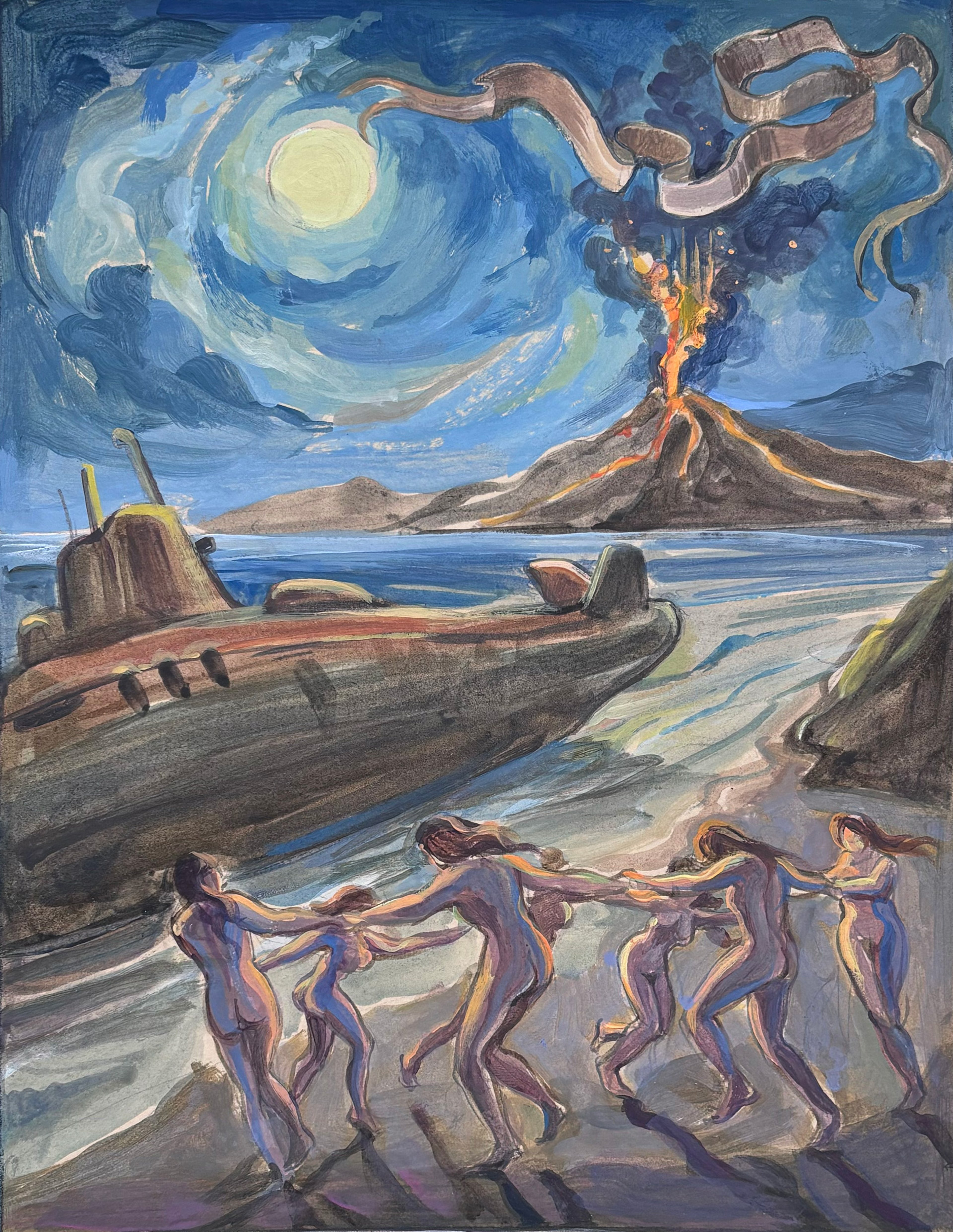
Study for The Still Point of the Turning World (2026)
Watercolour on paper
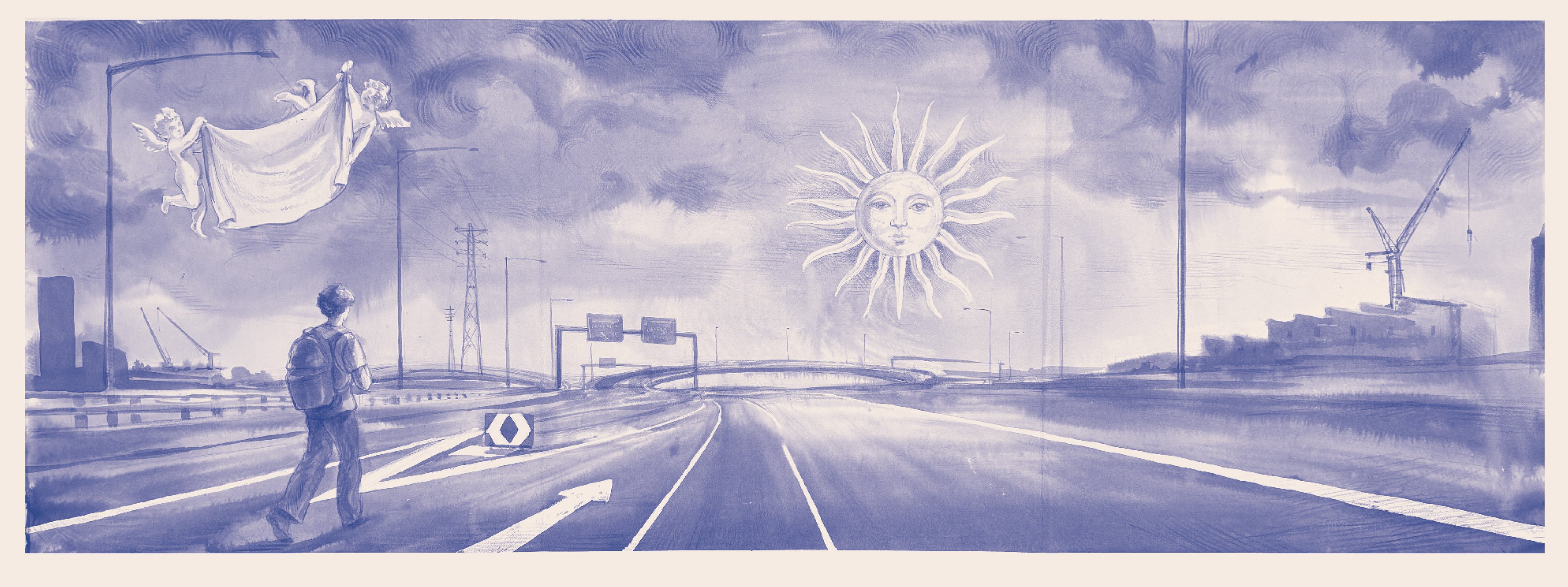
Untitled ink sketch (2026)
Ink on paper, 77 x 28.3 cm
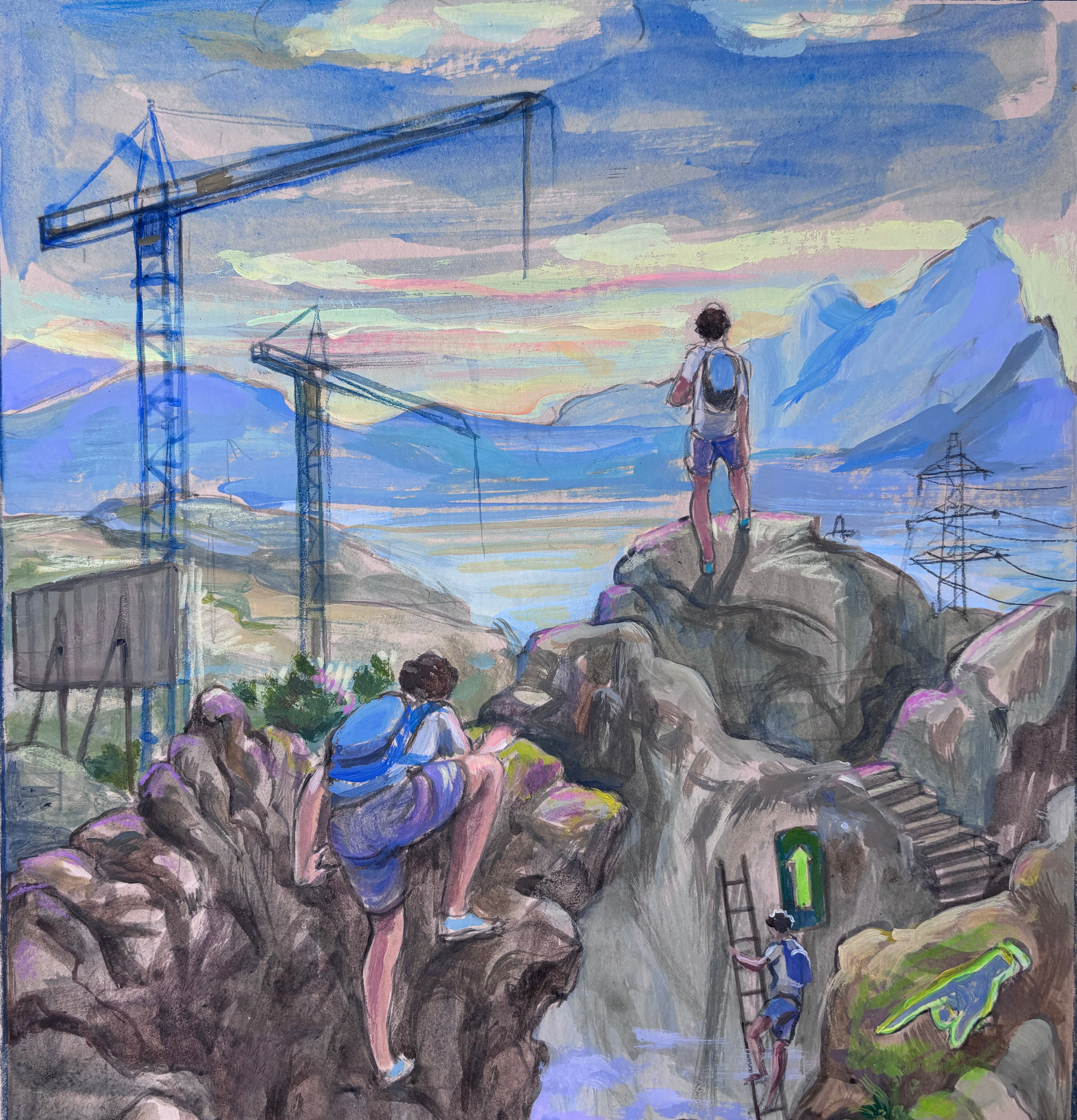
Gouache study for Oritur Sol (2026)
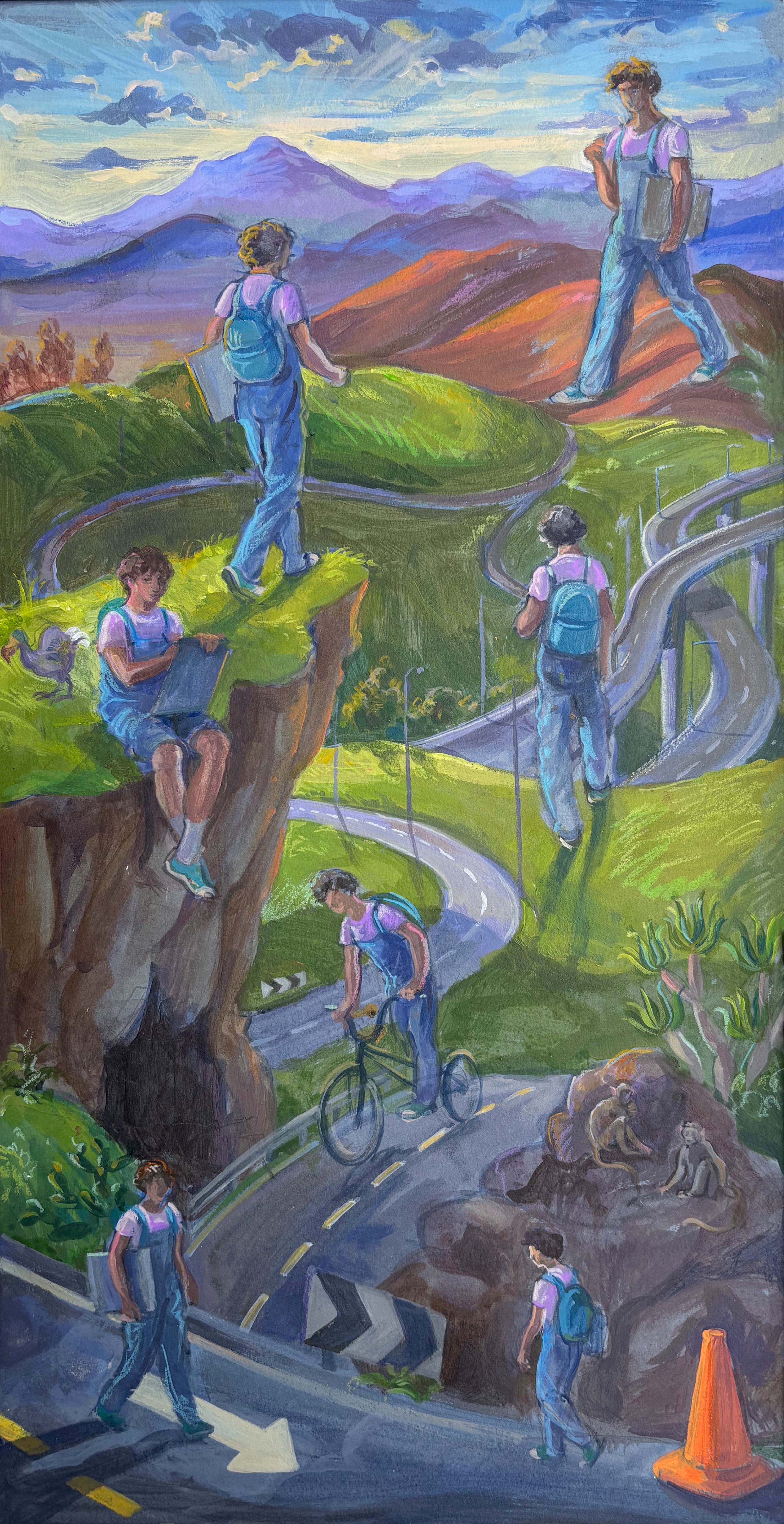
Panel study for You Are Here

Concertina sketchbook work
Sketch for the limited edition print volvelle 'The Silent Road'
Sketches for two possible volvelle works, Australis and Borealis

Ink Sketch Road (2026)
Ink on paper, 36 x 26 cm

Untitled panorama (2026)
Watercolour on paper, 77 x 28.3 cm
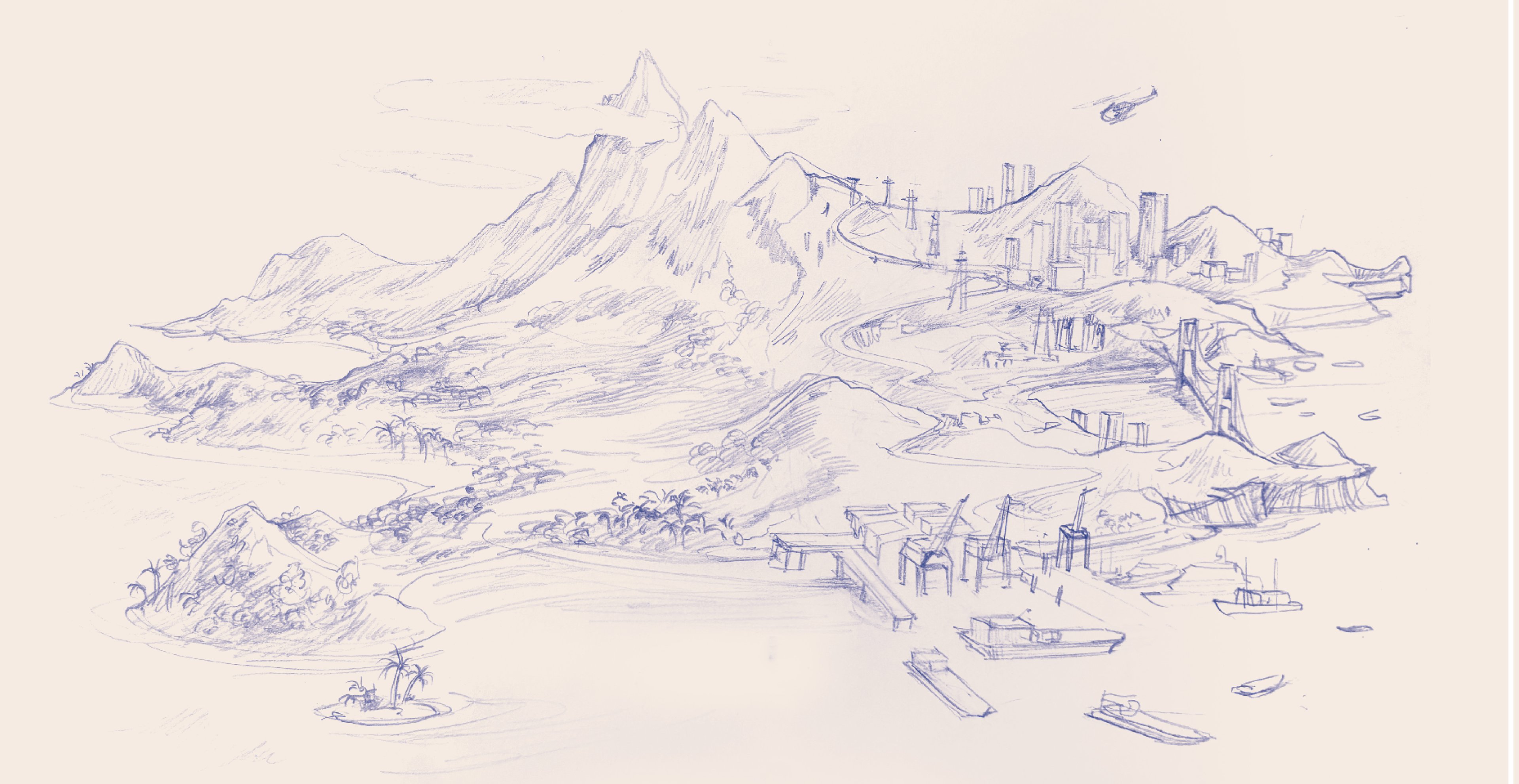
"An island embodying the contrasting powers of nature and technology"

Study for You Are Here (2026)
Watercolour on paper, 42 x 20.5 cm
Overview
Simon Bejer: And Everything Under The Sun
The Sunderland Collection is delighted to announce the third edition of its acclaimed Art Programme, culminating in a new body of work responding to the Collection by Australian artist Simon Bejer.
Working in oil on birch-wood boards, drawings, and mixed-media sculpture, Simon draws inspiration from Renaissance cosmologies, classical mythology, and the ornate aesthetics of antique celestial maps to construct expansive, fantastical vistas.
In his response to The Sunderland Collection, Simon consistently dissolves the boundaries between antiquity and modernity, the sacred and the mundane, the heroic and the absurd.
A single scene can bring together modern infrastructure, sea monsters, crumbling temples, classical iconography, and self-portraits. A grand galleon meets a contemporary roadblock; traditional architecture is positioned within built up industrial sprawl; and divine deities loom over motorway junctions in a modern urban landscape….
For availability of works and a price list, please email arts@sunderland-collection.com.
To view an accessible version of this online exhibition, click 'Enter' and then click 'Overview'.