Exhibitions
This pair of contrasting circular panel works, titled ‘Night’ and ‘Day’, feature a playful juxtaposition: a radiant sun illuminated a river and casts silhouettes of a construction site against a greenish-blue twilight sky, while a moon rests in a clear blue sky surrounded by wind turbines. Motorised to rotate, each panel emulates sixteenth-century volvelles - wheel instruments found in early books of knowledge and scientific tools.
By drawing on these mechanisms, the artworks connect modern solar and lunar tracking back to the medieval era and particularly to the work of Petrus Apianus (1495–1552). His ground-breaking 1540 treatise, Astronomicum Caesareum, featured interactive volvelles that functioned as analogue computers. These devices enabled readers to calculate planetary positions for specific dates and times based on the Ptolemaic model of the universe.
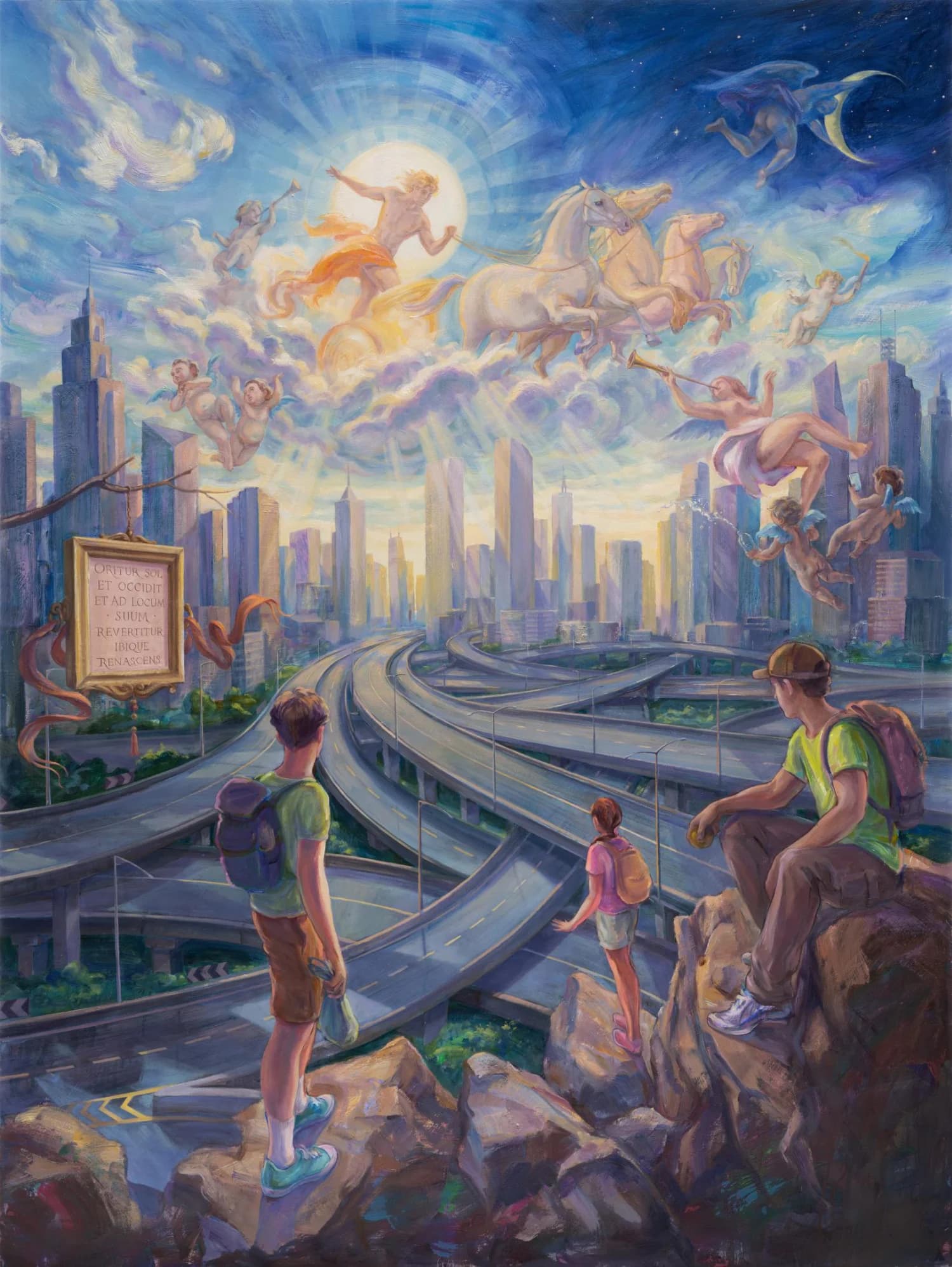
In Oritur Sol, backpackers watch the sun rise above a fantastical cityscape, accessible only by a criss-cross of motorways. Above the looming skyscrapers and towers, an Adonis rides a chariot - the Sun as his halo - and is surrounded by cherubs and putti, some carrying water bottles and another holding an iPhone.
Art Programme curator Beth Greenacre notes that this piece echoes Caspar David Friedrich’s famous painting, Wanderer above the Sea of Fog (c. 1817), in which a lone figure contemplates an enigmatic landscape shrouded in cloud.
The work takes many motifs from The Sunderland Collection’s maps. From the heavenly scene inspired by the allegorical figures in the ornate borders on seventeenth century double hemisphere world maps by Henricus Hondius (1633) and Frederick de Wit (circa 1660); to the grand cartouche encasing a famous Latin verse from the Bible, Ecclesiastes 1:5, reads: “The sun rises and the sun sets, and hurries back to where it rises again.”