Cultural Data Sculpting 2026
Proudly presenting a student project from Prof. Sarah Kenderdine's Cultural Data Sculpting Course at eM+ Lausanne
We were thrilled to see the end-of-year presentation by students from the Cultural Data Sculpting course at the École Polytechnique Fédérale de Lausanne (EPFL) - part of the Digital Humanities Master's degree.
The Sunderland Collection is a proud partner of EPFL's Laboratory for Experimental Museology (eM+), run by the pioneering Dr. Sarah Kenderdine. Each year, the Collection provides high-resolutions images of maps for use by students as a data set to create cutting-edge, immersive experiences for audiences engaging with cultural heritage objects.
We are proud to share what the students created in for Spring 2026 below:
2026: A Cultural Curation
This year, our data set was a Buddhist Mandala from Eastern Tibet (c1700) and a map of Jain cosmography (c1770). Students used them to design an interactive cultural heritage exhibition and experience, to teach visitors about both of these beautiful, complex objects.
The students envisioned transforming both cartographic artefacts into an immersive cultural showcase. They devised an exhibition that would allow visitors to learn about two religions while examining the objects through interactive displays and informative videos that would offer historical context. A central ‘cupola’ full-dome planetarium would serve as the exhibition's focal point, bringing the maps together and providing guests the choice between self-directed digital exploration or a structured interactive tour.
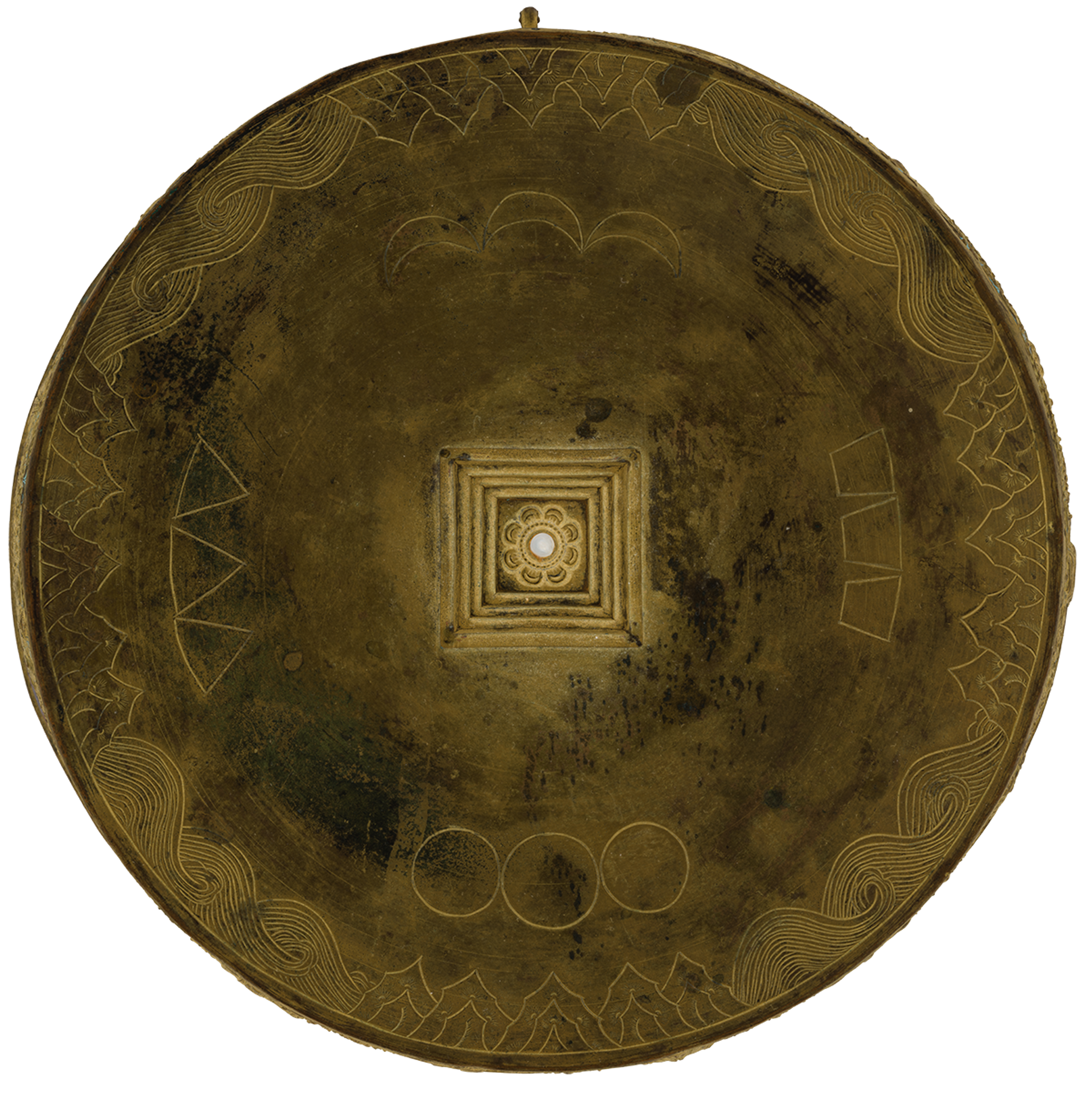
Eighteenth century Eastern Tibetan Meru Mandala ©The Sunderland Collection
The first item is a Buddhist mandala from Eastern Tibet. This gilt-copper mandala has a five-terraced pyramid at the centre which represents Mount Meru (also known as Mount Sumeru). Meru is the cosmic mountain that serves as the axis of the universe and the home of the Gods in Buddhist cosmology.
In Buddhist tradition, the world system is a vast disc called a Cakravala which contains seven concentric golden mountain ranges which circle Meru. Spaced equidistantly around the Mountain, there are four continents: Jambudvipa in the south (triangular); Aparagodaniya in the West (circular); Purvavideha in the East (crescent-shaped); and Uttarakuru in the North (trapezoid). The continents lie within the waters of the lake Anavatapta, which is known for its association with immortality. The tooled gilt sides of the Mandala are adorned with Buddhist symbols and botanical motifs.
Mandalas like this would have been created for ceremonial functions, such as to welcome distinguished guests to a monastery and symbolically, the mandala may signify the recipient’s connection to Meru.
Map of Jain Cosmology (1770) ©The Sunderland Collection
The map of Jain cosmology is a richly detailed painting presenting Aḍhāī-dvīpa, or Two and A Half Continents, namely, where mortal life dwells in the cosmos. It shows the universe according to the Jain religion, which is spatially boundless - a multiverse containing both known and unknown worlds. This hand painted map on textile was created circa 1770.
The continents on this map are arranged as symmetric petals of a lotus blossom, or as concentric circles of alternating seas and continents. The inhabited earth, Jambudvīpa lies at at the centre of the world system. You can explore more about this map here in the Collection environment of Oculi Mundi.
The significance of Mount Meru is shared by both Hinduism and Buddhism, but their cosmographies differ. Using this starting connection, the students set about building the exhibition. Firstly the students spent time researching each object, looking for appropriate connections and differences in order to consider the look and feel of the environment. For each work the students' intention was to decode the richness of maps, explaining the spiritual world and the physical geography.
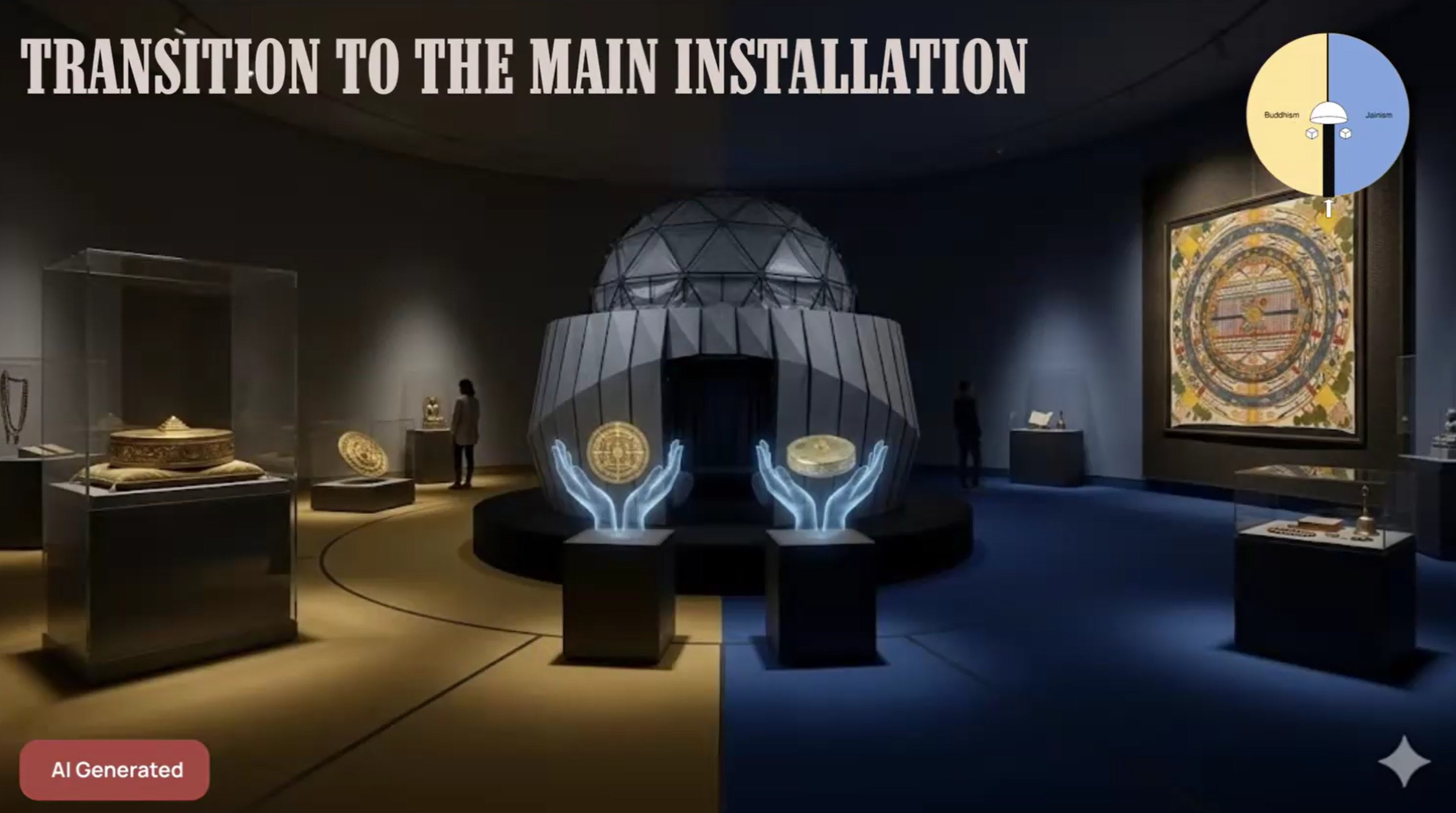
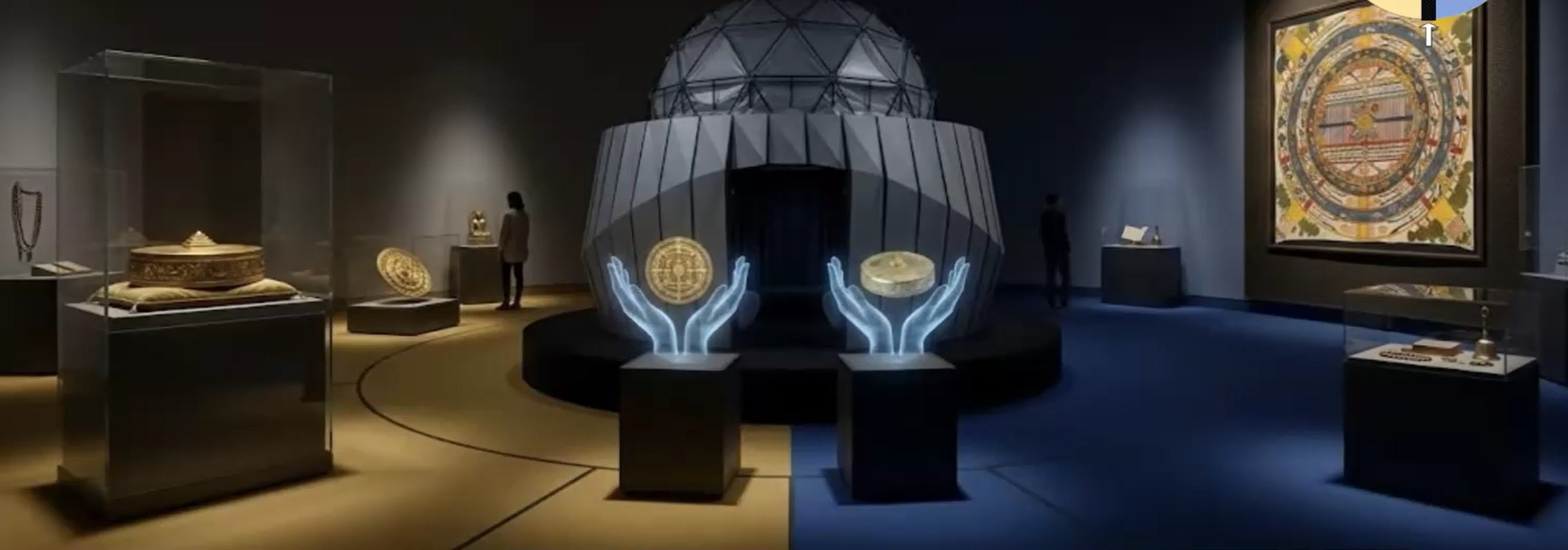
A visualisation of the dual exhibition space © eM+
The team working with these two objects envisaged their exhibition space as circular, reflecting the physical form of the two maps and the natural representations of both world systems. This design further emphasised the commonality of both religions regarding the theme of rebirth.
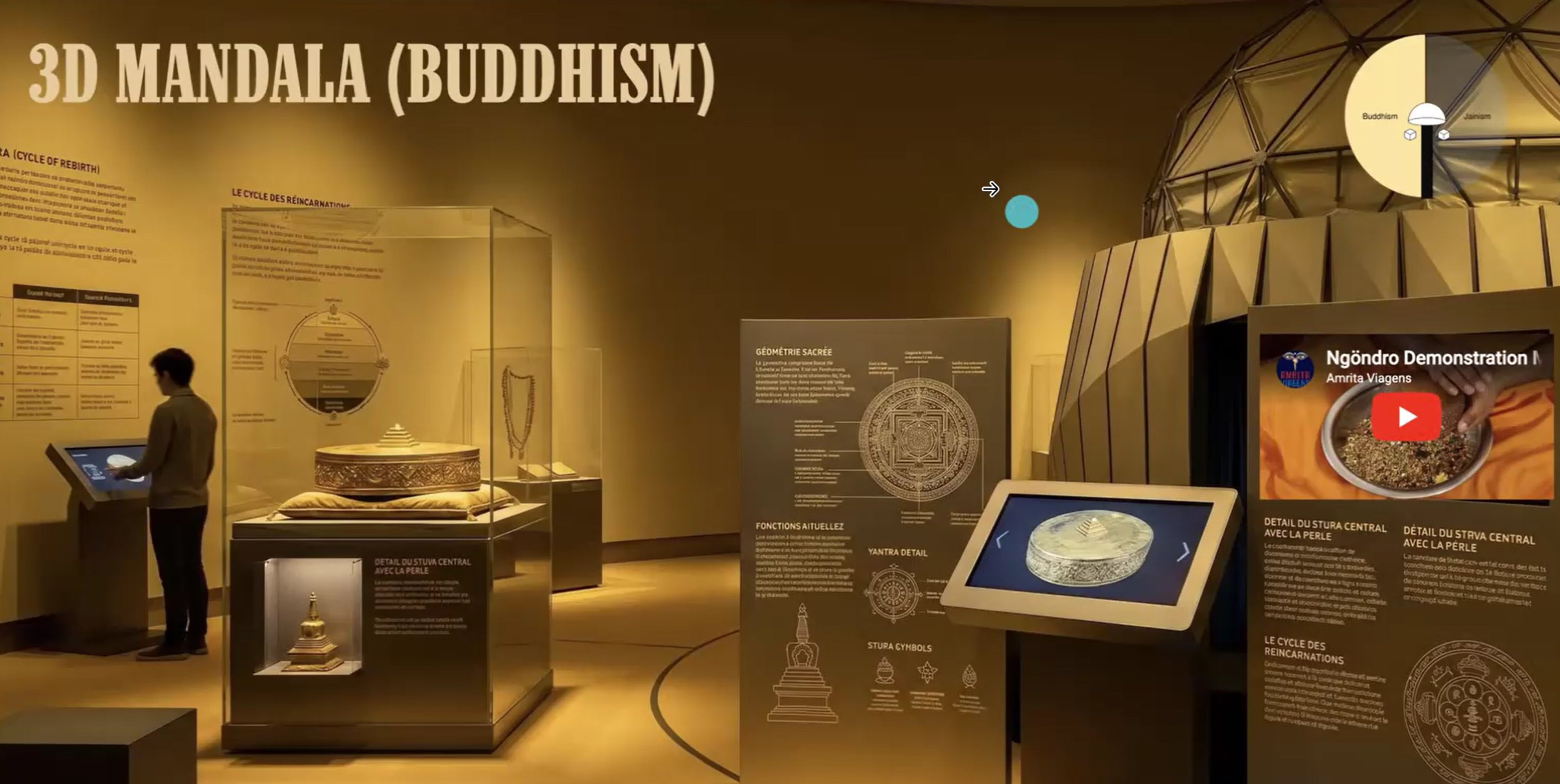
Exhibition on the Buddhist Mandala © eM+
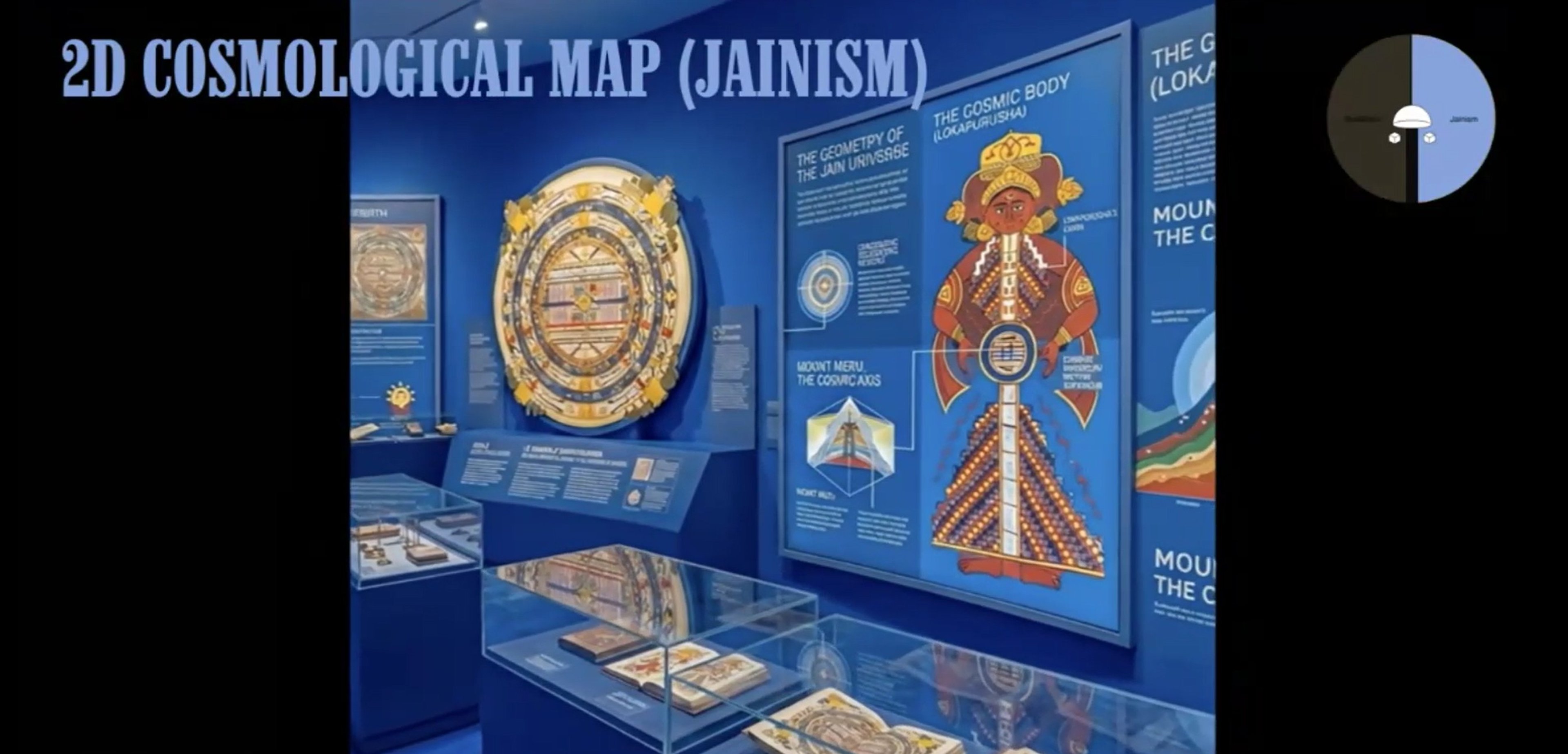
Exhibition on the Jain Cosmographical Map © eM+
Each half of the circular exhibition would be centred around the authentic artefact, and have a different look and feel to the other. The half containing the Mandala would be presented in gold to mirror the materiality of the piece, whereas the side of the exhibition dedicated to the Jain map would be a rich blue colour matching the colour of the oceans painted on it.
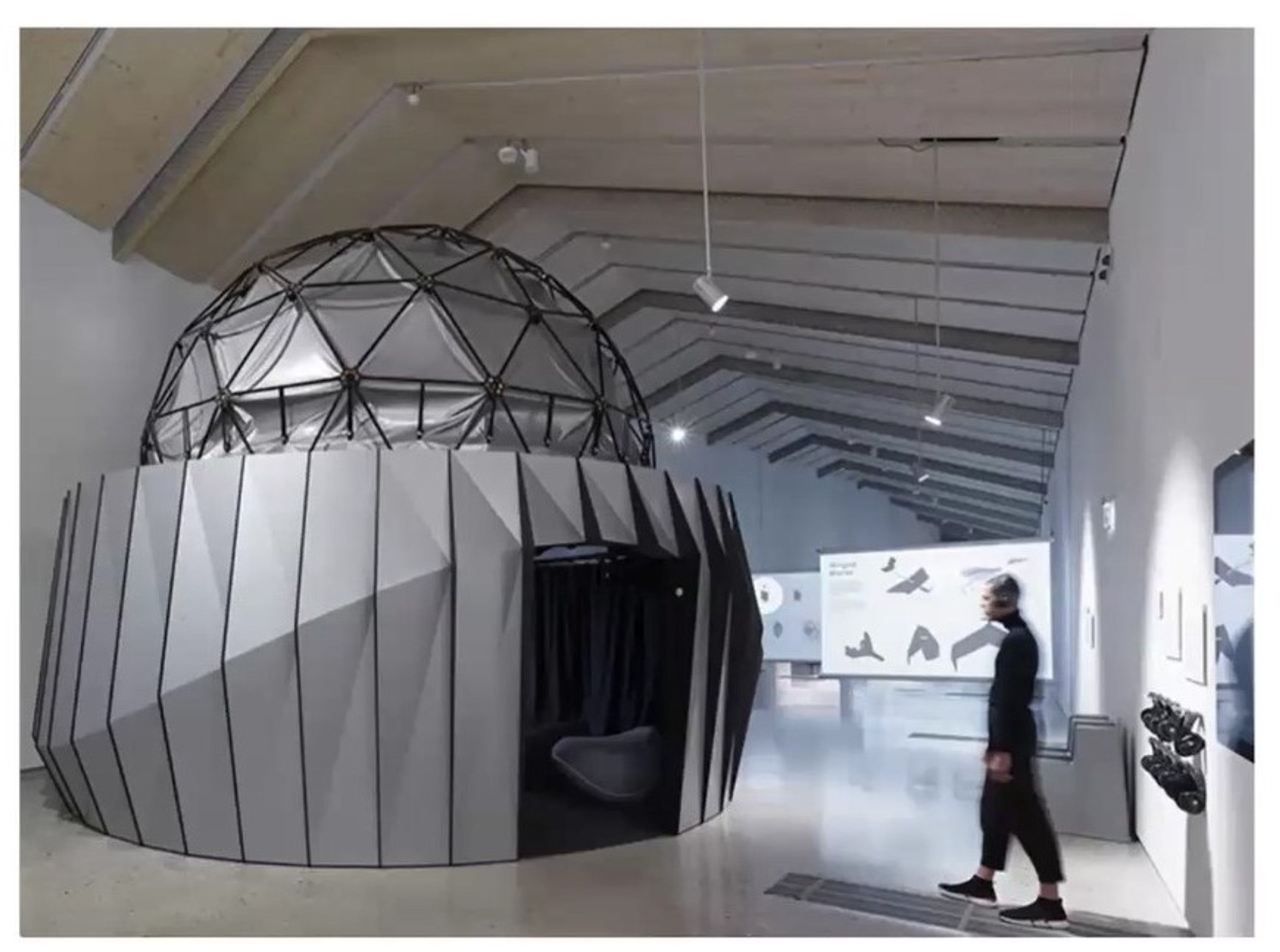
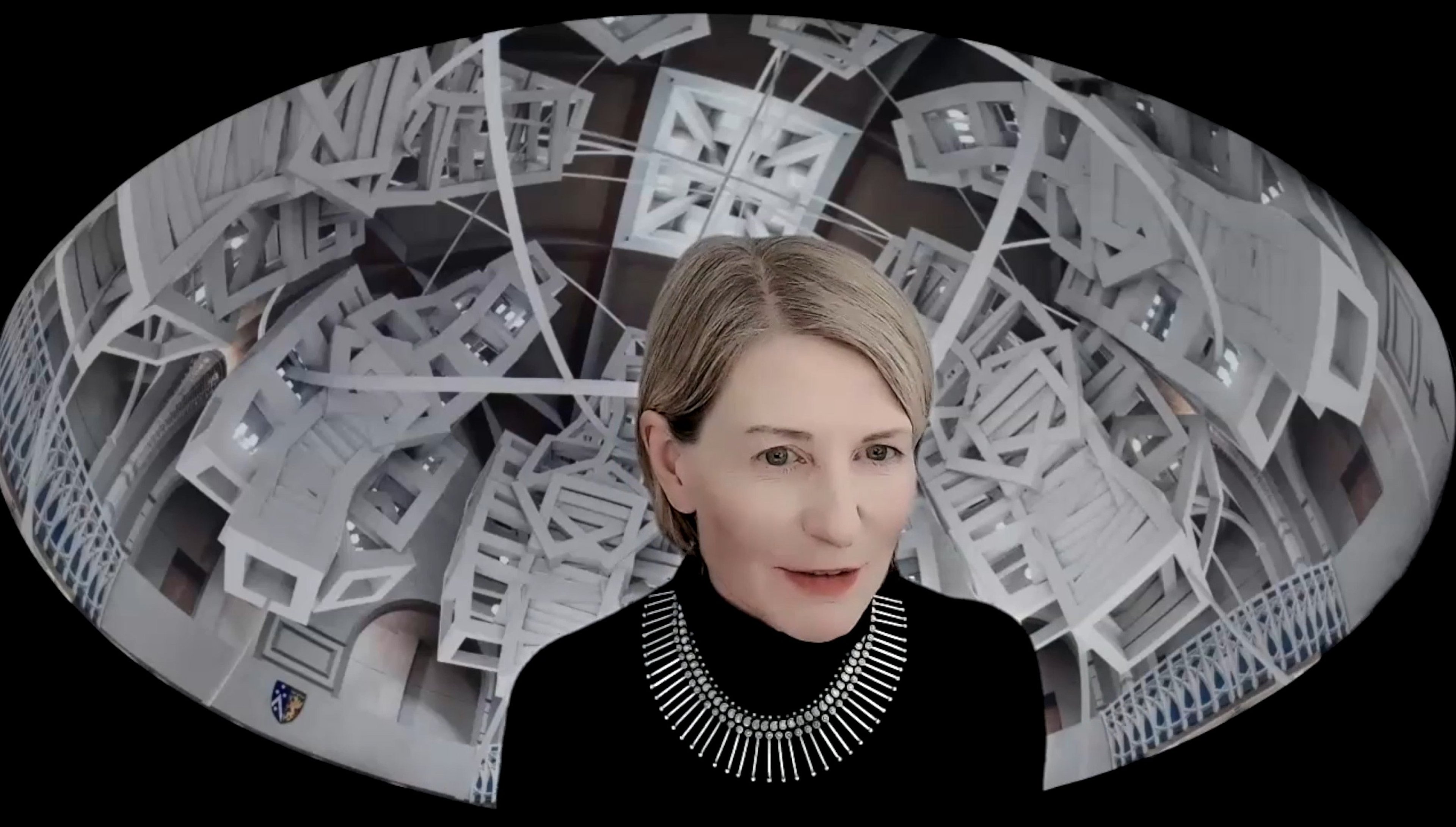
Interactive cupola (full-dome) © eM+
The ‘cupola’ planetarium - which sits at the centre of the exhibit -would feed into a coherent, visual symbolism because both belief systems in the exhibition.
A physical wayfinding controller for use in the planetarium was created based directly upon the physicality of the Tibetan Mandala.
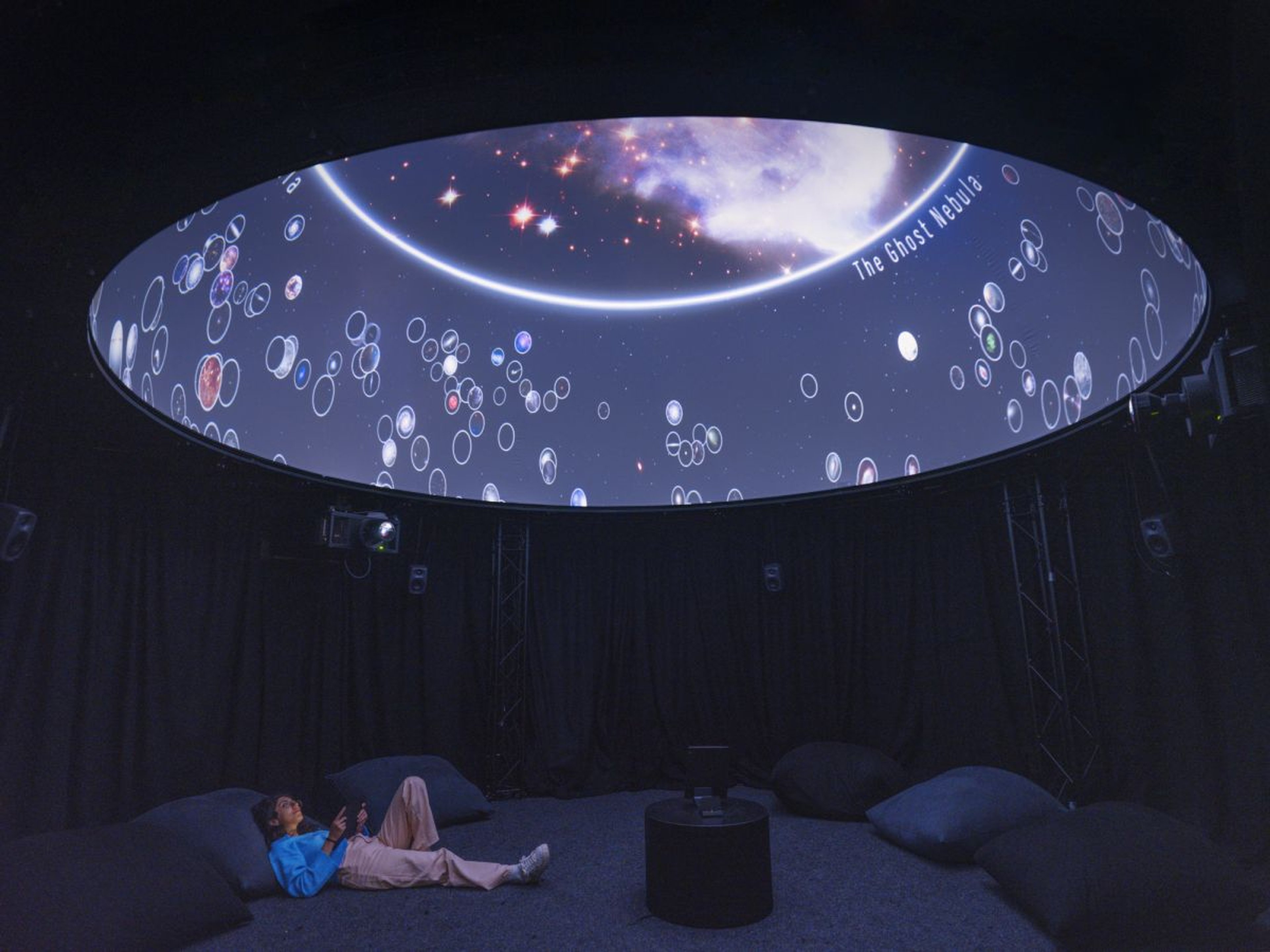
Interactive cupola (full-dome) in the exhibition Cosmic Collisions (2022) © eM+. Photo by Julien Gremaud.
This protype made available to the students is based on a working model of a full-dome projection, and uses existing technology with custom interfaces developed and programmed by Prof. Kenderdine and her team at eM+.
This interactive cupola was deployed in Cosmic Collisions, an astronomical collaboration with EPFL's Laboratory of Astrophysics (LASTRO); and in the award-winning travelling exhibition Songlines: Tracking the Seven Sisters that originated at the National Museum of Australia.
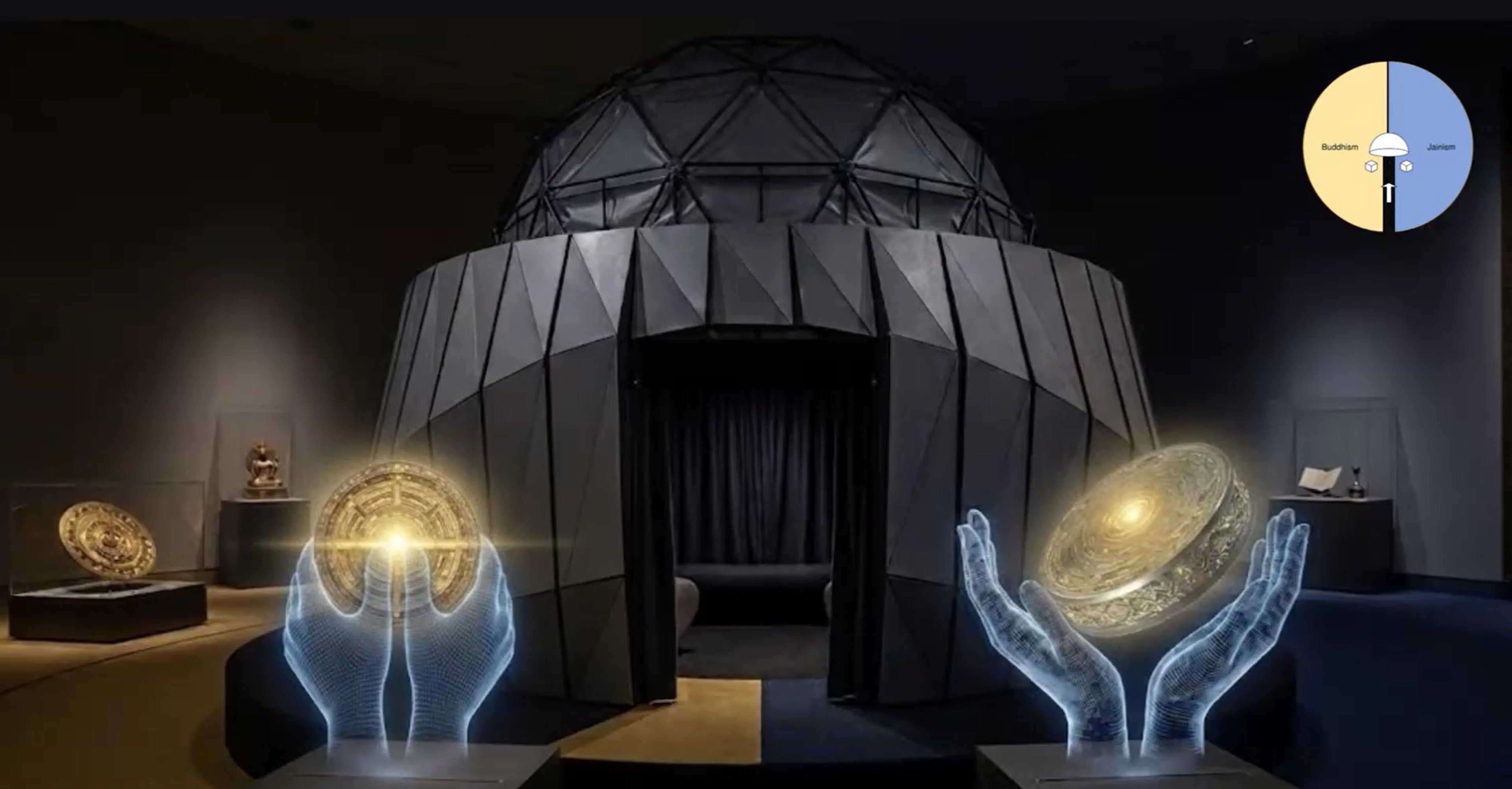
A visualisation of how the holographic explainers would present outside the cupola ©eM+
Like all exhibitions featuring cutting edge-technology, accessibility must be considered. The students were concerned that the mandala controller may not be as intuitive as other wayfinding controllers; they created two holographic explainers which would greet visitors as they approached the cupola dome, that would teach them how to use the Mandala-shaped controller.
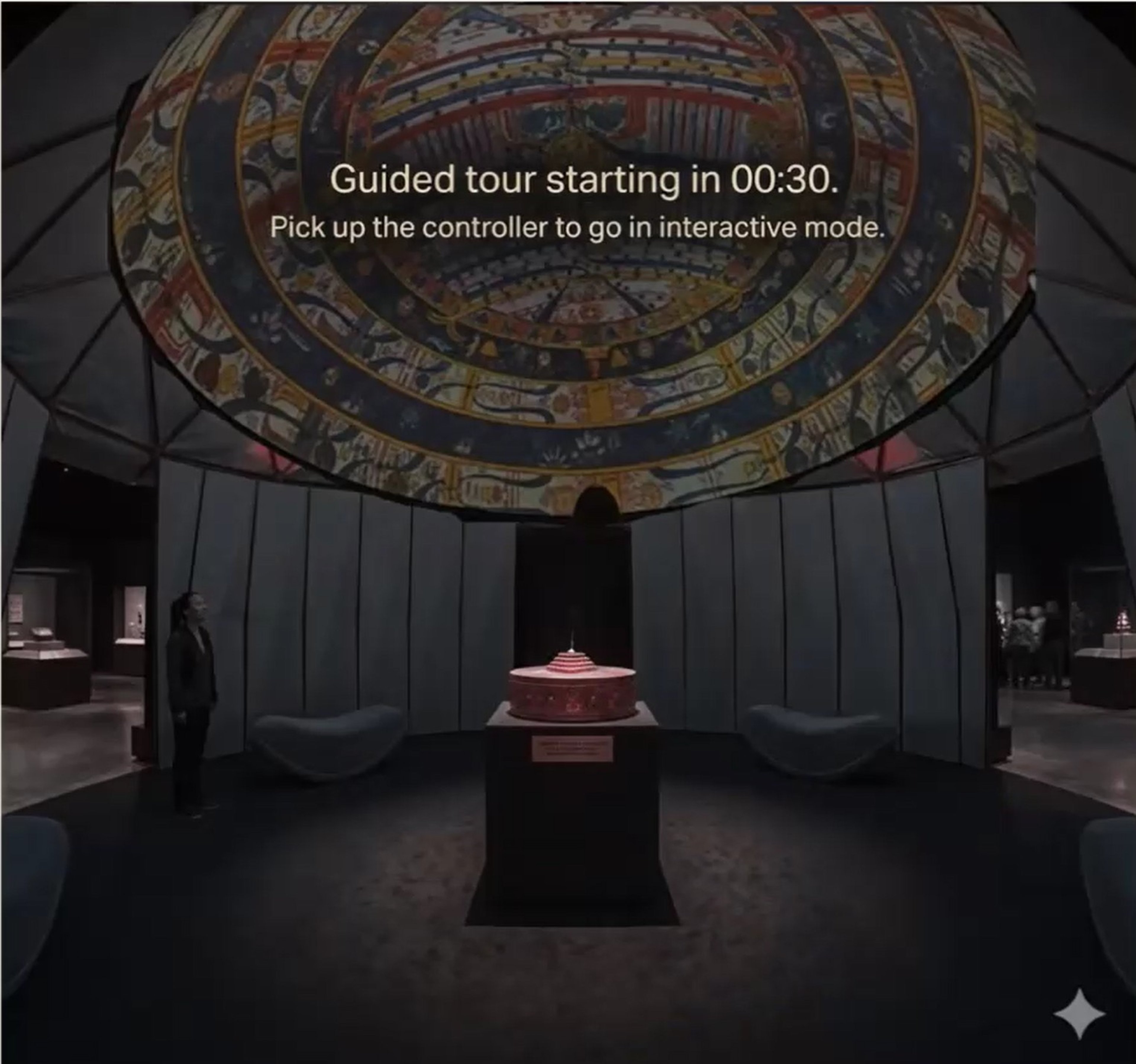
In the cupola, there would be suggestive messaging to invite the guest to interact with the Mandala-shaped controller which would be positioned in the central console. Touch would launch the animations. Using AI tools such as Veo AI, the students were able to visualise these interactions.
And here are some test visualisations - that show the different user interactions required to enact the guided and self-guided tours in the dome. These movements were inspired by contextual research and a video from Ka-Nying Shedrub Ling (a Tibetan Buddhist monastery in Kathmandu, Nepal) which showed how the artefact would be used in ceremonial practice.
Visualisations showing the actions of the interactive controller
All presentation images © eM+
Using Unreal Editor, a world-building software, the students visualised and evaluated functionality within the dome. The animations and scripts for the projected animations were developed through a combination of AI tools and drawing directly from the students' investigations into each cartographic object.
The students devised two settings in the cupola environment: a guided-tour mode and a self-exploration (‘interactive’) mode;
The guided tour offered a curated exploration of the map with oral explanations. This would be a short and engaging tour that covered the important elements.
The self-exploration mode was designed for higher interactivity, allowing users to navigate the map via the Mandala-controller and zoom into specific features. By touching different zones on the controller, visitors can trigger various sections of the Jain map, resulting in a significantly more detailed experience of the animations and exploration process. .
Feedback
During the project presentation, Prof. Kenderdine and her colleagues raised questions regarding the suitability of pairing these two cultures into a single experience, noting their distinct world views. They questioned the appropriateness of utilising the Mandala as a control mechanism.
To enhance the planetarium experience and reduce its didactic tone, it was suggested that traditional music could be incorporated into the self-exploration mode, and that the installation include more detailed visual representation of each specific culture and religion, alongside voice-over collaborations with academic experts.

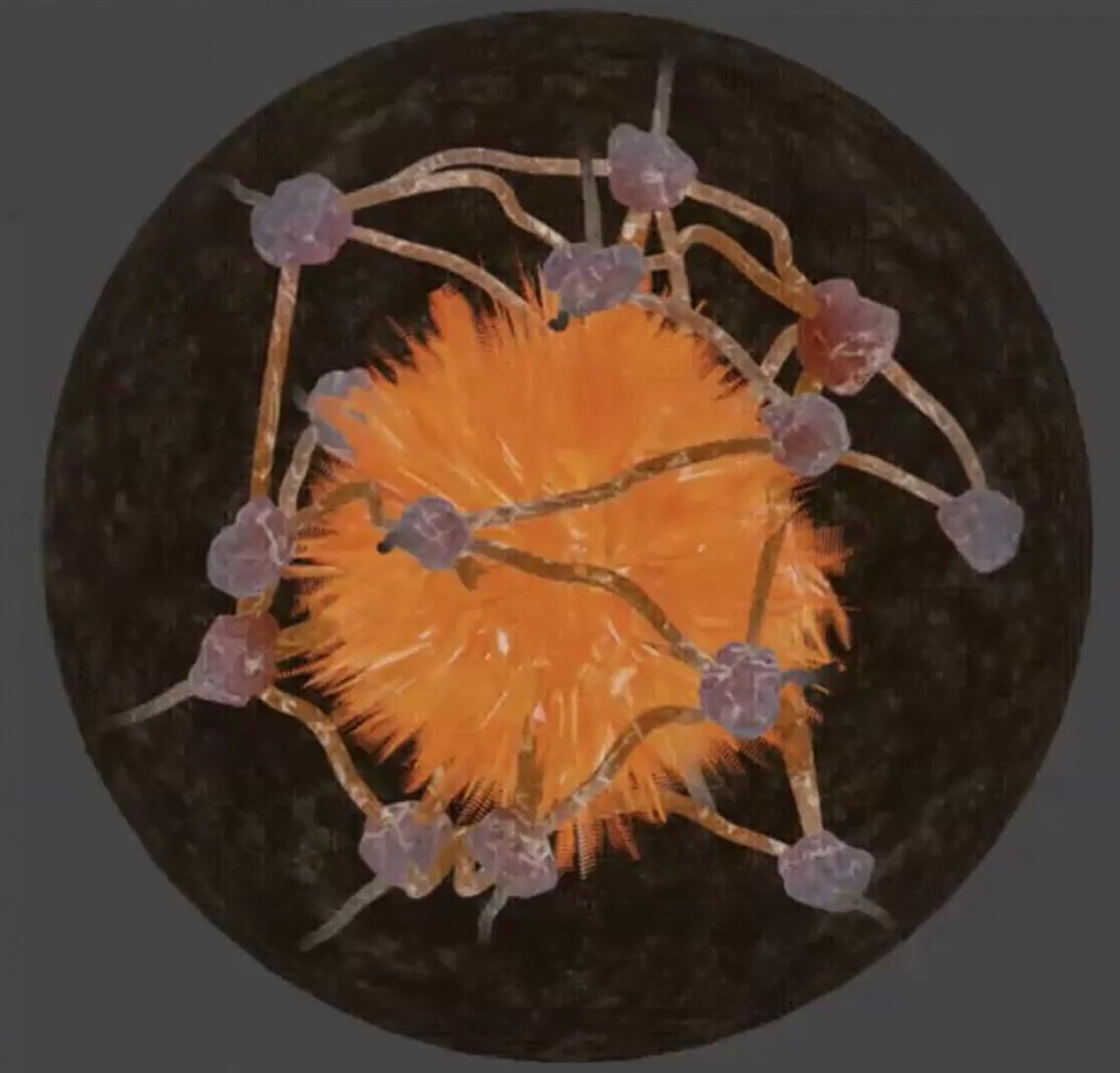
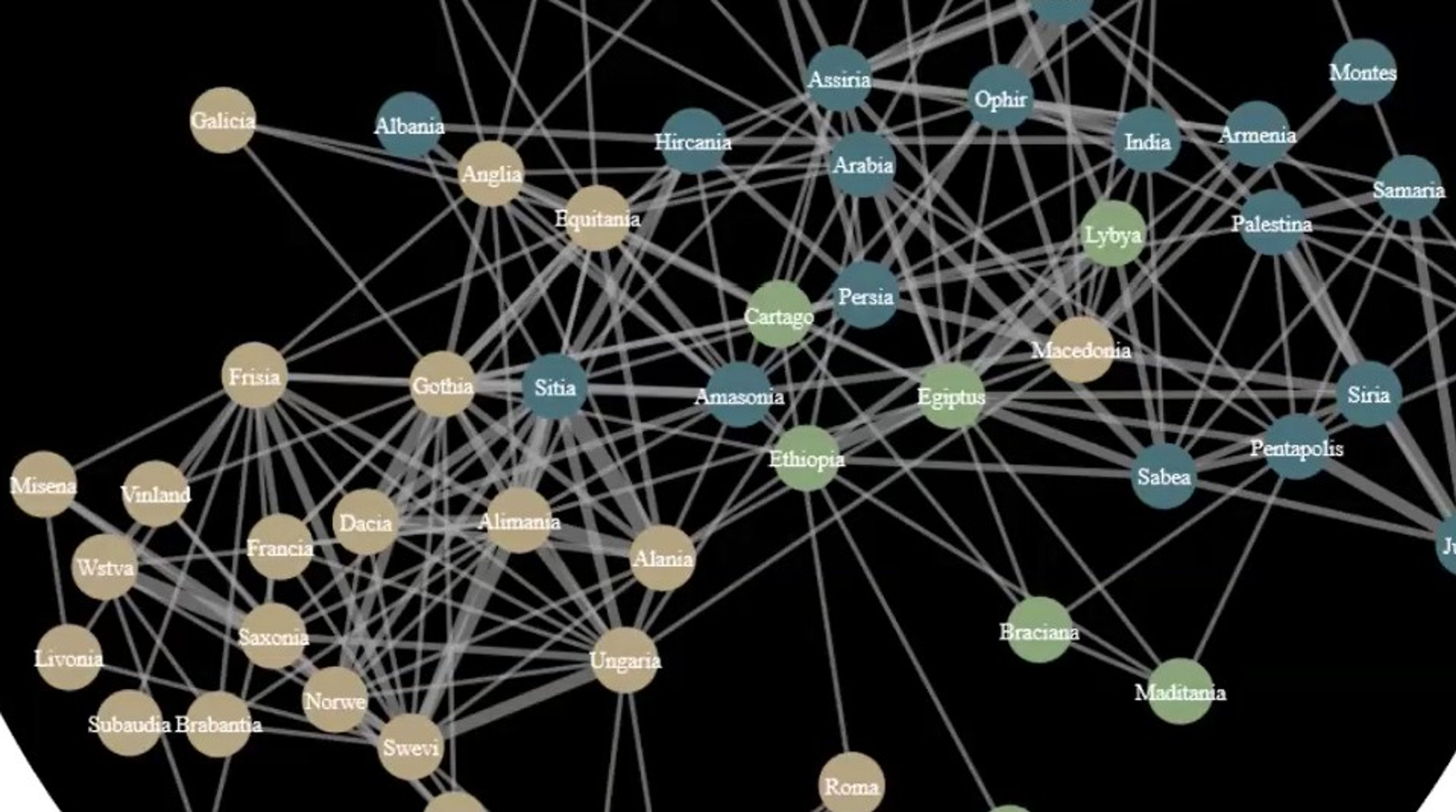
Visualisation within the cupola dome ©eM+
The Sunderland Collection is thrilled to partner with eM+. We are inspired by the next generation of digital humanities innovators, and looking forward to seeing what they create next!
All images courtesy of EPFL / eM+ and The Sunderland Collection.