Astronomicum Caesareum
The Sunderland Collection contains a selection of important early scientific textbooks to illustrate the theories that underpin terrestrial and celestial cartography, and that link directly to other works in the Collection through reference or authorship.
We are delighted to present an essay by art historian and scientific images specialist Dr Sara Öberg Strådal, who examines the Collection’s beautiful copy of the Astronomicum Caesareum (‘The Emperor’s Astronomy’) by Petrus Apianus (1540) and its influence on other contemporary works.
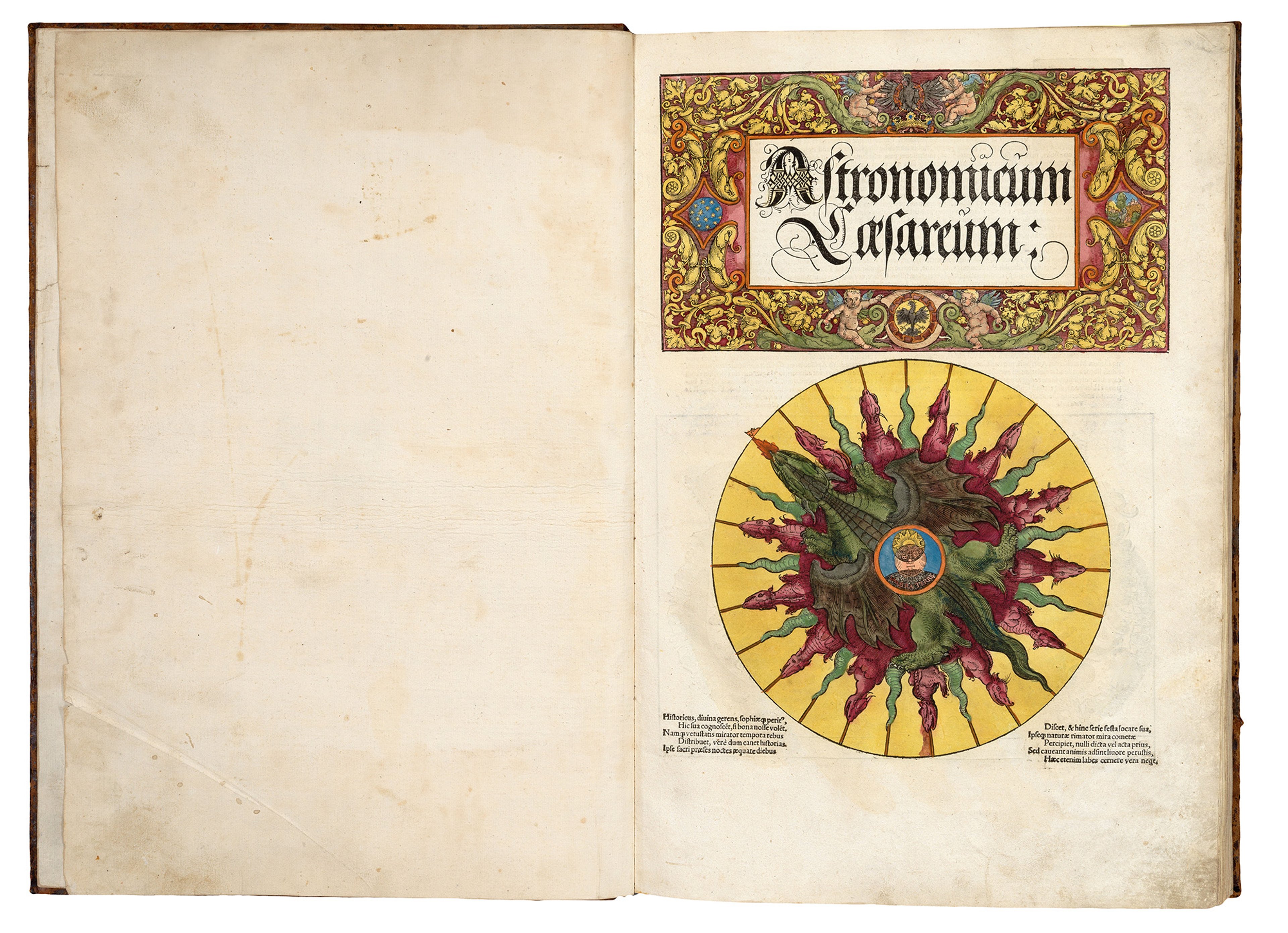
Frontispiece of Astronomicum Caesareum
Who was Petrus Apianus?
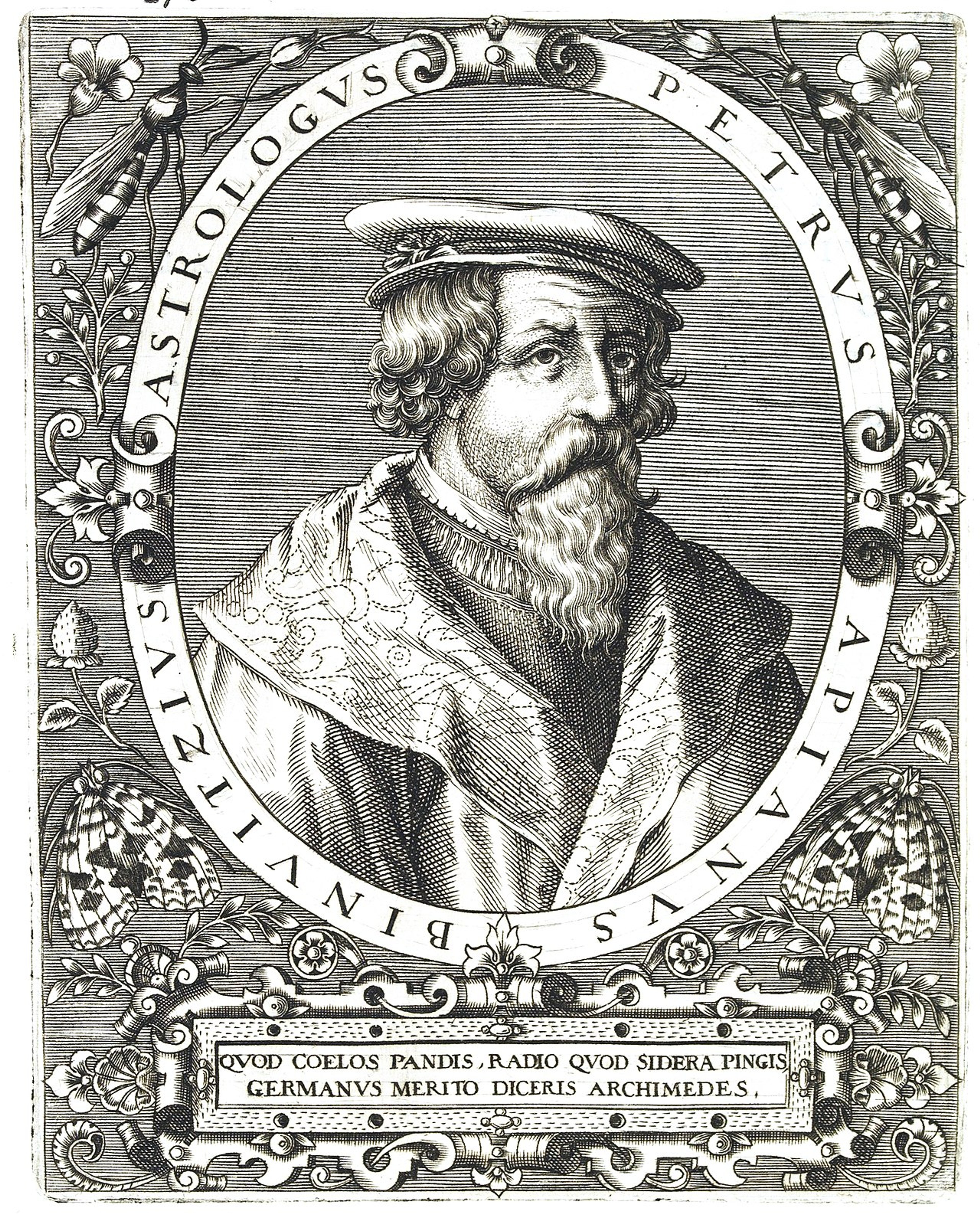
Portrait by Theodor de Bry. Public Domain
Petrus Apianus (1495-1552) was a mathematician, astronomer, and printer active in Ingolstadt, Germany in the first half of the sixteenth century.
The Latin name ‘Apianus’ is a pun on his surname, Bienewitz, derived from ‘Biene’ - the German word for ‘bee.’
Apianus received his mathematical training at the University of Vienna under Georg Tannstetter (1482-1535), a famous cartographer and physician to the Holy Roman Emperor. In 1526 he moved to Ingolstadt to become a professor of mathematics at the local university. Perhaps pre-occupied by his other endeavours, Apianus was reprimanded more than once for his lack of commitment to his students and their education.
To modern audiences, Apianus is most well-known as a master printer. He set up a printing press in Ingolstadt where he published works by other scholars and faculty members of the university as well as his own treatises. In 1528 he printed the first map of Hungary, devised and edited by Tannstetter. The sole surviving witness to this Tabula Hungariae is preserved at the National Library in Budapest.
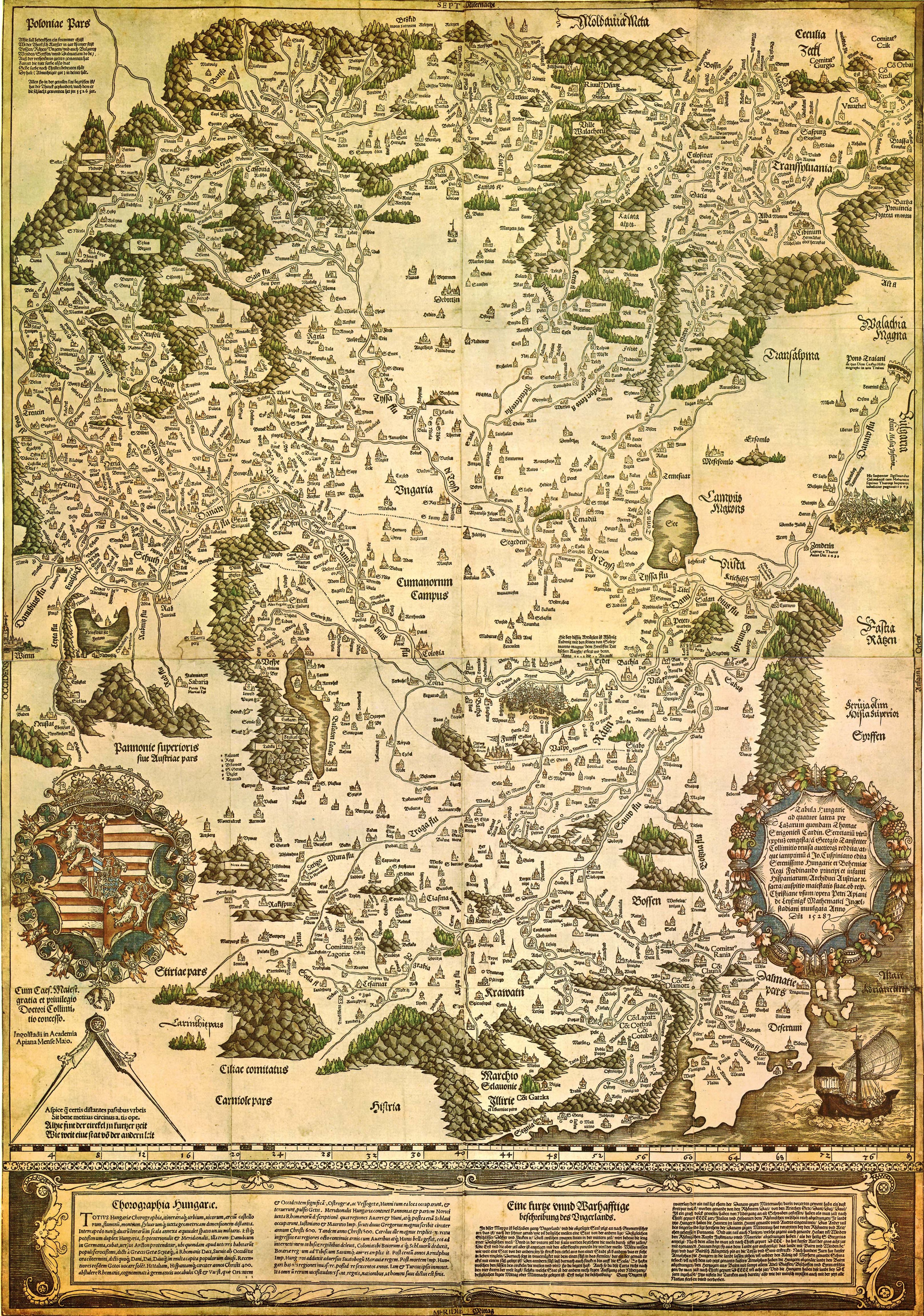
Hungariae Tabula by Lázár deák (1528) published by Petrus Apianus. Courtesy of ELTE Faculty of Informatics, Institute of Cartography and Geoinformatics.
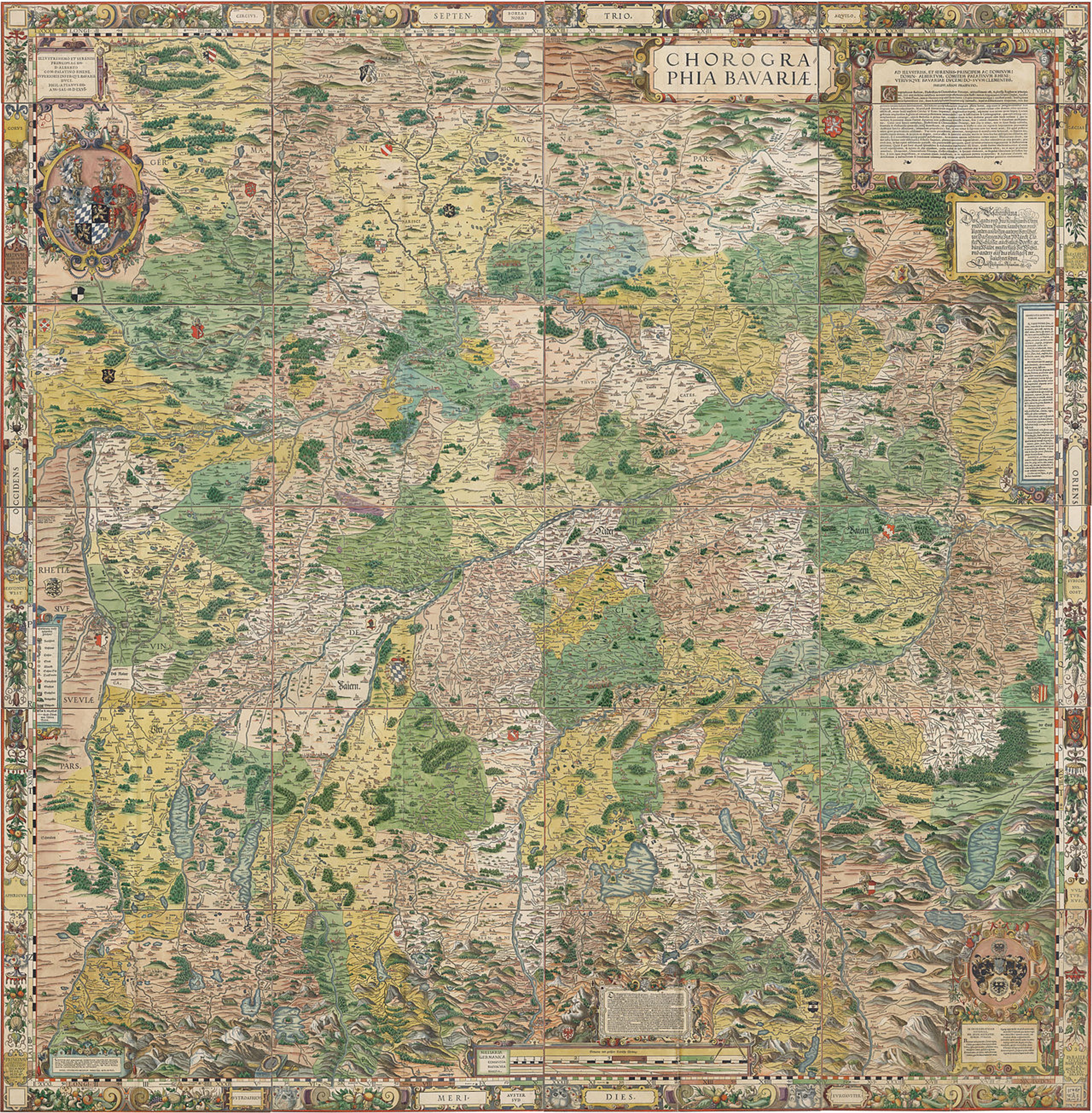
Philipp Apian’s Chorographia Bavariae (1568). Bayerische Landesbibliothek (Bavarian State Library Online) Stitching by M. Dörrbecker. Public Domain.
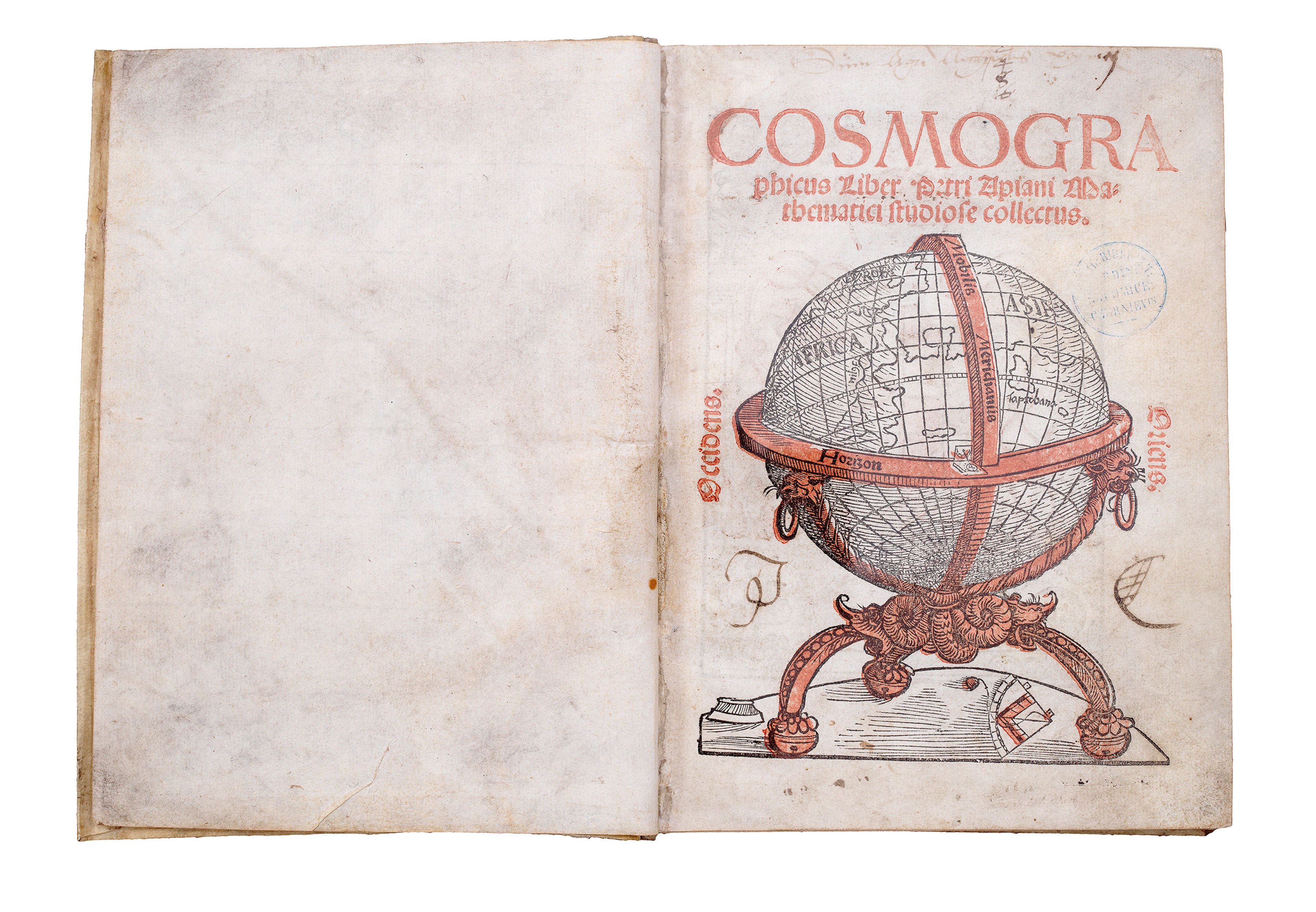
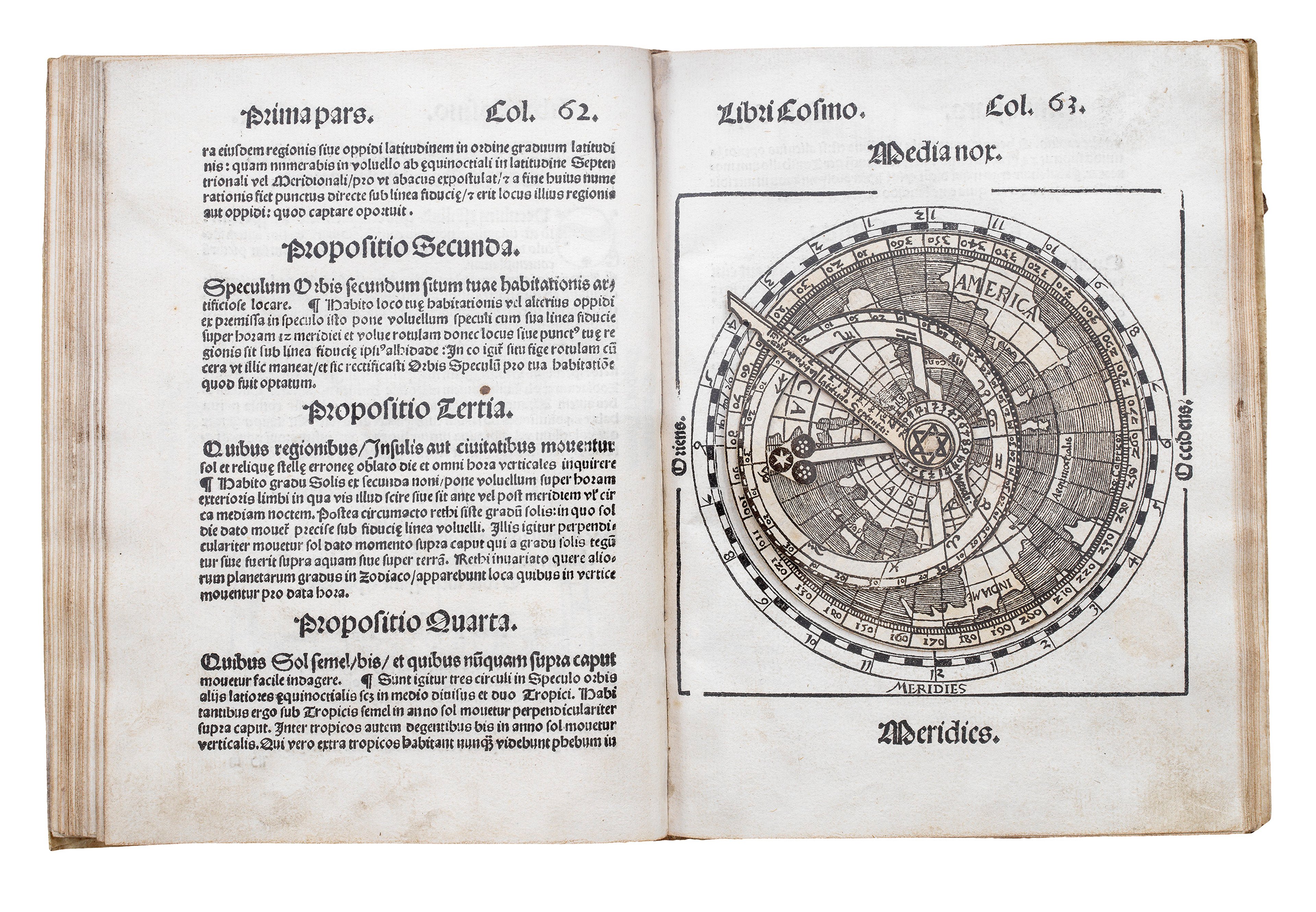
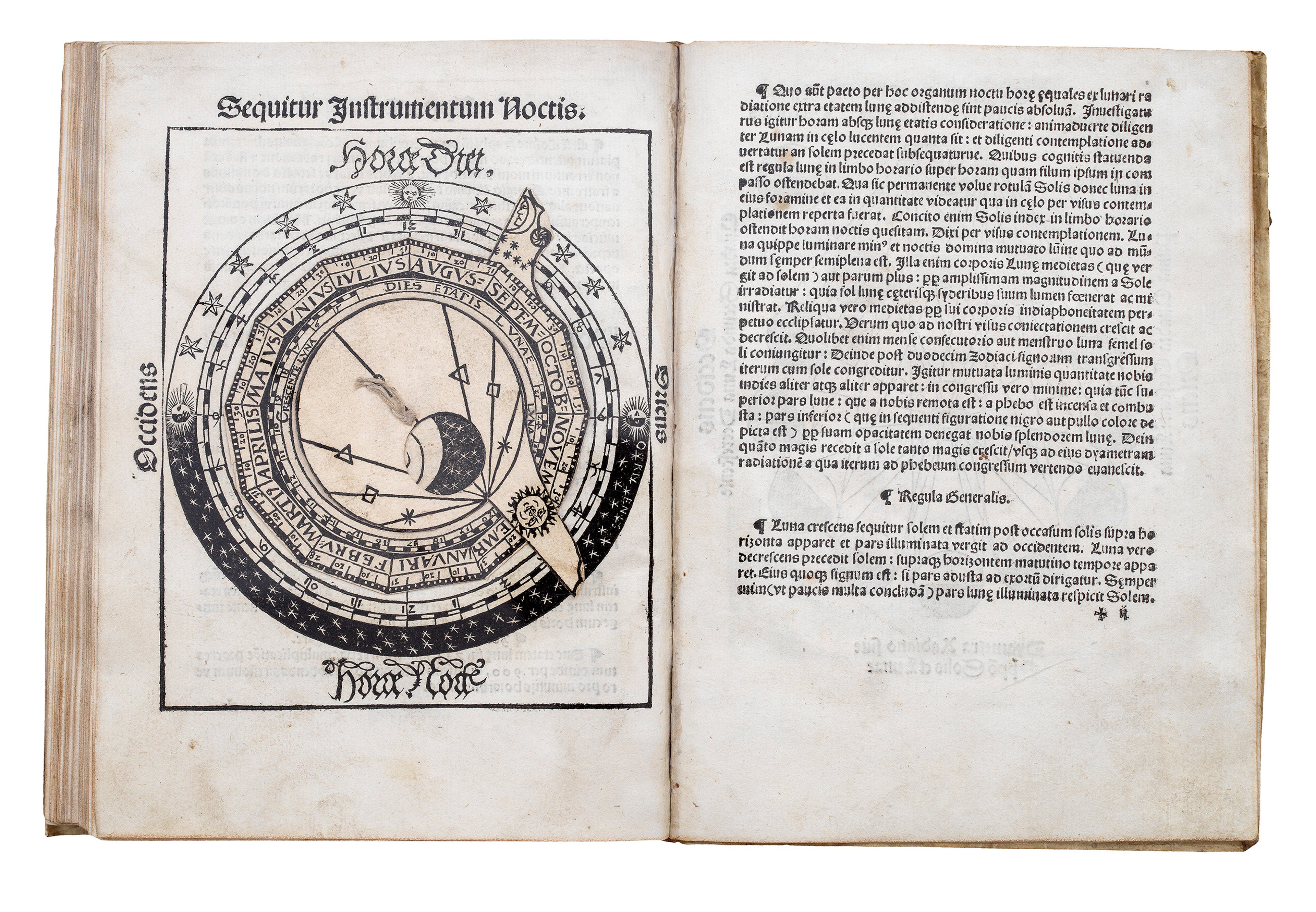
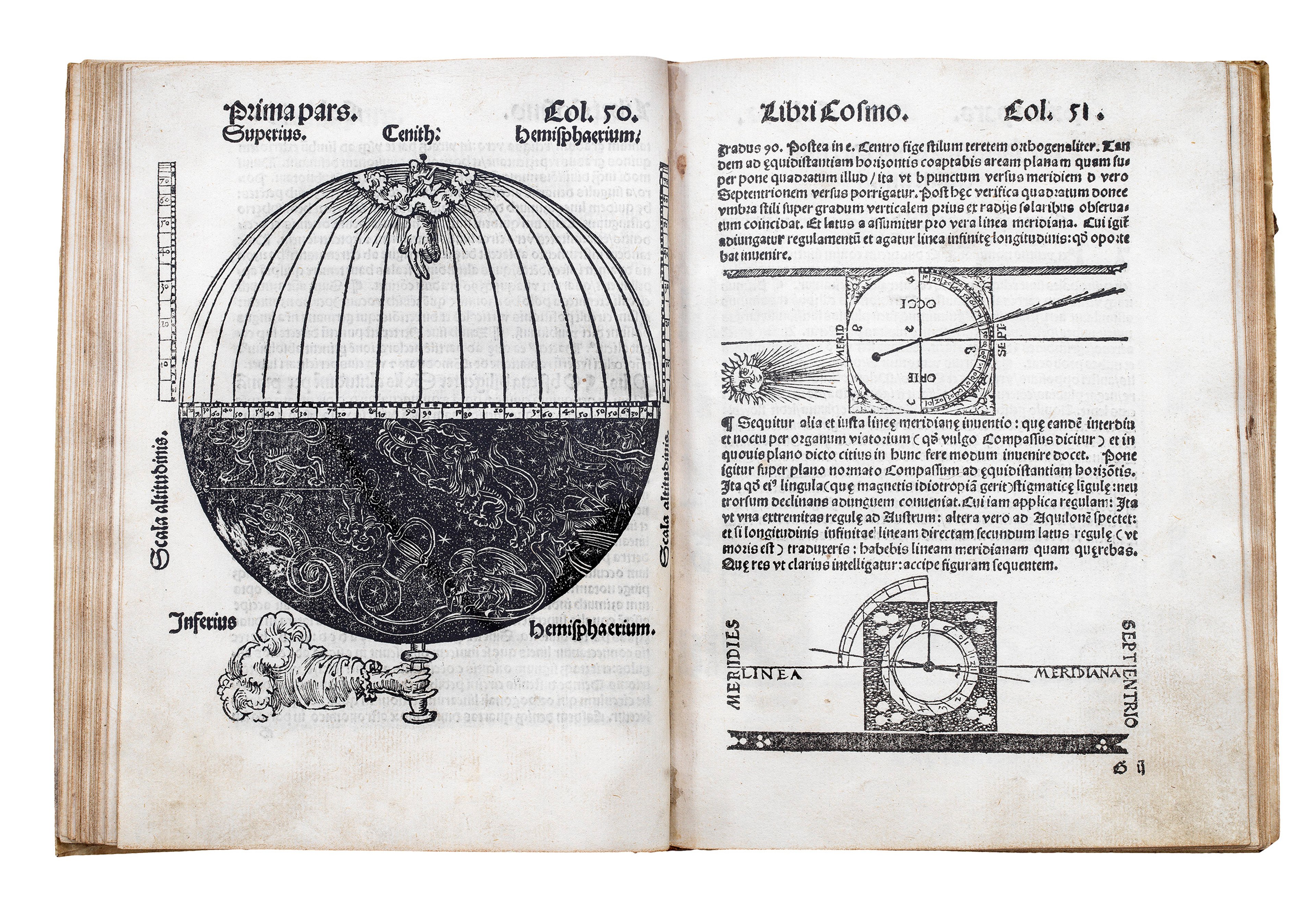
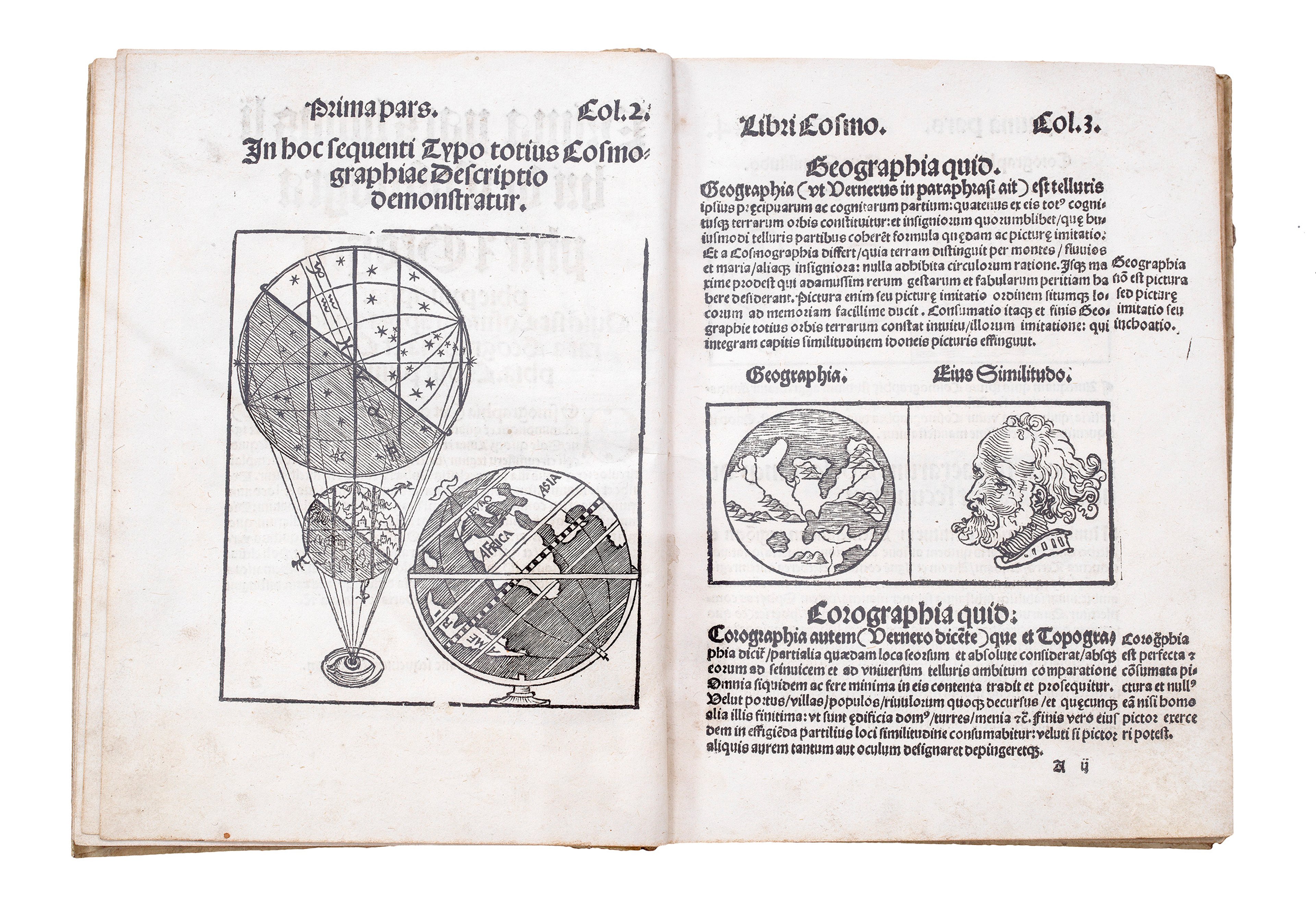
Apianus’s cartographic interests persisted throughout his lifetime: he went on to print the first world map to mention America - Apianus's Cordiform World Map (1520, image below) - as well as his own treatise Liber Cosmographicus (1524, carousel below), a text book that was translated and reproduced repeatedly over the next century.
His son, Philipp Apianus (1531-1589), would carry on this cartographic legacy and create several globes as well as the Baierische Landtaflen (image above right, 1568), a colossal wall map based on his land survey for Duke Albrecht V of Bavaria (1528-1579).
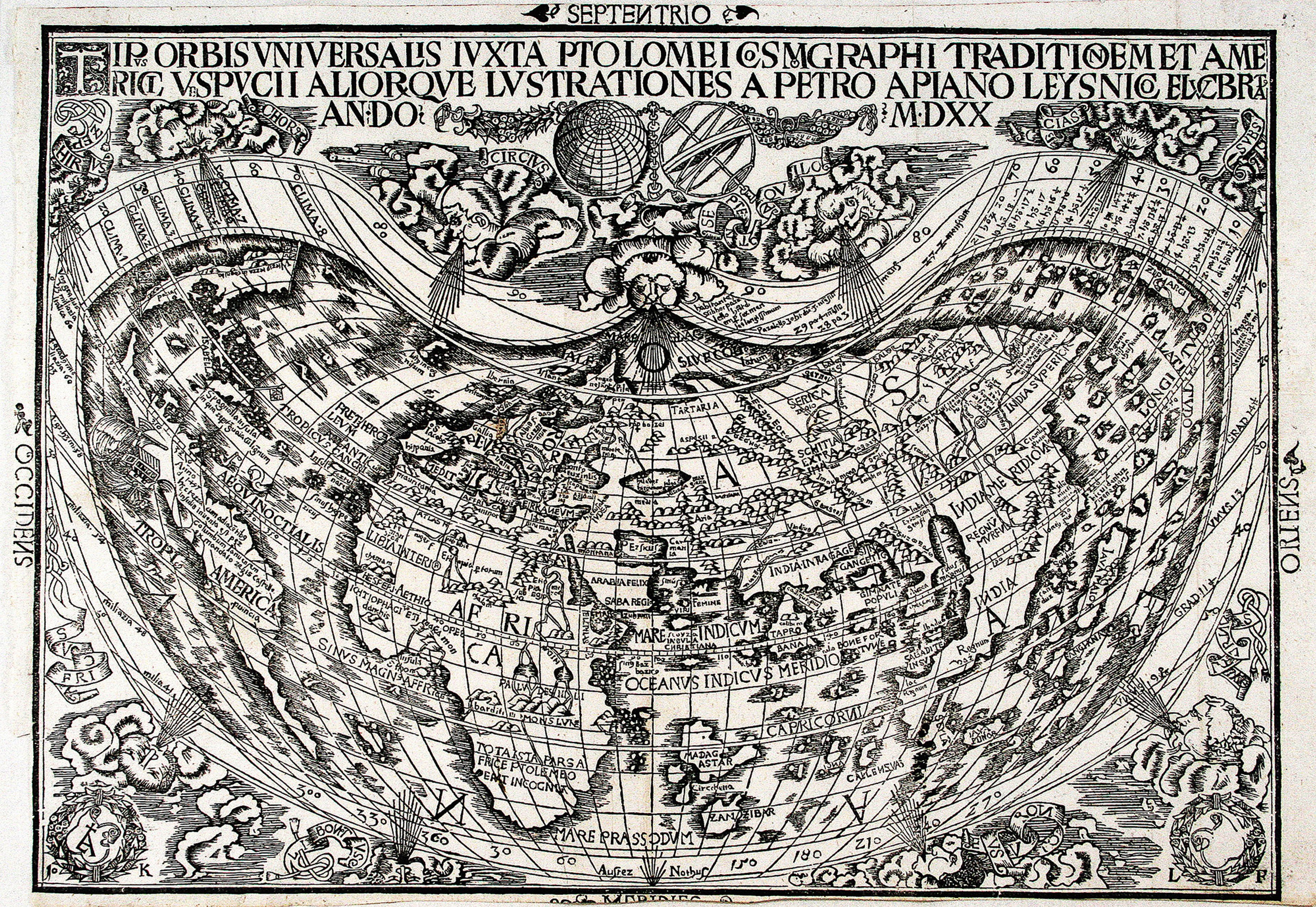
Apianus’s celebrated cordiform world map (1520) ©The Sunderland Collection
What is the Astronomicum Caesareum?
Apianus’s most famous and celebrated work is the Astronomicum Caesareum (1540) - ‘The Emperor’s Astronomy’ – a true masterpiece of printing and a watershed moment in the history of scientific publishing.
This was an incredibly complex printing project that took Apianus and his brothers, who ran the printing workshop with him, eight years to complete. Apianus received dispensation in 1532 from Charles V, the Holy Roman Emperor (1500-1558), to create this massive tome. It is dedicated to Charles V and his brother Ferdinand (1503-1564), and they are referenced throughout.
The position of the moon is calculated using their birthdays as examples and the concept of lunar is illustrated with the example of an eclipse that occurred in 1500, the year when Charles V was born.
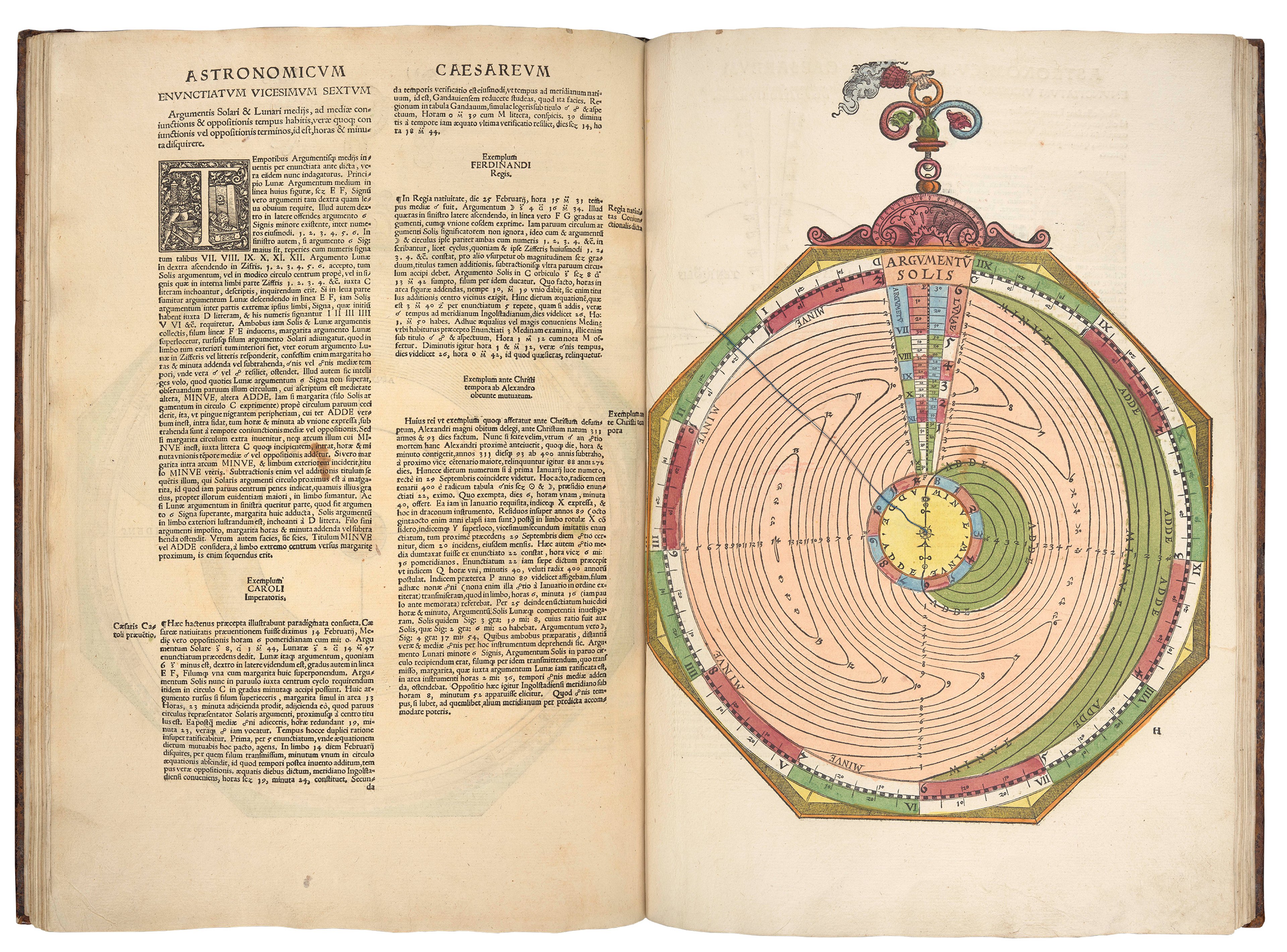
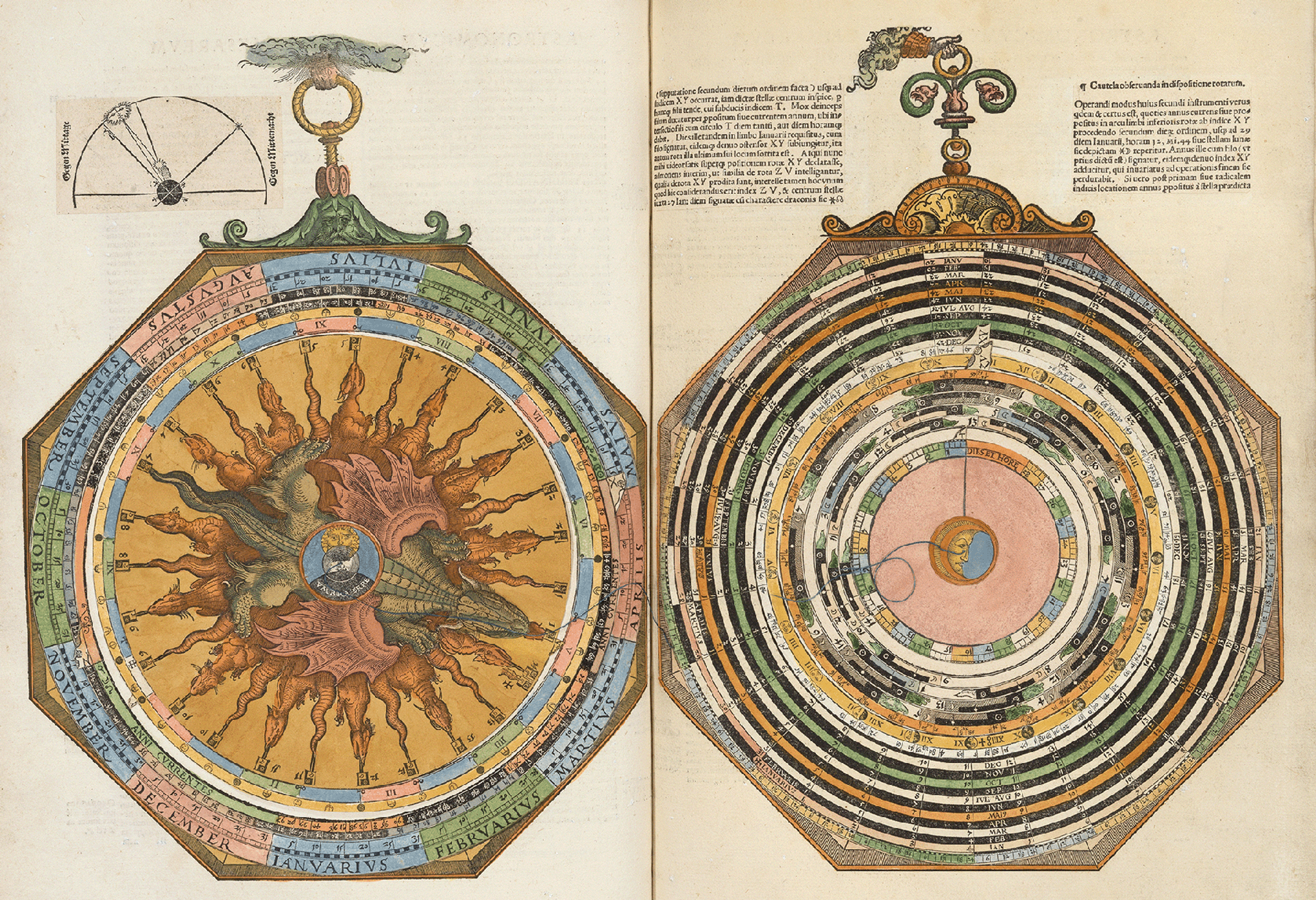
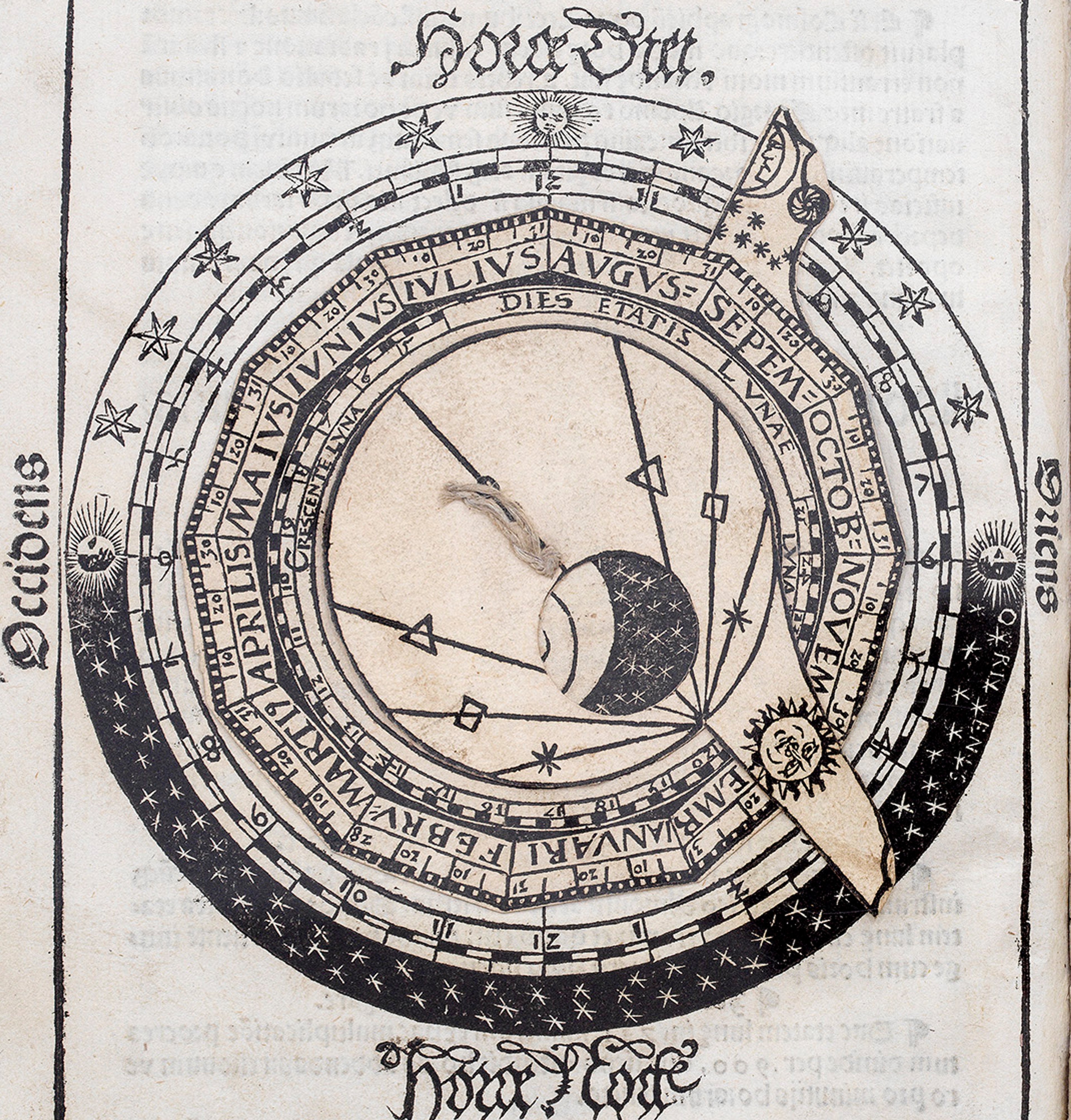
Volvelle to calculate the position of the sun.
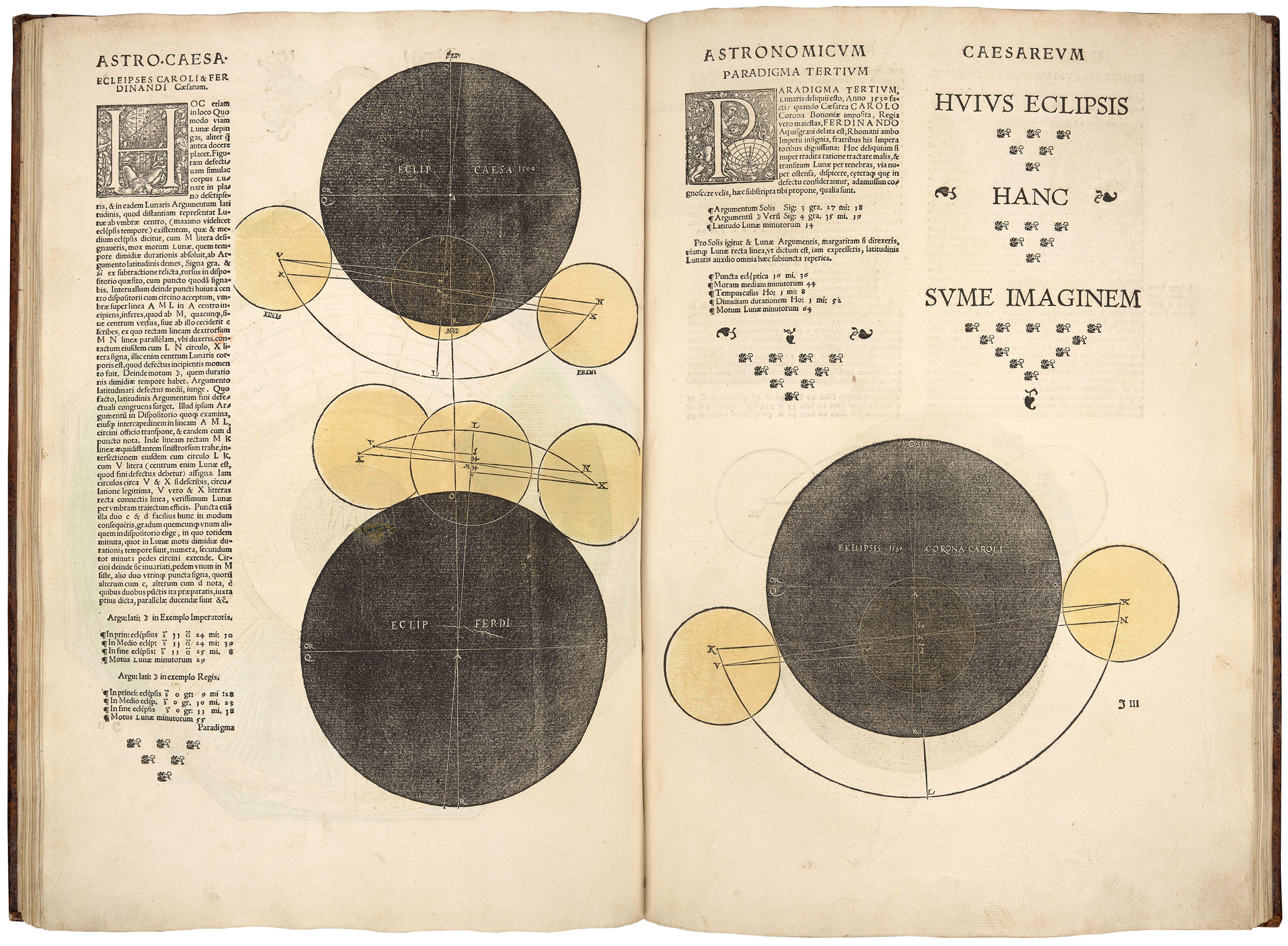
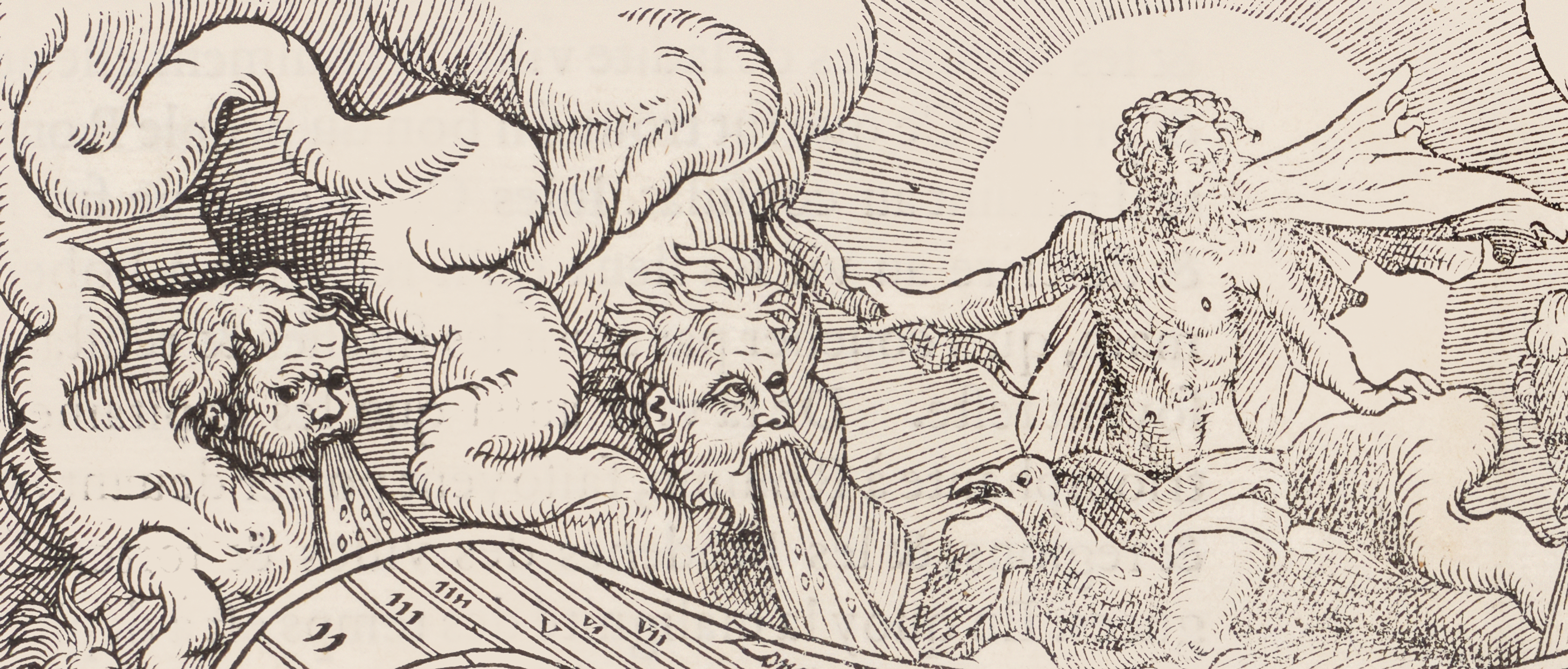
Illustration and explanation of eclipses.
In May 1540, the first presentation copies of the Astronomicum were printed, coloured by the workshop, and sent to the Apian brothers’ most important benefactors.
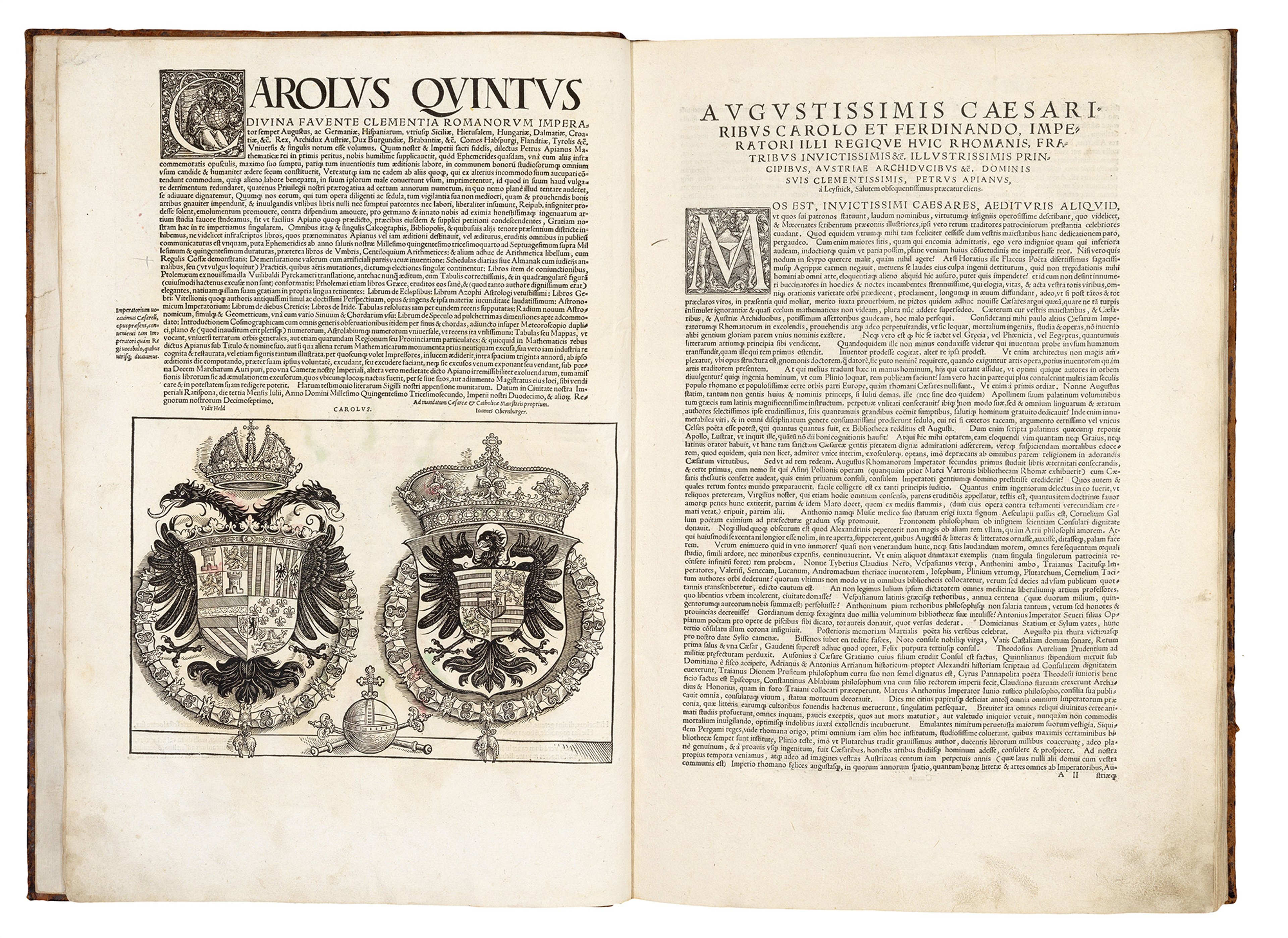
Dedication page with coat of arms of Charles V (Holy Roman Emperor) and his brother Ferdinand I (King of the Romans)
This flattery must have worked, because in 1541 Charles V ennobled them for their astonishing achievements in creating, computing, writing and finally printing this extraordinary book. Their new noble status allowed them to use an updated coat of arms - which features in The Sunderland Collection copy of the book - to appoint poet laureates, and to legitimise any children born out of wedlock.
What information does this treatise contain?
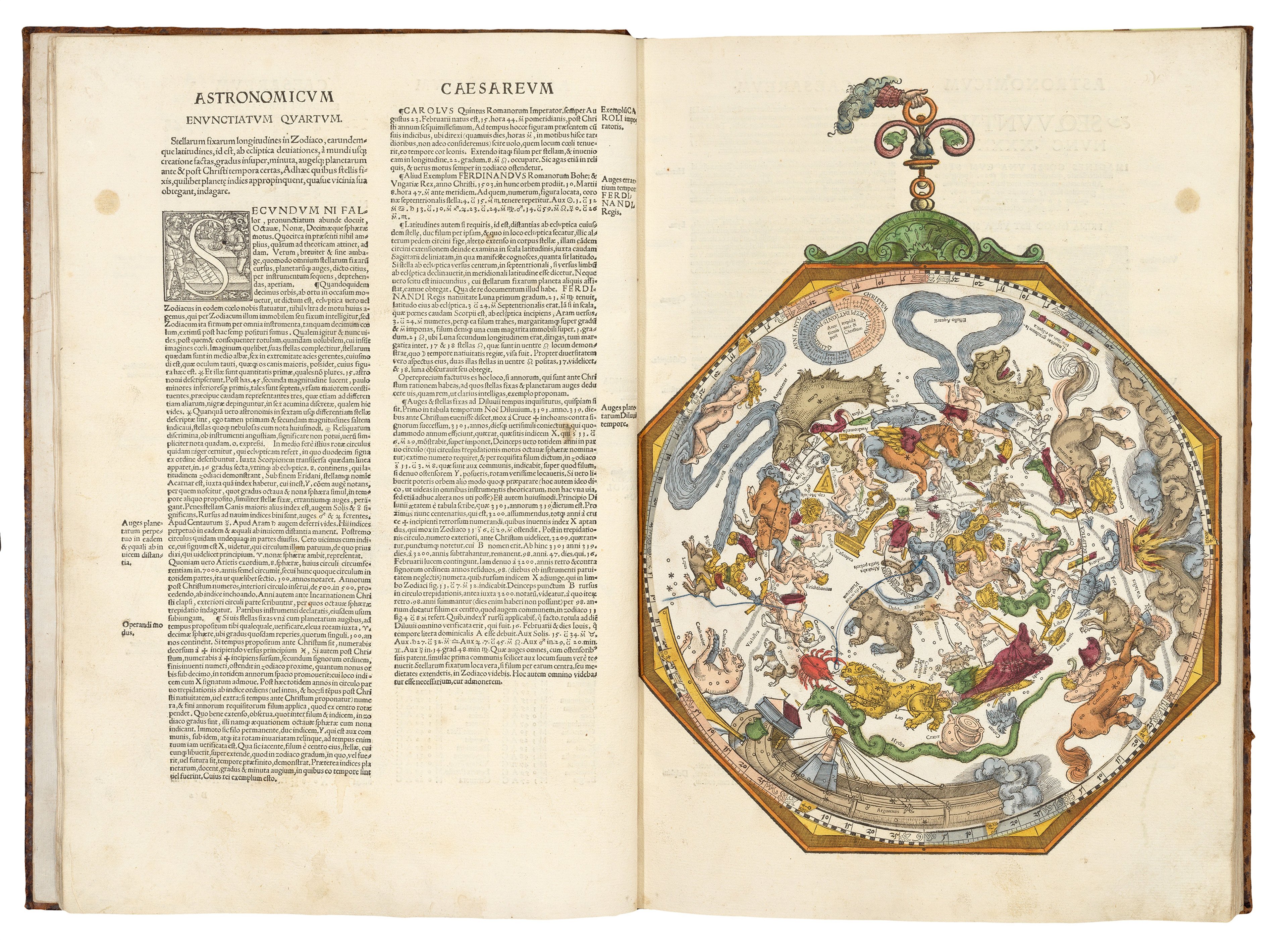
The first part of the Astronomicum presents the Ptolemaic cosmos, with a stationary earth at its centre and the celestial sphere - containing the Moon, Sun, planets, and the firmament with fixed stars - in constant motion around it.
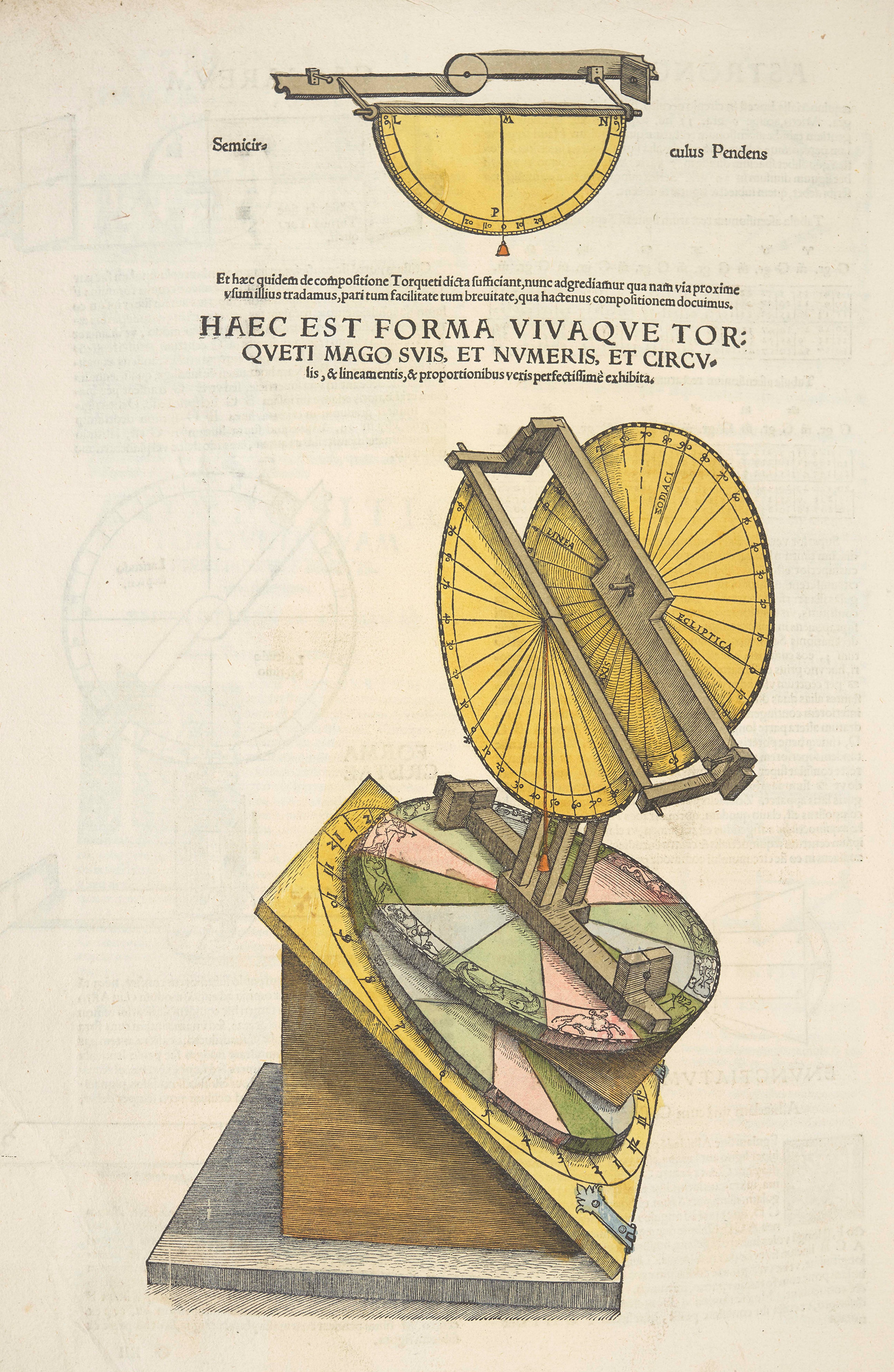
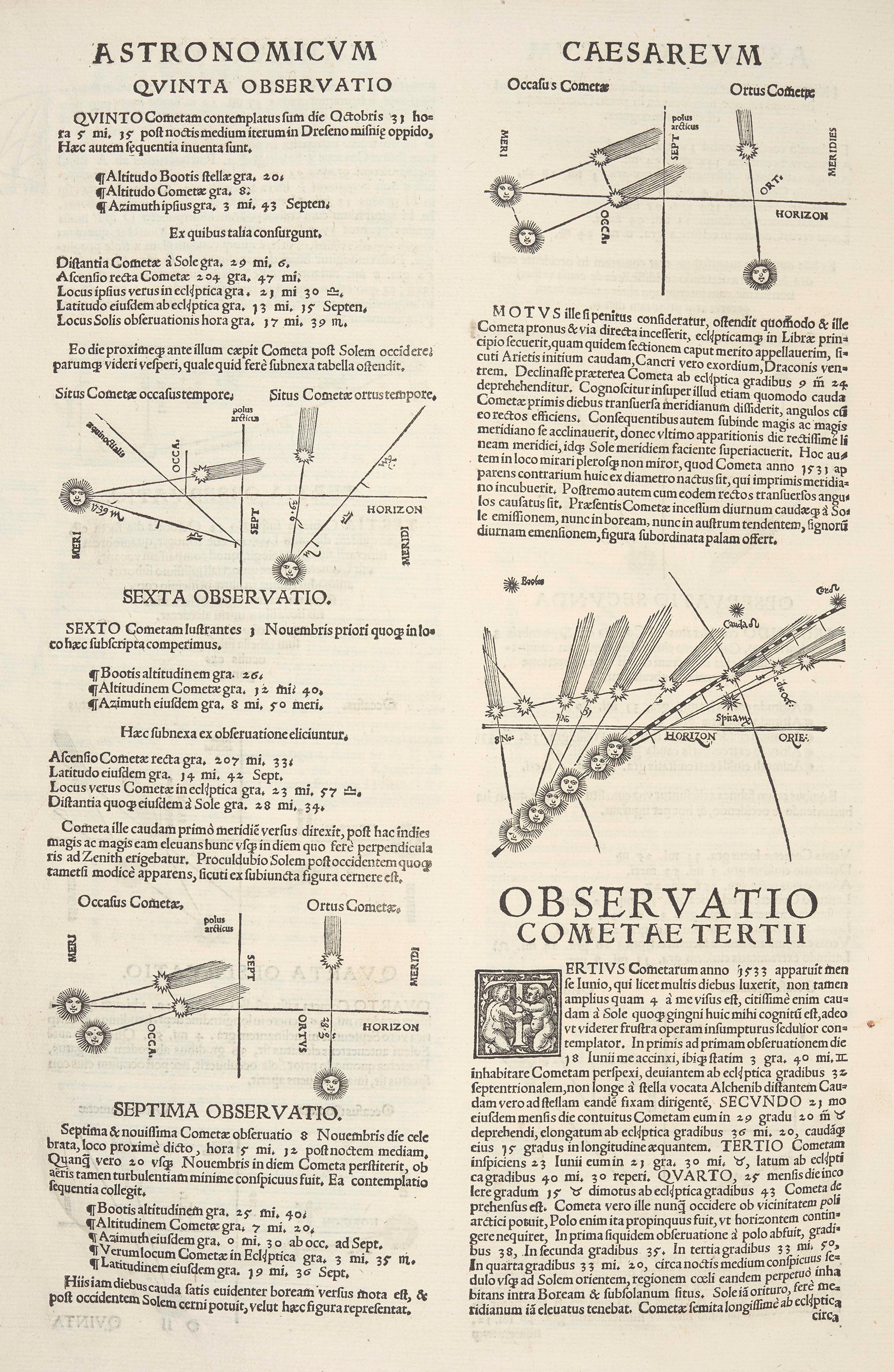
The second part contains a lengthy treatise on comets, along with many observations, and a treatise on the torquetum, a trigonomical tool used for advanced astronomical calculations. It allowed the user to calculate the position of planetary bodies in relation to the horizon, as well as along latitudinal and longitudinal lines - that is, on the equatorial and ecliptic.
What is so special about this book?
The theories on natural philosophy and science at the centre of the Astronomicum were not new or innovative when the book was written. In fact, they reflected how the universe had been understood in Europe with varying degrees of complexity for a millennium.

Animation of the horoscope volvelle.
What was new, however, was how information was presented. This tome contains twenty-one interactive wheel diagrams, known as volvelles, twelve of which use fine silk threads with a seed pearl at the end, to allow for more accurate readings of each diagram. Volvelles were not invented by Apianus, but the complexity of these tools in his book sets them apart from other examples.
The copy held by The Sunderland Collection has all of its volvelles intact, along with their original silk threads and pearls.

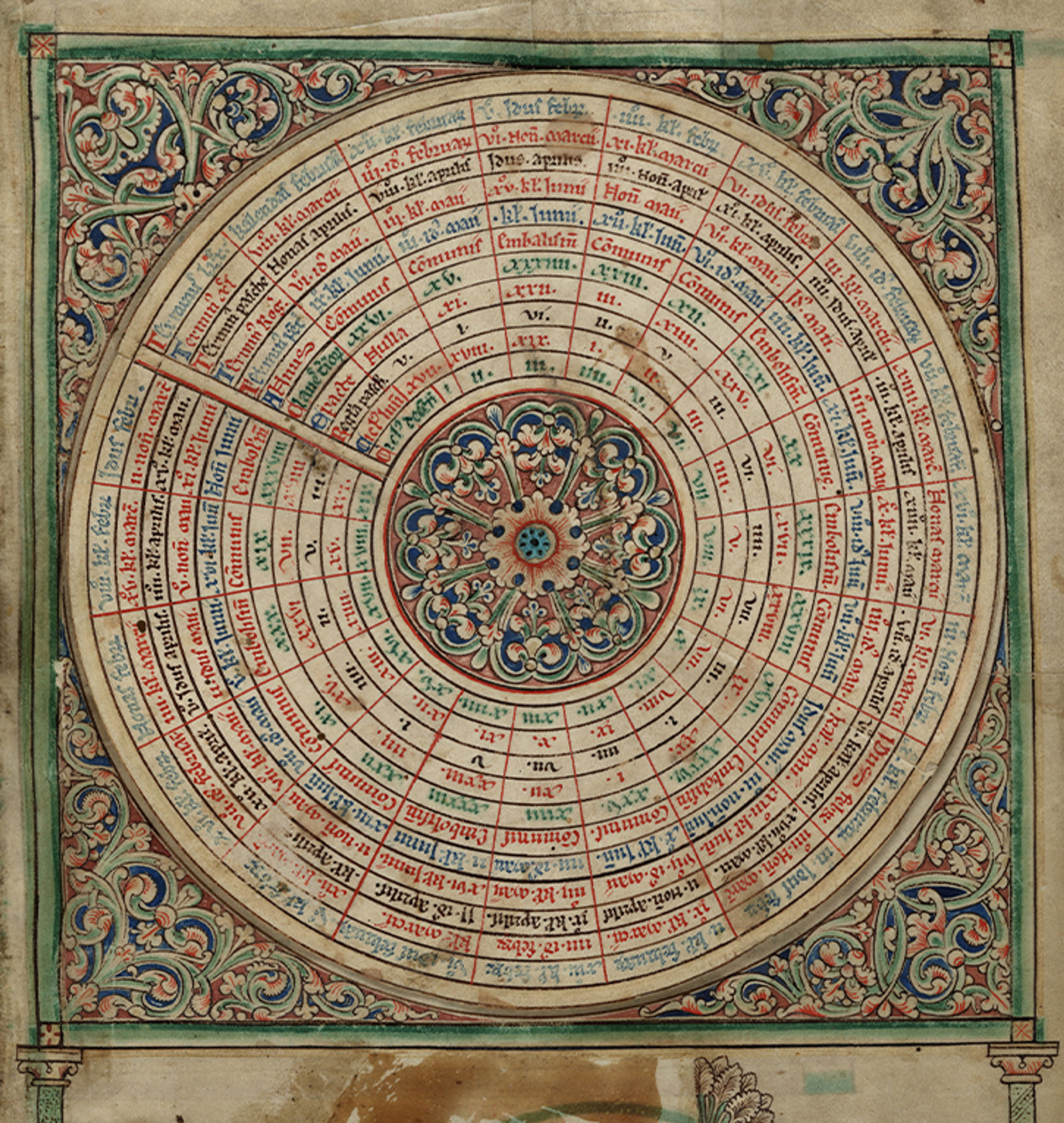
The volvelle from Matthew Paris’s ‘Chronica Maiora’. Image courtesy of The Parker Library, Corpus Christi College, Cambridge. [MS 026 f. vr]
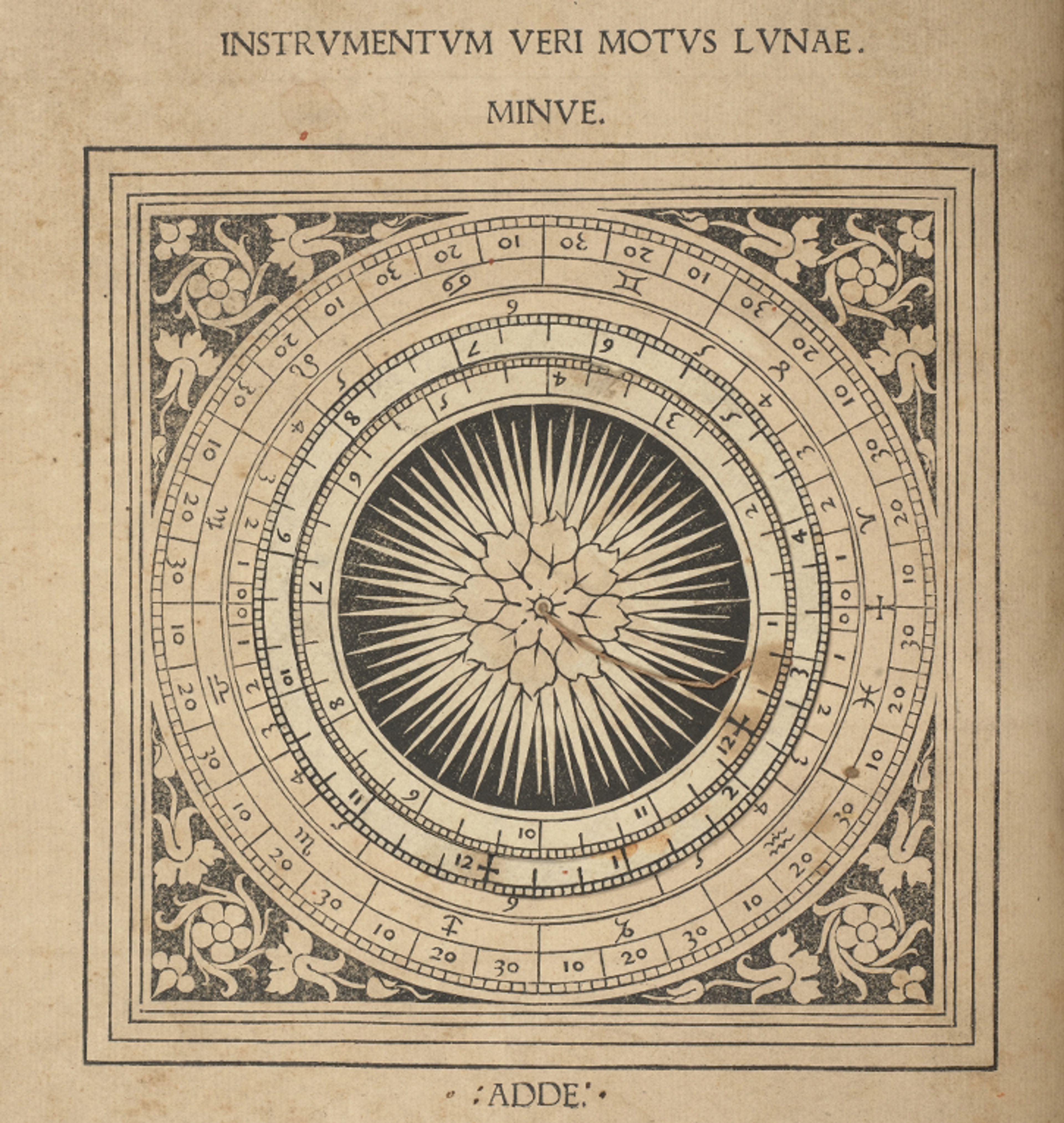
Volvelle to show the movement of the moon from Regiomontanus’s Calendarium (1476). Image courtesy of the John Rylands Library [JRL 18025.1, fol. 19v.]
The earliest surviving example of a volvelle had been created about three hundred years prior and was used to calculate the date of Easter. It was the work of Dominican Monk Matthew Paris (c1200-1259) at St. Albans Abbey in 1240. It is likely that earlier volvelles existed, both in Latin and in Arabic texts, but were lost or destroyed due to their fragility.
The first known printed volvelles are found in the works of the astronomer and mathematician Johannes Regiomontanus (1436-1476) in the second half of the fifteenth century.
In sixteenth-century Europe it was common for movable or interactive parts in books to be printed on single leaves, and then cut out and mounted by the first owner. Similarly, printed books would leave the publisher’s workshop uncoloured, to be embellished with pigments later by those owners wanting to enhance the pages. All copies of the Astronomicum, on the other hand, were coloured and assembled in the Apianus’s workshop.
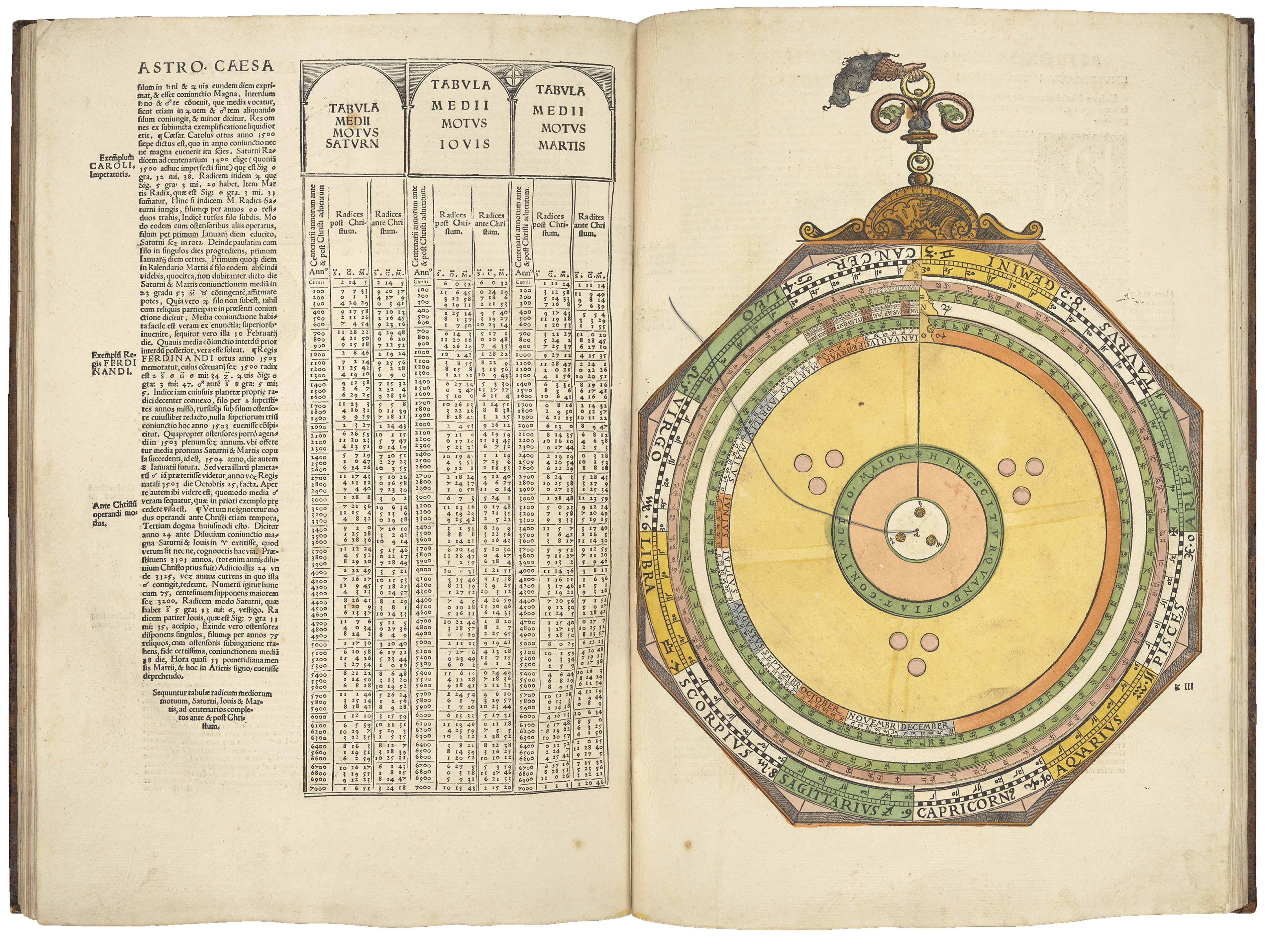
Volvelle for calculating planetary conjunctions
The volvelles in the Astronomicum are a type of analogue computer that help the reader make planetary computations according to Ptolemaic world view, allowing the reader to calculate the positions of planetary bodies on particular days and times. The same information has previously been found in complex tables; Apianus’s volvelles allowed some of these calculations to be automated, while remaining relatively exact.

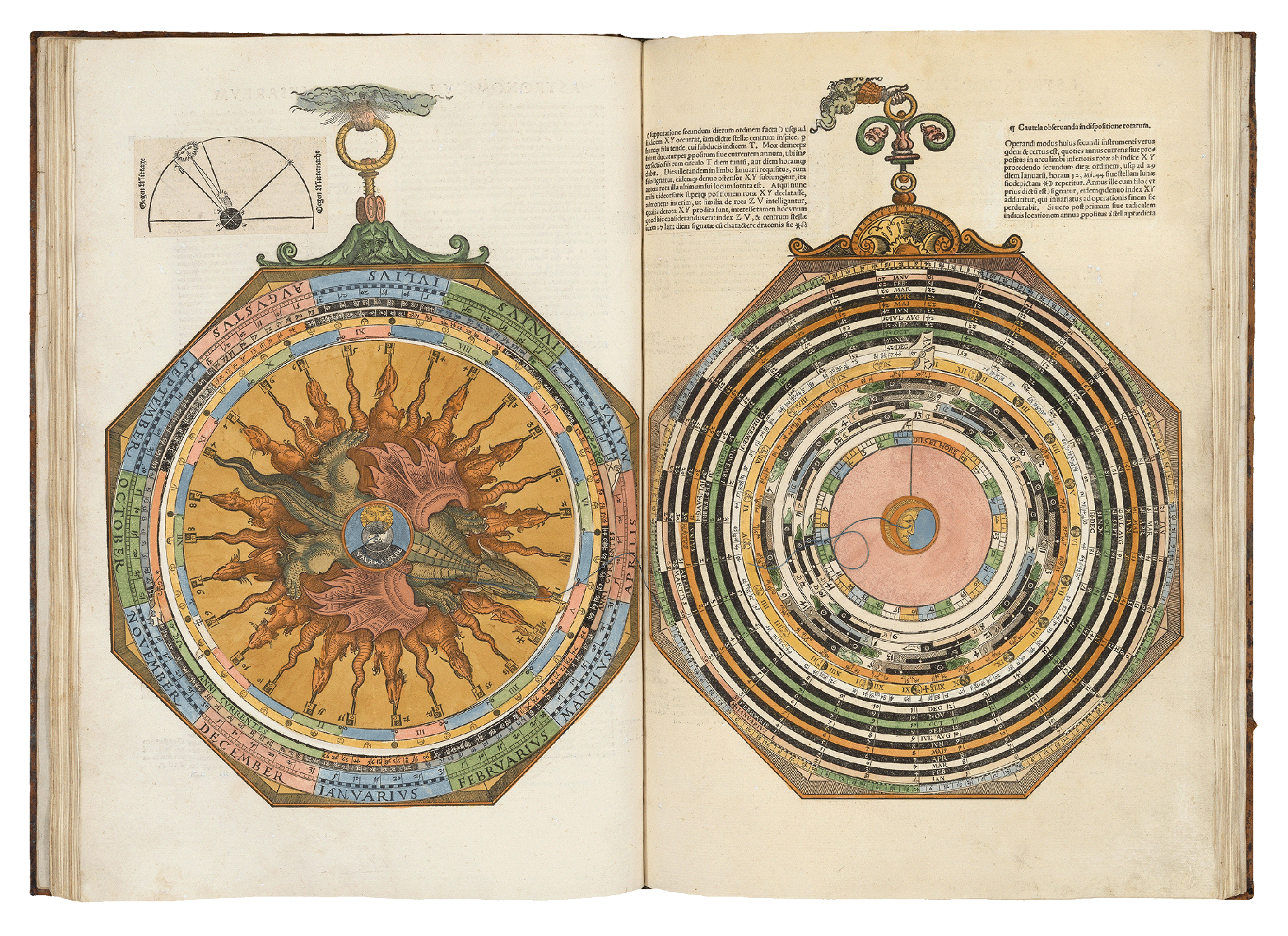
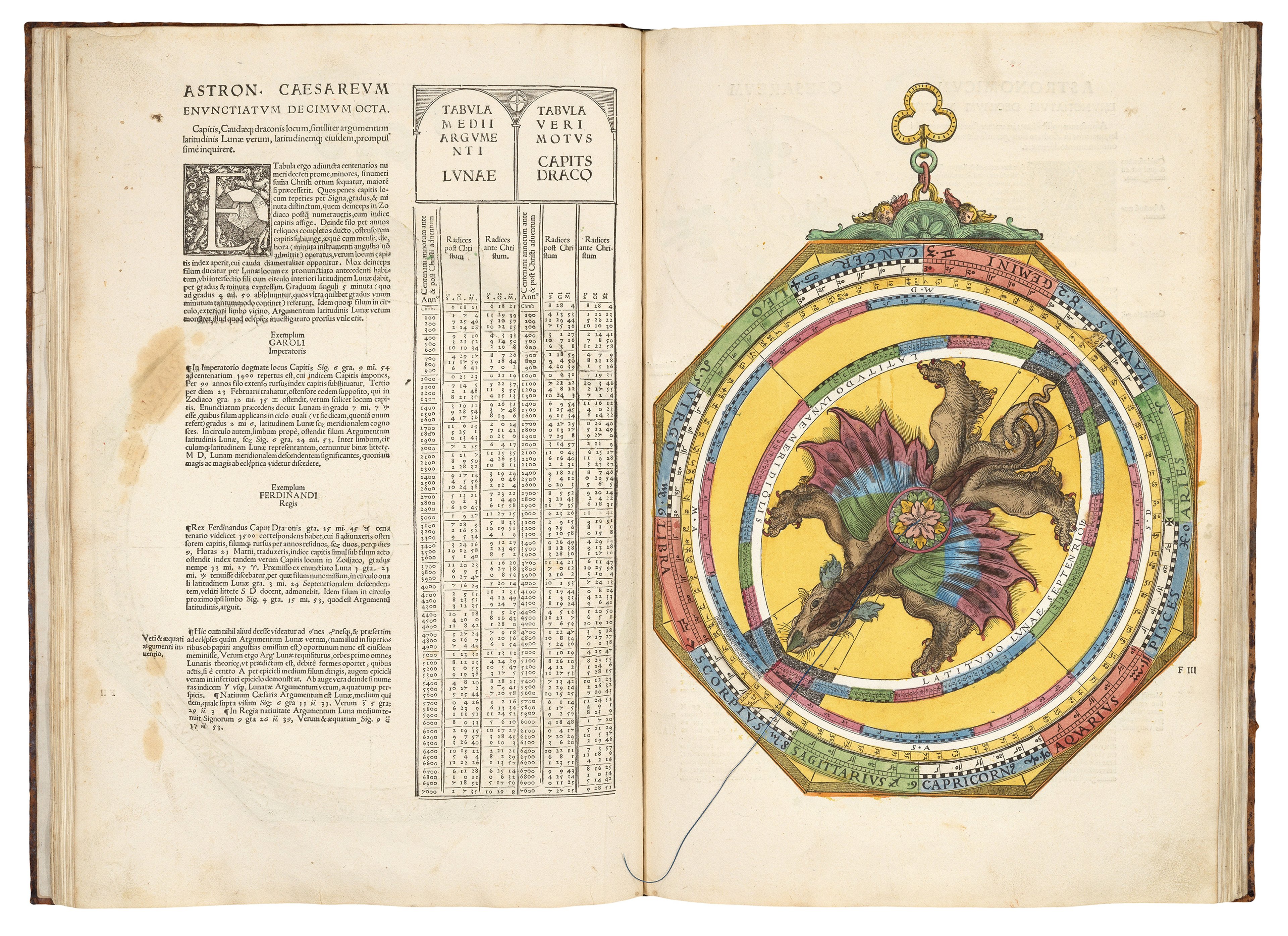
The Dragon volvelle
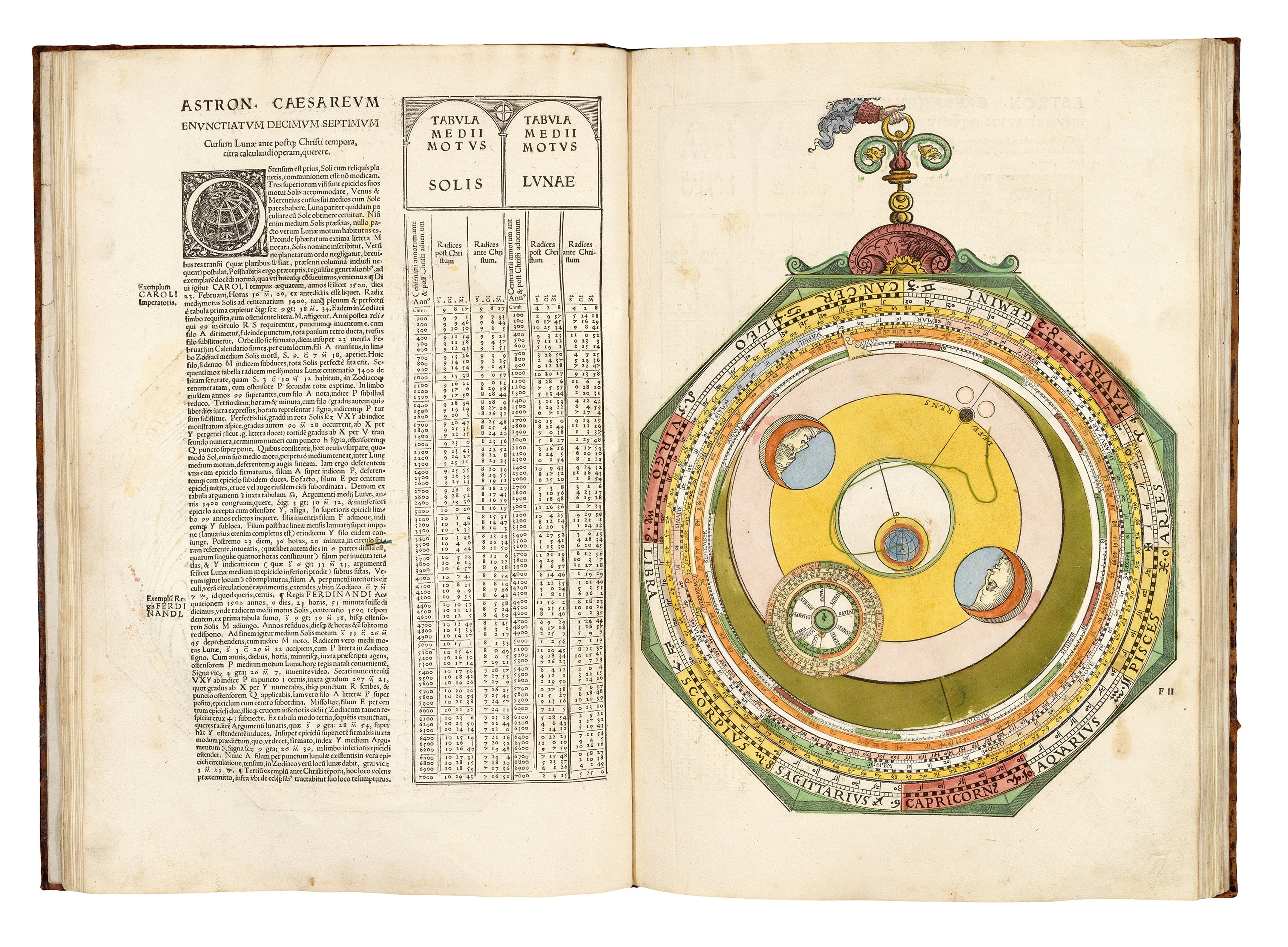
One of the most eye-catching of these early modern computers is the Dragon Volvelle, which is used to find the position of the Moon at a precise date and time, thus could be used to predict when eclipses would occur.
The Sun’s path around the central stationary Earth was known as the ecliptic; when the Sun intersected with a full Moon, it would cause an eclipse.
The position of the Moon in relation to the planets and the zodiac signs was very important in Early Modern astrology for other reasons as well, as it could affect predictions about the weather, the outcome of battles, or allow one to calculate auspicious times to set out on a journey or perform medical treatments.
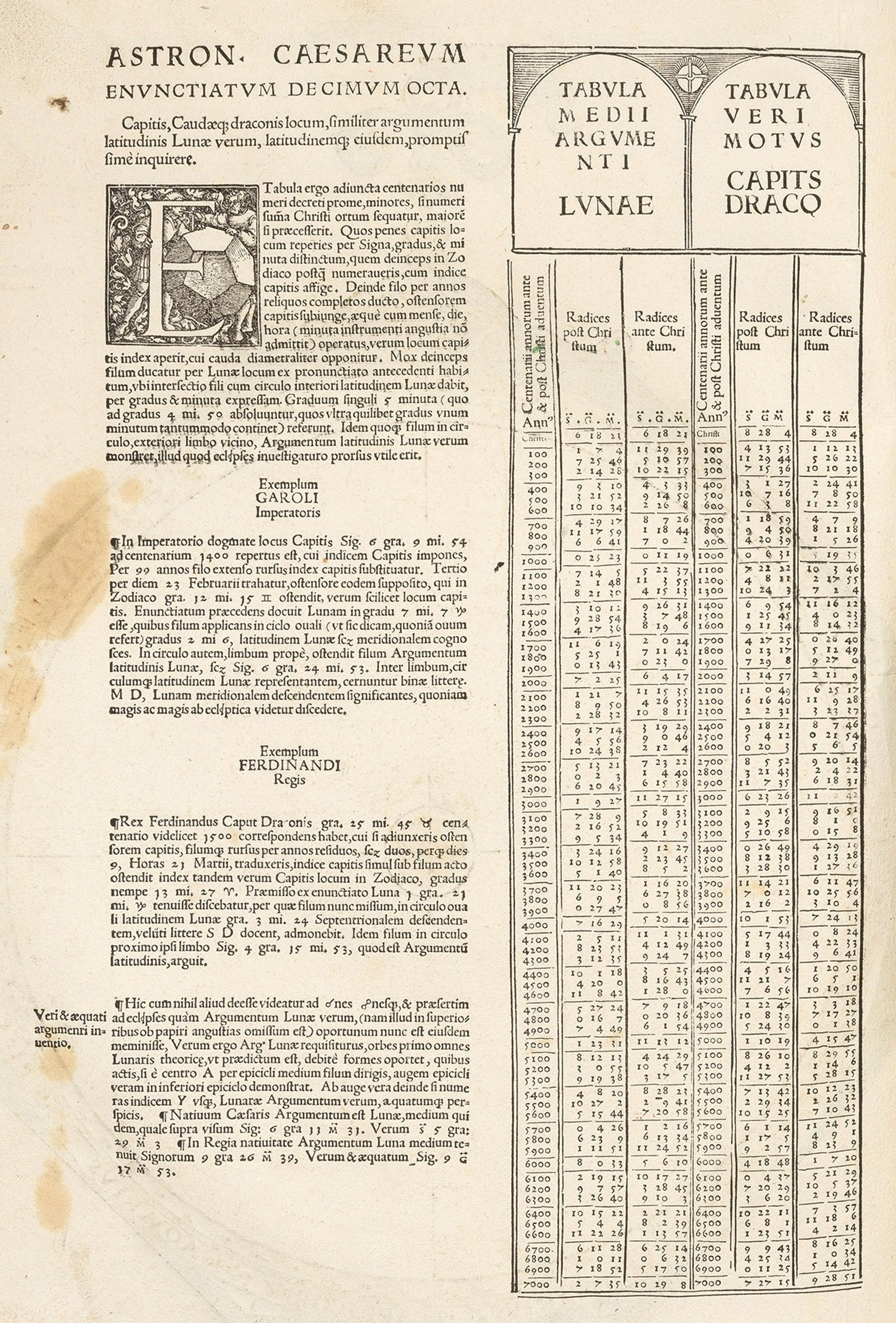
The first column uses the birth dates of Charles V and Ferdinand I as examples. The table in the second column lists the lunar nodes at the beginning of each century, that is which zodiac sign, degree and minute we can find the head of the dragon at that point.
By turning the dial on the volvelle on the facing page according to the degree and minute - listed in the table - and then by using the silk thread to read and turn the dial a final time so that it corresponds to the precise day of the year, it is possible to discern the node positions, that is the head and the tail of the dragon. This information could then be used to carry out even more complex astronomical calculations.
The vastly complex and intricate publication that the Astronomicum is a fascinating window in to the early understandings and visualisation of the universe. It is also important to remember that this was a luxury object, that should be understood in the context of a princely Wunderkammer, or ‘Cabinet of Curiosities’. Approximately 130 copies of this extraordinary book were printed, hand-cut and coloured in Apianus’s own workshop, and then distributed amongst the royal courts of Europe.
Renaissance nobles engaged in scientific pursuits at the highest level and were keen to display their knowledge and mastery of the world through curated displays of the wonders of the universe. The Astronomicum not only made the universe comprehensible and readable; the publication remains, to this day, breathtakingly beautiful.
Conclusion
The Astronomicum was printed only three years before Nicolaus Copernicus (1473-1543) published his important treatise On the Revolutions of the Heavenly Spheres (De Revolutionibus Orbium Coelestium, 1543). This iconic work placed the Sun, rather than the Earth, at the centre of the Solar system. This radically altered the understanding of how the cosmos functions, and the mathematics of astronomy.
Nonetheless, the Astronomicum did not become outdated immediately. Apianus almost certainly knew of Copernicus’s heliocentric theories at the time, but it would take many years for them to be broadly accepted. By the seventeenth century, however, the scientist and astronomer Johannes Kepler (1571–1630) would lament the effort and ingenuity wasted by Apianus on creating such an impressive printing project that illustrated an outdated and incorrect Ptolemaic universe.
While the acceptance of the heliocentric view of the universe would make the foundations of the Astronomicum Caesareum obsolete, the landmark publication is nevertheless an important witness to Early Modern computation, astronomical practice in the princely courts across Europe, and the ingenuity of sixteenth-century printing workshops.
Explore The Sunderland Collection’s copy of the Astronomicum Caesareum here.
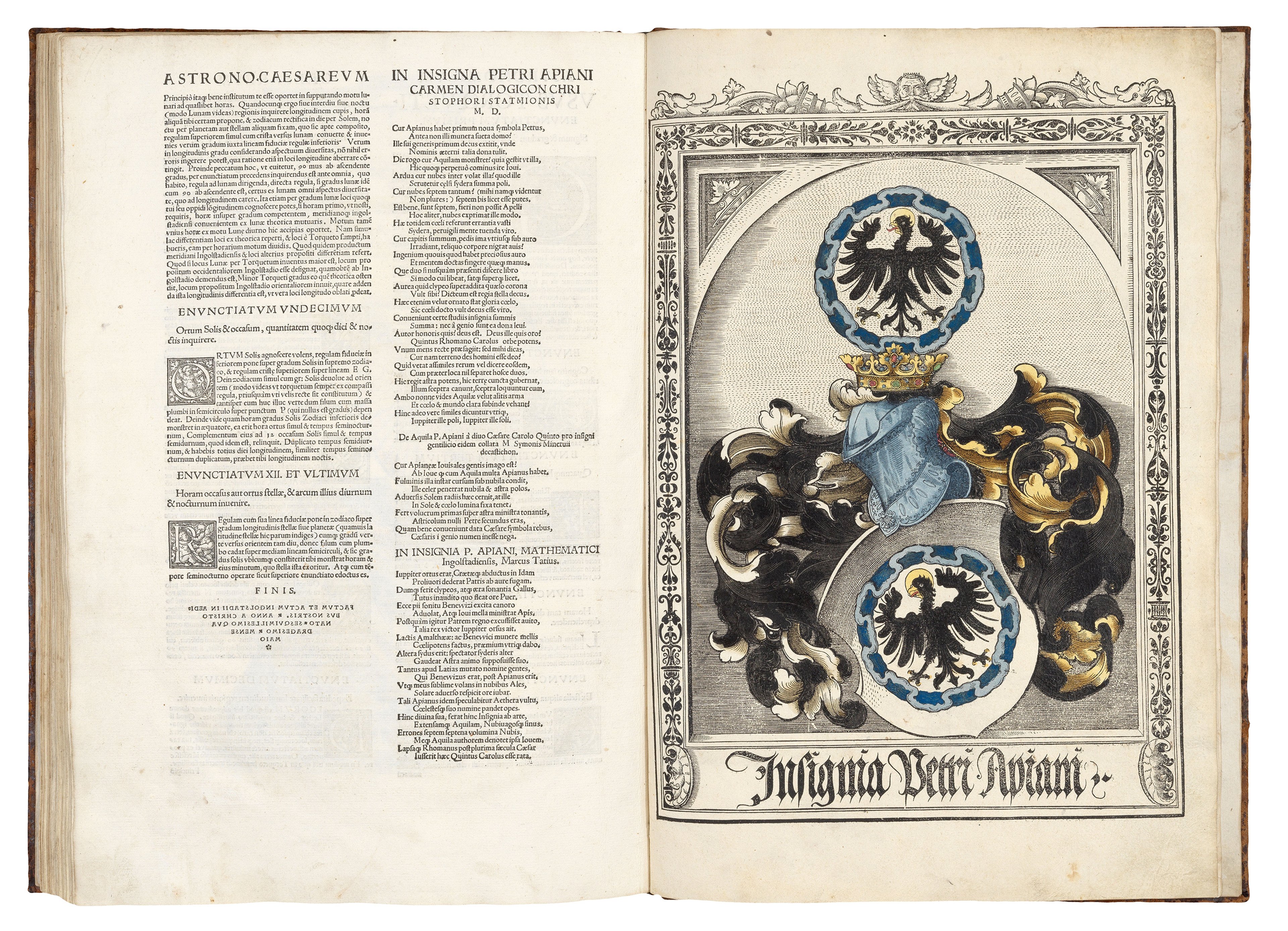
Petrus Aprianus’ coat of arms and insignia in the Astronomicum.
About Dr. Sara Öberg Strådal

©Sara Öberg Strådal
Dr Sara Öberg Strådal is an art historian and an expert in medieval scientific and medical images and diagrams (MPhil and PhD, University of Glasgow).
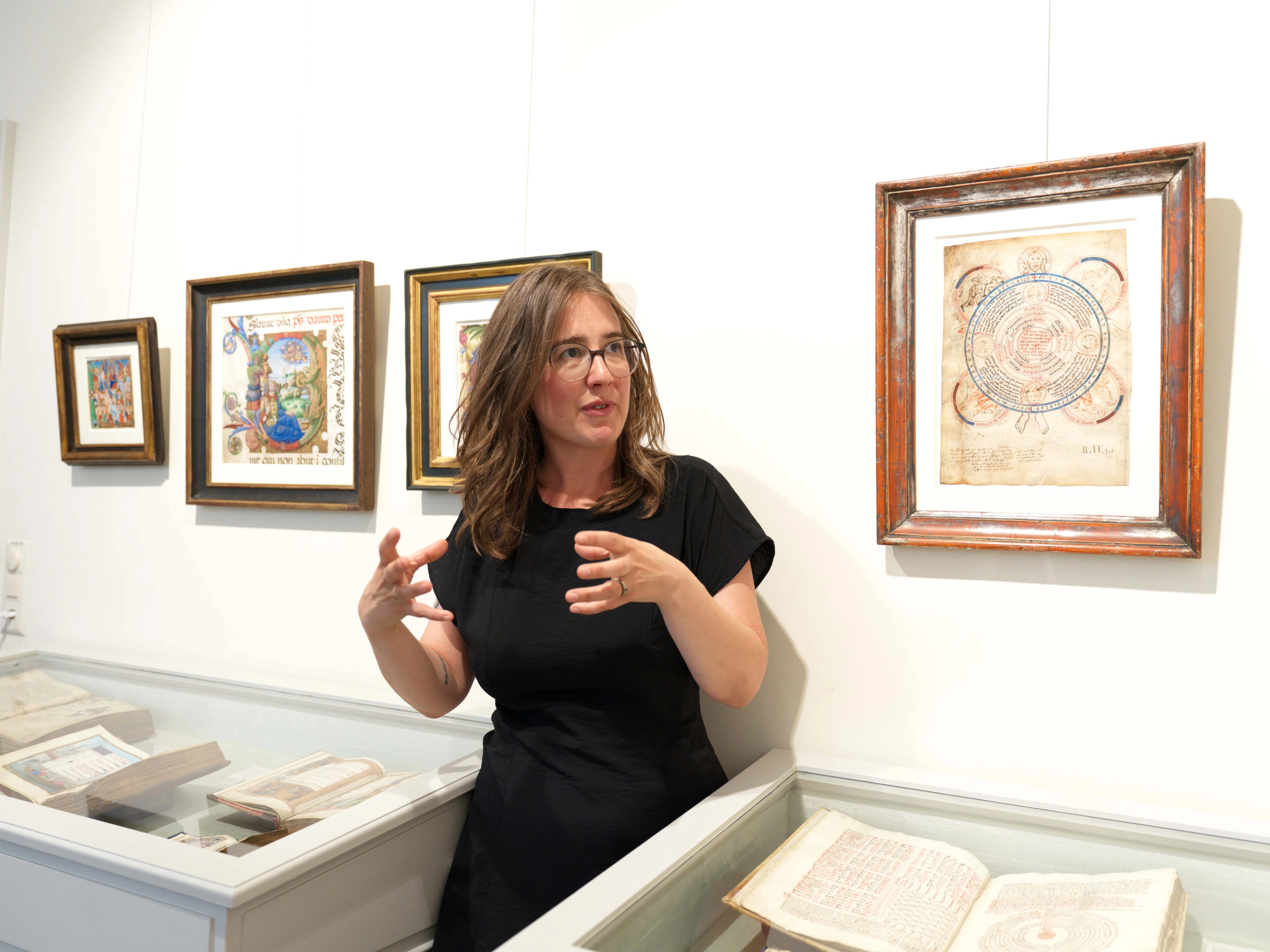
Her previous work at the Fitzwilliam Museum, University of Cambridge and as a Getty/ACLS Research Fellow (2021-2022), focused on volvelles and the circulation of interactive diagrams in manuscripts, print, and other media.
She is the Managing Director at Dr. Jörn Günther Rare Books, a world-leading specialist dealer in Medieval and Renaissance manuscripts and miniatures, based in Basel.
Selected Bibliography
On Peter Apian and Early Printing:
Peter Apian: Astronomie, Kosmographie und Mathematik am Beginn der Neuzeit, ed by Karl Röttel (Polygon: Eichstätt, 1995).
Flavia Fiorillo et al, “The extraordinary universe of Peter Apian: technical investigation of five copies of a 16th-century astronomical book” Heritage science 12 (2024).
Suzanne Karr Schmidt, Interactive and Sculptural Printmaking in the Renaissance (Brill, 2018).
Karl Schottenloher, Die Landshuter Buchdrucker des 16. Jahrhunderts: Mit einem Anhang: Die Apianusdruckerei in Ingolstadt (Brill, 1967).
On Pre-Modern Astrology and Science:
Seb Falk, The Light Ages: the Surprising Story of Medieval Science (Norton, 2020)
John Freely, Before Galileo: The Birth of Modern Science in Medieval Europe (Duckworth Overlook, 2012).
John North, Cosmos: An Illustrated History of Astronomy and Cosmology (University of Chicago Press, 2008).