Ross Perlin
Series 5 Episode 3
To Hear the World in a New York Street with Ross Perlin
Series 5 Episode 3
Available on all major podcast platforms: click the icons or hit 'play' to listen now.
This week, Jerry meets Ross Perlin, a linguist, writer, and translator focused on exploring and supporting linguistic diversity. Ross is the co-director of the Endangered Language Alliance , a non-profit organisation dedicated to documenting Indigenous, minority, and endangered languages, and supporting a mosaic of languages in New York City - Lenapehoking and beyond.
Ross shares an incredible interactive map that illustrates the rich tapestry of languages in New York with a focus on languages at risk of disappearing. We delve into the City's foundational language, Lenape, and trace some of the journeys of native speakers and inspiring revitalisation projects for some the 700 languages that thrive and survive in New York.
As well as learning about some of the challenges of mapping and preserving languages, and the questions around AI and language legacy, we also hear about Ross’ career in linguistics. This includes his language investigations in the Eastern Himalayas and the influence of his mentor, eminent linguist Hongkai Sun.
To view and explore this interactive map while you listen, click here.
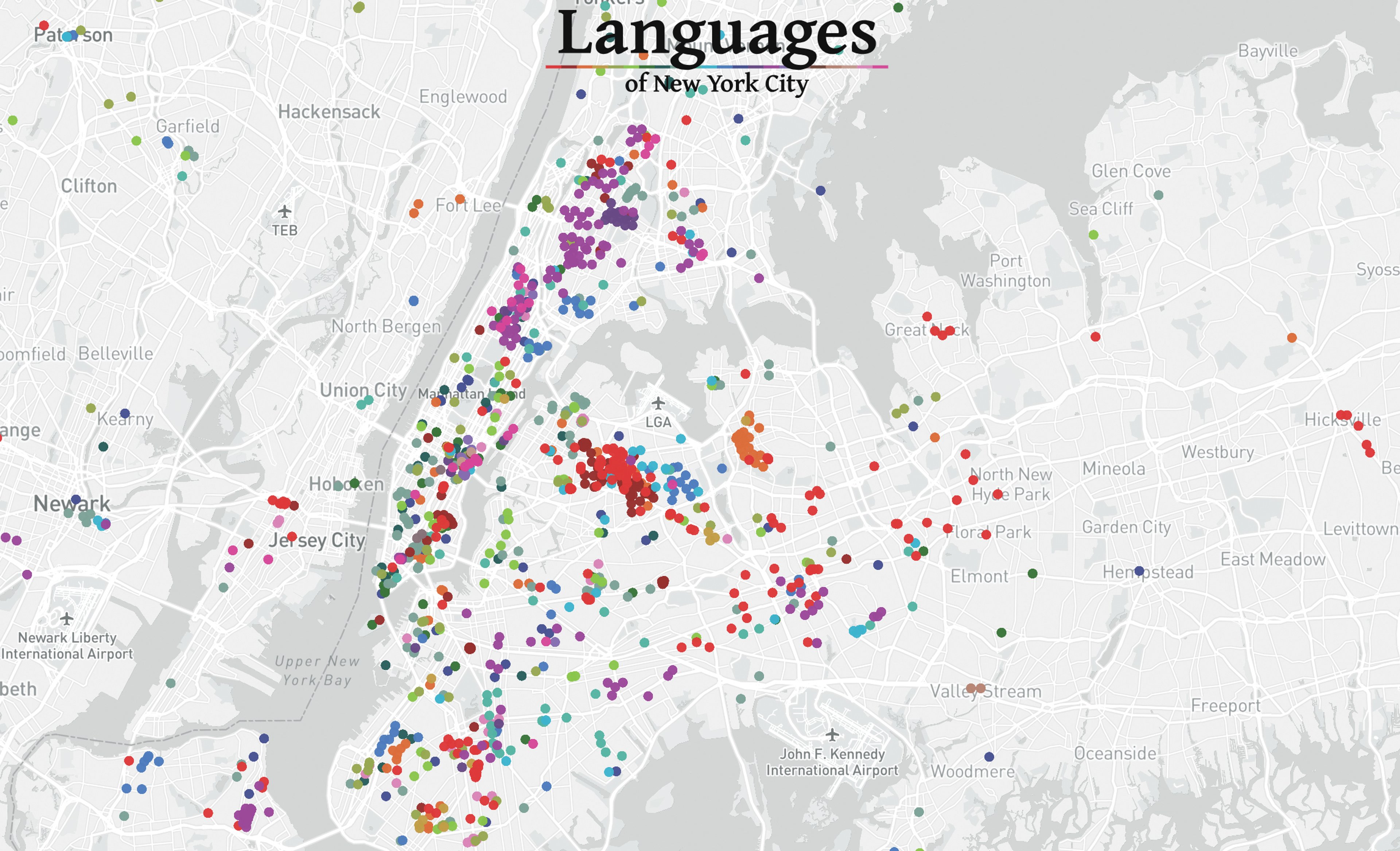
©Ross Perlin, Daniel Kaufman, Jason Lampel, Maya Daurio, Mark Turin, Sienna Craig, eds., Endangered Language Alliance.
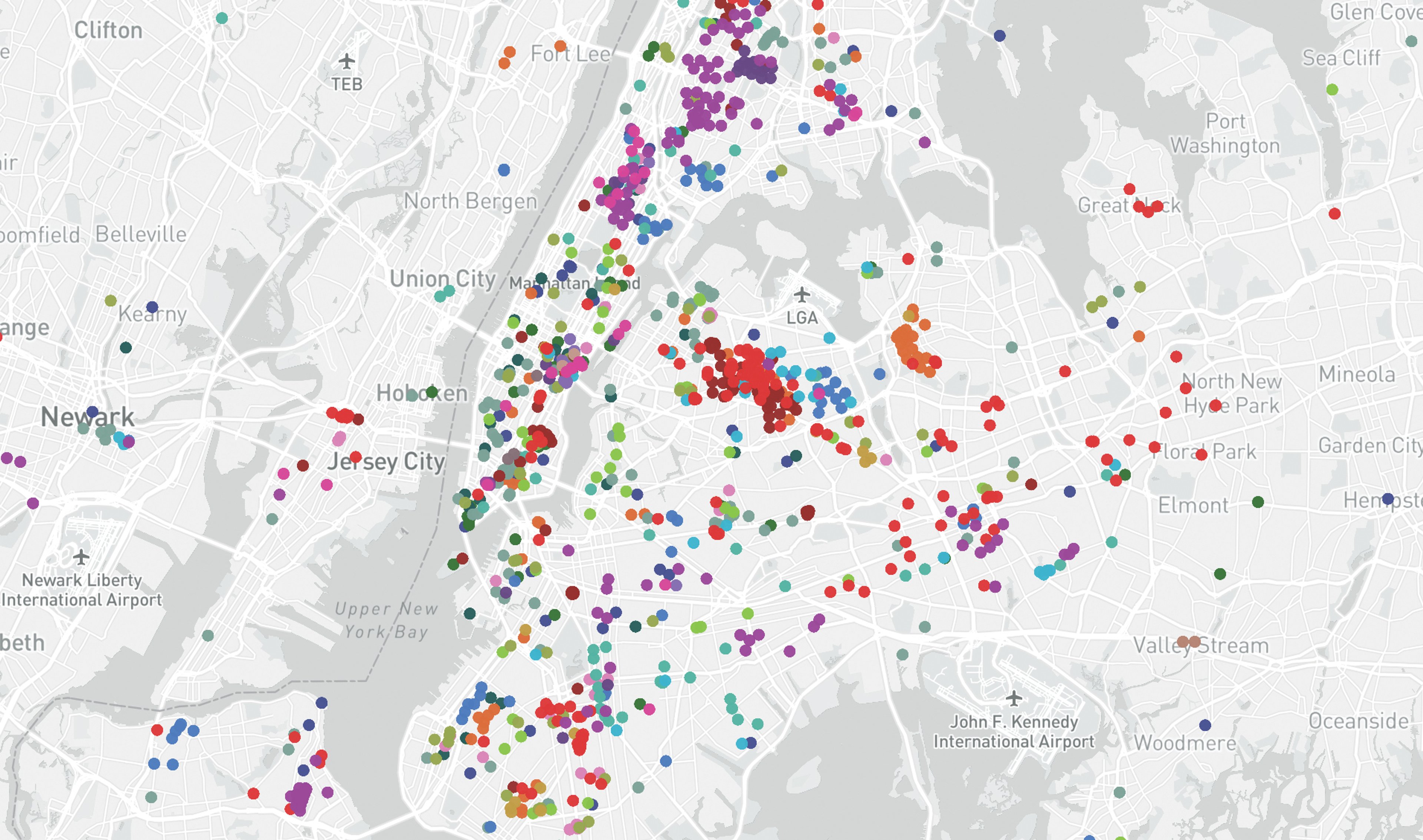
New York City is the most linguistically diverse location in the history of the world. Ross and his colleagues at the Endangered Language Alliance (ELA) have spent 10 years cataloguing and mapping the languages and communities that call the city their home.
This striking thematic map features over 1,200 markers pinpointing over 700 languages, which in turn tell the story of 400 years of migration history. It is a tremendous feat of data collection and visualisation.
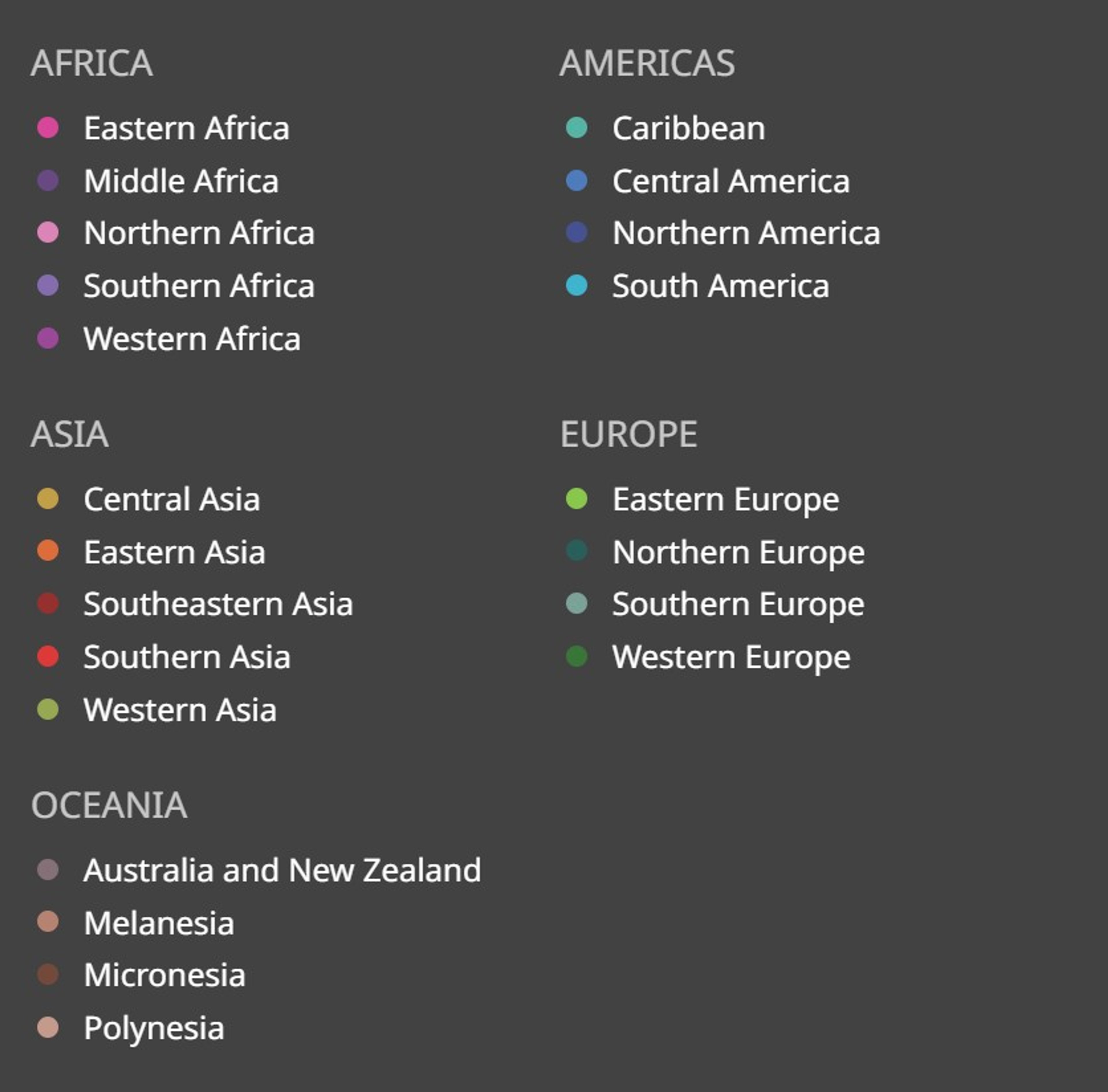
Language Map Legend ©ELA
The focus of the map is endangered languages and each coloured dot represents the regions of the world that the languages come from.
When the map is opened in its browser, viewers can click on the interactive markers to explore the origins of each language, see statistics about speakers, listen to recordings, learn about important community locations, and more.
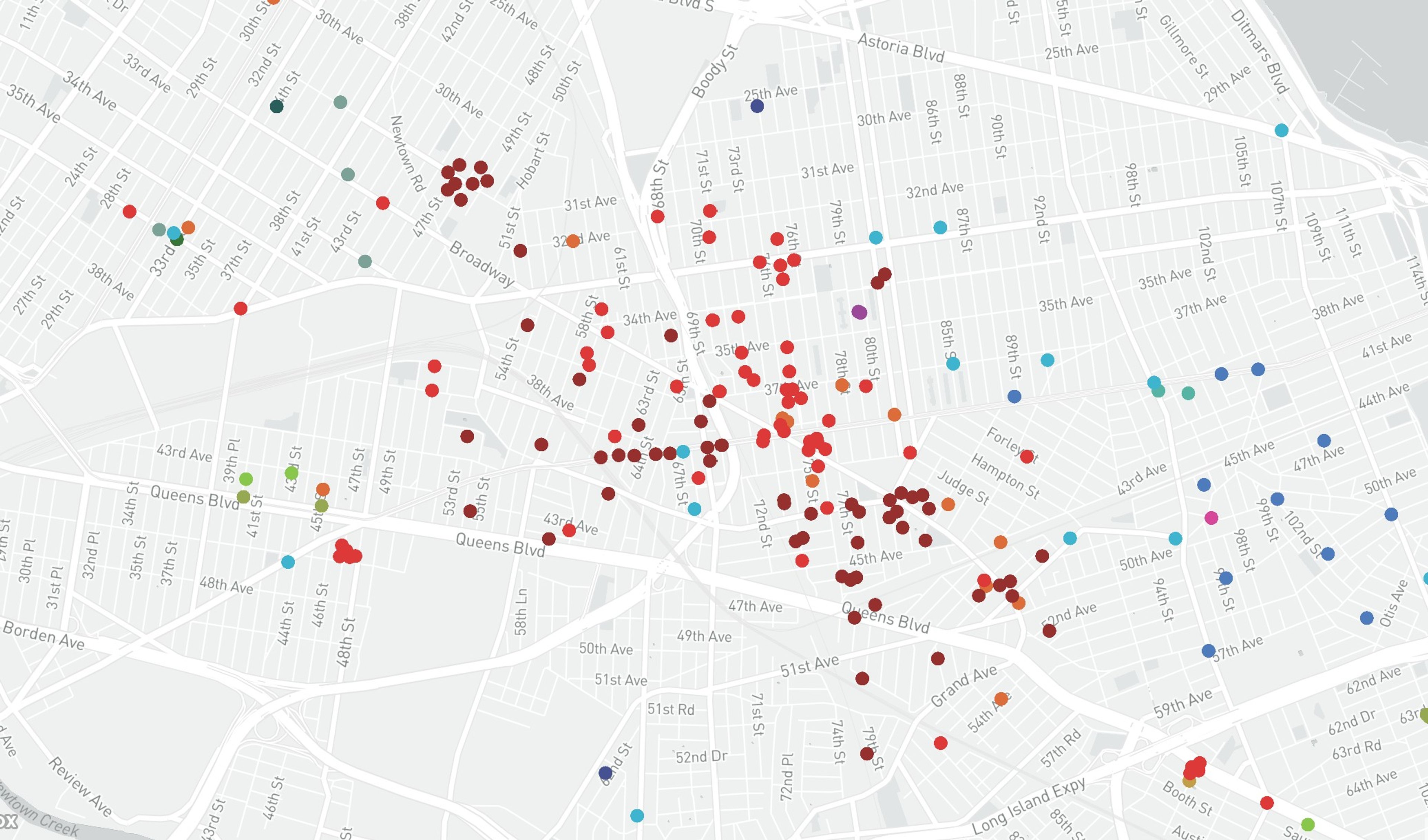
Detail of Queens, NYC ©ELA
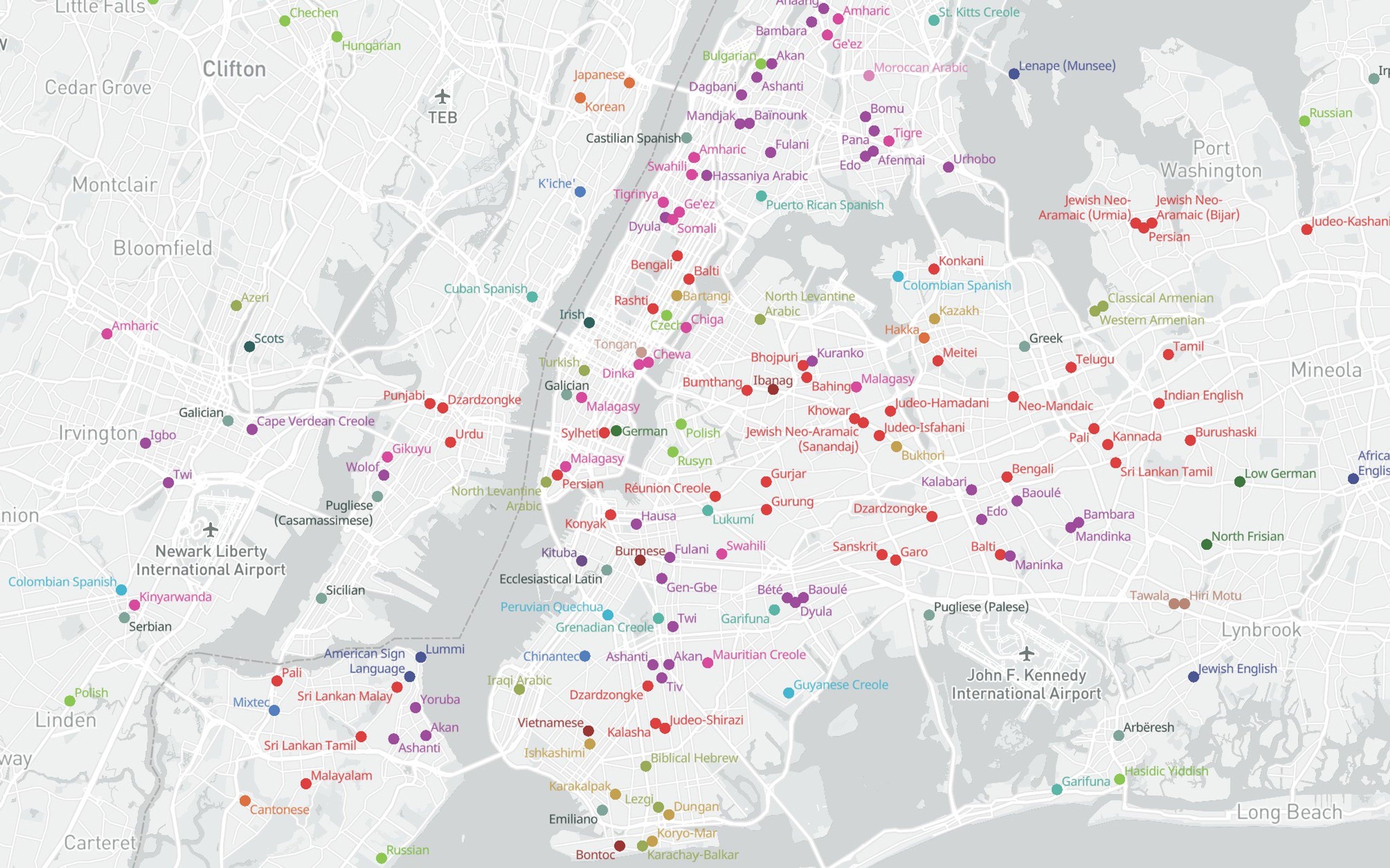
Languages at a glance ©ELA
All of the data has been collected by the ELA, and draws directly on information from communities and speakers. As Ross tells Jerry, the Census Bureau's American Community Survey is only useful for approximately the largest sixty languages, and at most only 200 of the 700 languages are accounted for in the governmental survey - which is why the ELA’s work is so important.
Ross describes New York as a global microcosm, and takes us on a whistle-stop tour of some of the clusters of languages in the neighbourhoods on the map, from the array of South- and South East Asian communities in Jackson Heights, to the Yiddish, Fujianese and Basque speakers living side-by-side on Manhattan’s Lower East Side.
We hear about the difficulties of mapping languages that are on the brink of extinction and some of the remarkable language activists who are working to revitalise and preserve them. The task was complex not only because of the organic nature of languages - as Ross says, they reside ‘in the mouths of the speakers and hands of their signers’ - but also because of the density and verticality of New York.
The more linguistically diverse neighbourhoods are unsurprisingly slightly further out from Manhattan where it is more affordable to live. Factors such as the rising cost of living, threats to immigration and simple language abandonment all contribute to the changing language landscape and fragility of their existence can threaten the loss of cultural, scientific, and economic knowledge.
We also find out about Ross’s project and his book Language City where he follows the stories of six everyday speakers that are fighting to keep their languages alive.
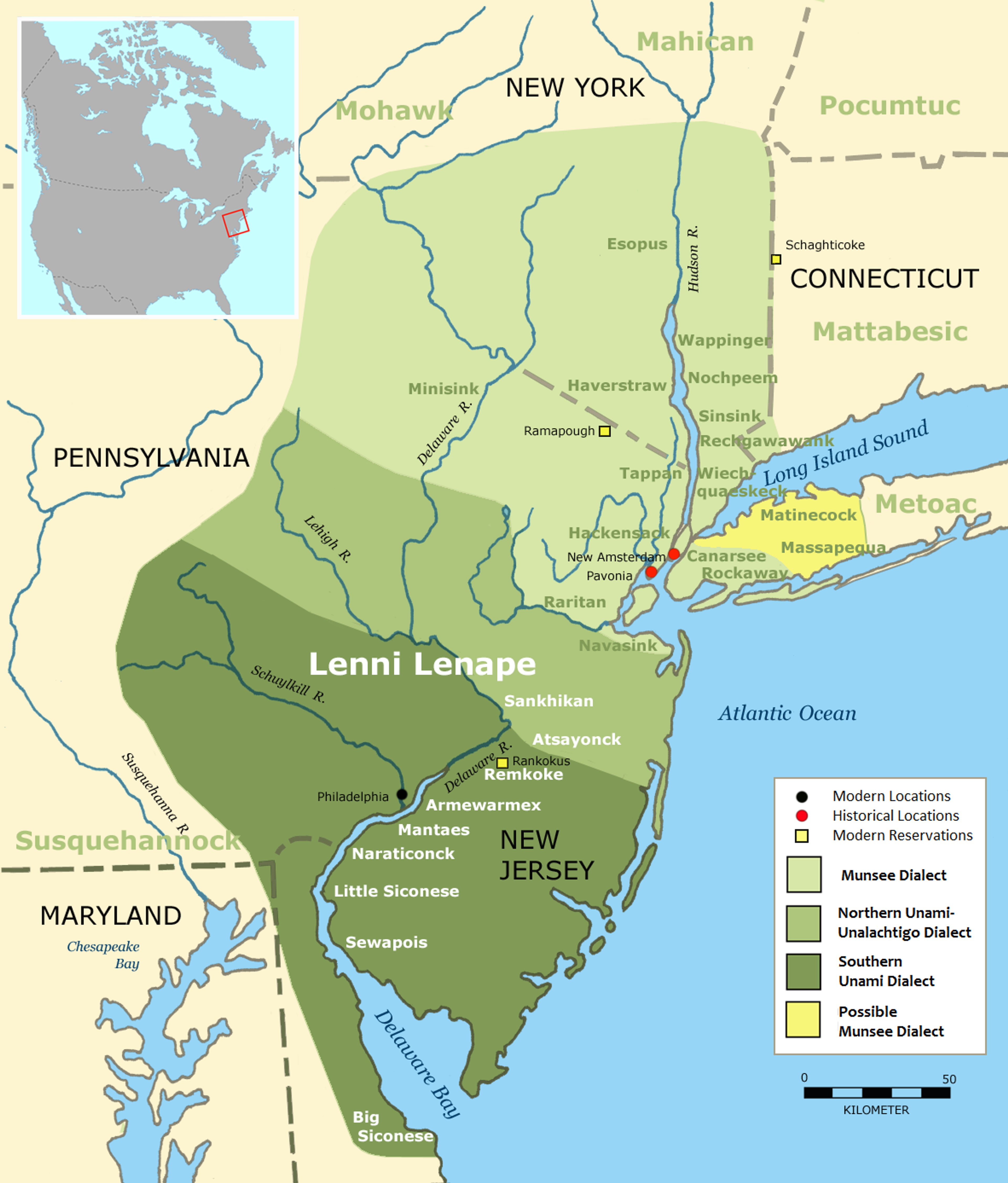
By Nikater, via Wikimedia Commons
During the episode, we learn about the first language of NYC - Lenape (pron. Len-a-pey). Lenape translates as ‘the people’ or ‘the original people.’
Lenapehoking (‘land of the Lenape’) encompasses southern New York City, parts of Long Island and the Hudson Valley, New Jersey, Northern Delaware, and Eastern Pennsylvania.
This map shows the territory and highlights the three main dialects spoken in Lenape, with speakers of Munsee in the north, Unalachtigo in the centre, and Unami in the south.
Of the three dialects, it is the northern variety of Munsee which is associated with most of today's metropolitan New York (ELA). Organisations like the Endangered Language Alliance and the Lenape Center support and preserve ancestral stories, language and maintain knowledge passed down through generations.
Ross also tells Jerry about his PhD and his focus on Himalayan languages. For his fieldwork, he created a trilingual dictionary, a repertoire of recordings, and a descriptive grammar of Trung (Dulong, 独龙), a Tibeto-Burman language of the Nungish group. His research found that the language was spoken by fewer than 7000 people, primarily in the far northwest of Yunnan Province.
During his fieldwork he worked alongside famed Chinese anthropological linguist, the late Hongkai Sun (1934-2024), a Professor at the Institute of Ethnology and Anthropology, Chinese Academy of Social Sciences. He was best known for his investigation of Chinese minority languages, prolifically publishing over two hundred papers and twenty-five books on descriptive, comparative, and social linguistics, with a focus on Sino-Tibetan languages.
About Ross Perlin
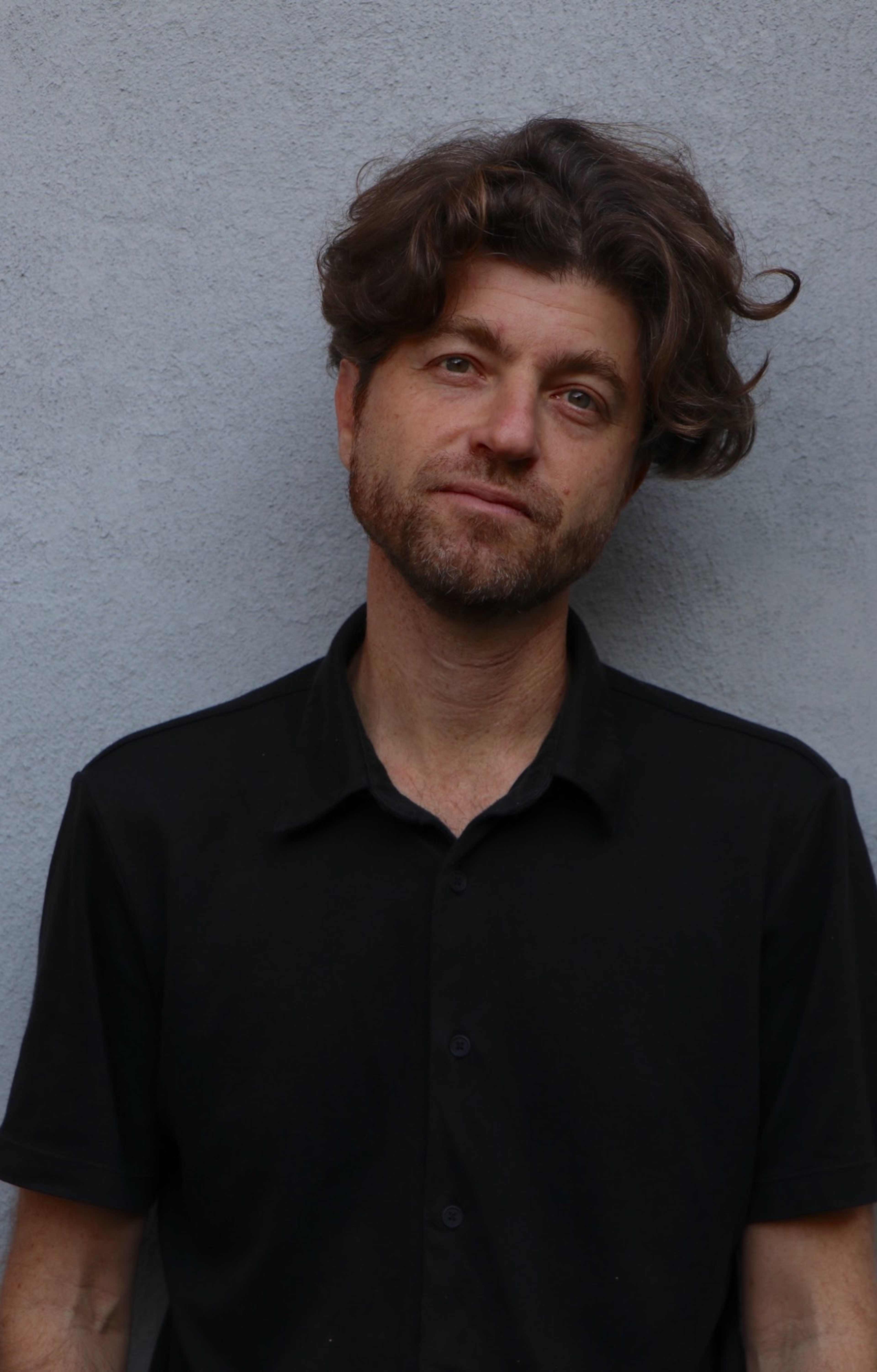
Ross Perlin is a linguist, writer, and translator based in New York City – Lenapehoking.
He holds a BA from Stanford, an M.Phil. from Cambridge, an MA from the University of London (SOAS) as a Marshall Scholar, and a PhD in Linguistics from the University of Bern in Switzerland. He is a 2025-26 Nina Maria Gorrissen Fellow at the American Academy in Berlin. He also teaches linguistics at Columbia University.
Ross is the co-director of the non-profit Endangered Language Alliance (ELA), where he has overseen research projects since 2013, focusing on documentation, mapping, policy, and public programming such as classes and artistic projects.
His book, ‘Language City: The Fight to Preserve Endangered Mother Tongues in New York’, won the British Academy Book Prize and the New York City Book Award, was longlisted for the Carnegie Medal, and was a New York Times Notable Book.
You can find out more about Ross’ work here, and about the brilliant work of the Endangered Language Alliance here.
Why not continue your exploration of the wonderful world of maps by subscribing to the podcast? That way you will never miss an episode.
Feel free to let us know - What's YOUR Map?!
All views and opinions expressed by guests on the podcast are entirely their own and do not represent those of The Sunderland Collection or Whistledown Productions.